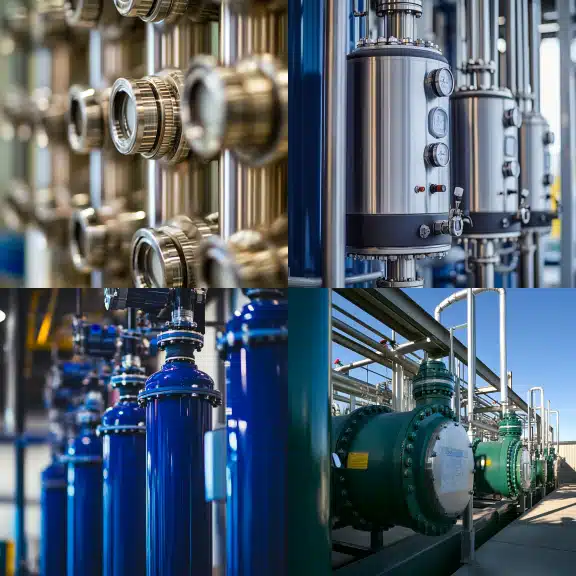
A coalescer is an essential separation device used in industrial processes to remove liquids from gas streams or separate immiscible liquids like oil and water. By merging small droplets into larger ones, coalescers enhance separation efficiency, reduce contamination, and protect downstream equipment. Red River designs coalescer systems tailored to a wide range of industry applications.
What is a Coalescer?
A coalescer is a critical industrial device used across various sectors to separate mixtures of immiscible liquids or remove suspended solids and liquids from gas streams. At Red River, we understand that reliable separation equipment is essential for your operations’ success.
How Coalescers Work
Coalescers operate on the principle of merging small droplets into larger ones, a process known as coalescence. By encouraging droplets to combine, separation becomes significantly easier, whether the application involves liquid-liquid separation or gas-liquid separation. This technology ensures purer outputs and protects downstream equipment from damage. For a deeper understanding of coalescing mechanisms, explore Understanding the Process of Coalescence.
Why Industrial Coalescers Matter in Operations
Industrial coalescers serve as the backbone of efficient separation processes across industries. They are indispensable in applications requiring:
- Fine droplet separation from gas streams
- Mist removal from process gases
- Emulsified water removal from fuels and oils
- Contaminant elimination for product purity
Business impact: Implementing the right coalescer technology delivers measurable benefits including significant cost savings, reduced equipment downtime, enhanced operational performance, and improved product quality standards.
Common Coalescer Applications Across Industries
Coalescers demonstrate remarkable versatility across industrial applications:
Oil & Gas Industry:
- Natural gas coalescers for processing and purification
- Petroleum refining operations
- Hydrocarbon-water separation systems
Chemical Processing:
- Process gas purification
- Liquid-liquid coalescers for separations
- Emulsion breaking applications
Power Generation:
- Steam turbine protection
- Fuel gas conditioning
- Moisture removal systems
For more details on liquid-gas separation, see Oil Separation Technology.
Types of Liquid-Liquid Coalescers
Mechanical Coalescers for Industrial Separation
- Operating principle: Mechanical coalescers separate immiscible liquids through engineered physical processes. These systems utilize specialized components such as mesh elements or corrugated plates to enhance droplet coalescence.
- How they work: As the liquid mixture flows through the coalescer, smaller droplets collide with the mechanical elements and merge into larger droplets. These enlarged droplets can then be easily separated using conventional separation methods.
- Key applications: Mechanical coalescers excel in oil and gas operations where efficient water-hydrocarbon separation is critical for product quality and equipment protection.
Electrostatic Coalescers Technology
- Technology overview: Electrostatic coalescers harness controlled electric fields to induce coalescence of dispersed liquid droplets within emulsions.
- Process mechanics: By applying precise electrical charges, these coalescers cause droplets to migrate and collide, forming larger droplets that separate more readily from the continuous phase.
- Ideal applications: This technology proves particularly effective for challenging emulsions that resist conventional mechanical separation methods. Petroleum refining operations benefit significantly from electrostatic coalescer technology for breaking stable water-oil emulsions.
Plate Coalescers for High-Volume Separation
- Design concept: Plate coalescers employ a series of closely spaced, inclined plates arranged to maximize droplet contact and coalescence opportunities.
- Separation process: As the liquid mixture flows across the plate surfaces, smaller droplets combine to form larger ones. Gravity then causes these enlarged droplets to settle naturally, creating distinct separated phases.
- Primary applications: Industries such as wastewater treatment and chemical processing rely on plate coalescers for efficient liquid-phase separation where high throughput and reliability are essential.
Fiber Bed Coalescers for Fine Filtration
- Construction: Fiber bed coalescers feature densely packed fiber media that creates an extensive surface area optimized for droplet coalescence.
- Operational mechanism: As the liquid mixture passes through the fiber matrix, fine droplets are captured and gradually merge into larger droplets that can be easily collected and removed.
- Best suited for: Chemical and petrochemical industries utilize fiber bed coalescers when removing extremely fine droplets from liquid streams where high separation efficiency is paramount.
Learn more about Liquid-Liquid Coalescer Applications.
Types of Gas-Liquid Coalescers
High-Efficiency Coalescer Filters
- Performance characteristics: High-efficiency coalescer filters remove submicron liquid droplets from gas streams with exceptional precision and reliability.
- Advanced technology: These coalescer filters incorporate cutting-edge materials and multi-stage designs to capture and merge microscopic droplets, enabling superior separation performance.
- Critical applications: Natural gas processing and petrochemical operations depend on these coalescers to maintain gas product purity, prevent downstream equipment damage, and optimize overall system performance.
Mist Eliminator Coalescers
Purpose: Mist eliminator coalescers specifically target mist and fine droplet removal from gas streams in demanding industrial environments.
Technology options:
- Mesh pad systems: Utilize knitted wire mesh for droplet capture
- Vane pack designs: Employ directional changes to promote coalescence
- Hybrid configurations: Combine multiple technologies for enhanced performance
Essential applications: Chemical processing facilities rely on mist eliminators to maintain gas stream integrity, ensuring both operational safety and product quality standards.
Coalescing Filter Cartridges
Versatility: Coalescing filter cartridges offer flexible, high-performance solutions for liquid-gas separation across diverse applications.
Multi-layer design: These coalescer cartridges feature specialized media layers engineered to promote efficient coalescence of small droplets into easily removable larger ones.
Maintenance advantages: Easy replacement capability and broad application compatibility make these cartridges ideal for:
- Air compressor systems
- Refrigeration equipment
- Process gas conditioning
- Moisture removal applications
For additional insights, check Understanding Coalescing Filters.
Gas-Liquid Coalescer Applications by Industry
Oil & Gas Sector:
- Natural gas coalescers for dehydration and purification
- Associated gas processing
- Pipeline gas conditioning
Chemical Manufacturing:
- Process gas purification
- Reaction vessel off-gas treatment
- Solvent recovery systems
Power Generation:
- Steam turbine protection systems
- Fuel gas conditioning
- Generator moisture protection
Food & Beverage:
- Compressed air purification
- Process gas cleaning
- Product quality assurance
Selecting the Optimal Coalescer for Your Application
Critical Coalescer Selection Factors
Separation requirements analysis:
- Determine separation type (liquid-liquid vs. gas-liquid)
- Identify target separation efficiency
- Define acceptable carryover limits
Operating conditions assessment:
- Operating temperature range
- System pressure requirements
- Flow rate specifications
- Fluid properties (viscosity, density, chemical composition)
Performance criteria:
- Required separation efficiency
- Maintenance interval preferences
- Space and installation constraints
- Budget considerations
Red River engineers provide expert analysis to ensure you select a coalescer that maximizes ROI. For operational efficiency in gas systems, see Air Compressor Capacity and Air Supply.
Industry-Specific Coalescer Recommendations
Oil & Gas Industry:
- Primary choice: Mechanical and electrostatic coalescers for water-hydrocarbon separation
- Secondary applications: High-efficiency filters for gas processing
- Key benefit: Proven reliability in harsh operating conditions
Chemical Processing:
- Recommended: High-efficiency coalescer filters and mist eliminators
- Application focus: Gas stream purity and process optimization
- Key benefit: Enhanced product quality and process safety
Power Generation:
- Optimal choice: Coalescing filter cartridges for turbine protection
- Critical function: Moisture removal and equipment protection
- Key benefit: Extended equipment life and reduced maintenance costs
Water Treatment:
- Best option: Plate coalescers for liquid-liquid separation
- Primary function: Oil-water separation and emulsion breaking
- Key benefit: Environmental compliance and water quality
Coalescer Maintenance and Performance Optimization
Preventive maintenance essentials:
- Regular inspection schedules based on operating conditions
- Timely replacement of filter elements and cartridges
- Performance monitoring to identify efficiency trends
- Cleaning protocols following manufacturer specifications
Performance optimization strategies:
- Implement proactive maintenance programs
- Monitor pressure differentials and flow rates
- Track separation efficiency metrics
- Schedule preventive replacements before failure
For guidance on monitoring separation efficiency, see Separator Efficiency for Better Operations.
Service offerings include:
- Customized maintenance planning
- Replacement part inventory management
- Performance optimization consulting
- Emergency repair services
Ready to Optimize Your Separation Processes?
Partner with Red River for custom-designed coalescer systems engineered for your industry. From mechanical to electrostatic, plate, and fiber bed coalescers, our solutions maximize efficiency, protect your equipment, and ensure product quality.
Contact our team today to discuss your application and experience the Red River difference in reliable, American-made separation technology.
Frequently Asked Questions
1. What are the key differences between liquid-liquid and fuel-liquid coalescers?
Liquid-liquid coalescers are designed to separate immiscible liquids, including oil and water, through the merging of small droplets into larger ones, which could then be separated without problems. Gas-liquid coalescers, alternatively, are used to get rid of liquid droplets from gasoline streams. They hire exceptional mechanisms, including high-efficiency filters or mist eliminators, to capture and coalesce first-class liquid droplets from gases. The primary distinction lies in their software and the physical properties they are designed to handle.
2. How do electrostatic coalescers enhance separation efficiency?
Electrostatic coalescers beautify separation efficiency with the aid of applying an electric area to the combination of immiscible beverages. This electric-powered discipline induces the movement and collision of dispersed liquid droplets, causing them to merge into larger droplets. These larger droplets can be separated more easily from the continuous phase. This method is mainly effective for breaking stable emulsions which can be difficult to split via mechanical way alone, making it relatively useful in industries like petroleum refining.
3. What preservation practices are encouraged for coalescers?
Proper maintenance of coalescers involves ordinary inspections, cleansing, and timely substitutions of clear-out elements or cartridges. It is vital to observe the producer’s guidelines for cleansing to prevent clogging and ensure certain most fulfilling overall performance. Routine monitoring of working conditions, including pressure drop and going with the flow rate, also can assist in figuring out any problems early. Establishing a proactive upkeep timetable will extend the lifespan of the coalescer and prevent steeply-priced operational disruptions.
4. Can coalescers be used in excessive-temperature and high-pressure environments?
Yes, coalescers can be designed to operate in excessive-temperature and high-pressure environments. The materials and construction of the coalescer should be selected to resist those conditions. For example, in excessive-temperature packages, coalescers made from stainless steel or other heat-resistant materials are used. Similarly, coalescers supposed for high-pressure environments are built to meet unique pressure ratings. It is crucial to specify the running situations when choosing a coalescer to make certain it meets the required performance standards.
5. What industries gain the most from using coalescers?
Coalescers are useful in a huge range of industries, which include oil and gasoline, chemical processing, power technology, and water treatment. In the oil and gasoline industry, coalescers are used to split water from hydrocarbons, ensuring the first rate of gas and decreasing corrosion in pipelines. Chemical processing plants use coalescers to put off impurities from technique streams, improving product first-rate. Power technology facilities make use of coalescers to protect turbines from moisture, and water remedy plants use them to eliminate oil and other contaminants from wastewater. Each enterprise has precise necessities that coalescers assist in satisfying efficiently.
Key Takeaways:
- Coalescers are critical for efficient oil-water and gas-liquid separation.
- Mechanical, electrostatic, plate, and fiber bed coalescers serve different industrial needs.
- Proper selection and maintenance ensure high performance and operational reliability.
- Coalescers improve environmental compliance and reduce equipment wear.
- Industries including oil & gas, power, chemical processing, and water treatment heavily rely on this technology.
Related Blog Post
Which Materials Suit Make-Up Water Service?
How Big Should Make-Up Water Tanks Be?
Make-Up Water Tanks: Design, Sizing, and Fabrication
When to Spec Equalization Tanks for Industrial Systems
How Do Equalization Tanks Balance Flow?
About Author