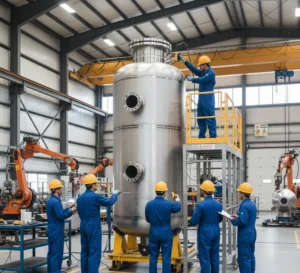
Aerospace pressure vessels are critical components that store and control gases and fluids under extreme conditions. Their design, materials, and testing standards directly impact safety, mission success, and long-term system reliability.
The Critical Role of Aerospace Pressure Vessels
Aerospace pressure vessels are engineered containers designed to safely hold gases or liquids at pressures far above or below surrounding conditions. In aerospace and defense environments, these vessels must perform reliably despite vibration, thermal cycling, mechanical loads, and long service lives. Their role extends far beyond storage, as they actively support propulsion, life support, and control systems that define modern flight and space operations.
Because aerospace systems operate in unforgiving environments, aerospace pressure vessels are designed with tighter tolerances, higher safety margins, and stricter quality requirements than many industrial vessels. Their performance directly influences crew safety, equipment reliability, and overall mission success.
How Aerospace Pressure Vessels Function in High-Stress Environments
Aerospace pressure vessels are exposed to combined stresses that rarely occur together in other industries. Internal pressure creates hoop and longitudinal stresses, while launch forces, turbulence, and maneuvering introduce dynamic loads. At the same time, temperature extremes can alter material properties and accelerate fatigue.
To manage these demands, aerospace pressure vessels are carefully analyzed during design. Engineers model stress distribution, fatigue cycles, and failure modes to ensure consistent performance throughout the vessel’s operational life. This systems-level approach helps prevent leaks, deformation, and catastrophic rupture.
Pressure Management and System Integration
In aerospace platforms, pressure vessels are rarely standalone components. They are integrated into complex systems that include valves, regulators, sensors, and control electronics. Proper pressure regulation ensures steady fuel delivery, consistent hydraulic response, and breathable cabin environments.
This integration makes aerospace pressure vessels a central part of system reliability rather than a passive component.
Core Applications of Aerospace Pressure Vessels
Aerospace pressure vessels support a wide range of critical functions across commercial aviation, space exploration, and defense programs.
Propulsion and Fuel Storage
Rocket engines and spacecraft propulsion systems rely on aerospace pressure vessels to store propellants and pressurant gases. These vessels must maintain precise pressure levels to deliver fuel efficiently during ignition, ascent, and orbital maneuvers. Weight reduction is especially important in these applications, driving advanced material selection and optimized geometry.
Life Support and Environmental Control
Crewed aircraft and spacecraft depend on aerospace pressure vessels for oxygen storage, cabin pressurization, and emergency breathing systems. These vessels must deliver consistent performance over long durations while meeting stringent safety requirements.
Hydraulic and Pneumatic Systems
Flight control surfaces, landing gear, and braking systems often rely on hydraulics or pneumatics powered by pressurized fluids. Aerospace pressure vessels ensure these systems respond accurately under rapid and repeated load changes.
Defense and Strategic Systems
Missile platforms, defense aircraft, and specialized ground support equipment use aerospace pressure vessels for propulsion, actuation, and energy storage. In these applications, resistance to impact, vibration, and environmental exposure is critical.
Materials Used in Aerospace Pressure Vessels
Material selection plays a defining role in the performance and longevity of aerospace pressure vessels. Engineers balance strength, weight, corrosion resistance, and manufacturability when choosing materials.
High-Strength Metal Alloys
Aluminum, titanium, and stainless steel alloys are commonly used due to their predictable mechanical properties and proven performance. Titanium offers excellent strength-to-weight characteristics, while stainless steel provides durability in corrosive or high-temperature environments.
Composite Pressure Vessels
Composite aerospace pressure vessels, often reinforced with carbon fiber, are increasingly used to reduce weight while maintaining strength. These vessels combine a metallic or polymer liner with composite overwraps, allowing for significant mass reduction without compromising safety.
Design and Engineering Considerations
Designing aerospace pressure vessels requires careful evaluation of both static and dynamic loads.
Stress analysis tools are used to evaluate pressure distribution and identify high-stress regions. Fatigue life is calculated based on expected pressure cycles and environmental exposure. Safety factors are incorporated to account for uncertainties, manufacturing tolerances, and operational variability.
Weld quality and joint integrity are also critical. Poor welds can become failure initiation points, so aerospace pressure vessels are fabricated using qualified procedures and thoroughly inspected before service.
Quality Control and Regulatory Oversight
Aerospace pressure vessels are subject to rigorous quality control processes to ensure compliance and reliability.
Non-destructive testing methods such as radiography, ultrasonic inspection, and dye penetrant testing are used to identify internal and surface defects. Pressure testing verifies leak resistance and structural integrity, often exceeding normal operating conditions to confirm safety margins.
Design and manufacturing practices are influenced by standards from organizations such as NASA, the FAA, and the ASME Boiler and Pressure Vessel Code, adapted to meet aerospace-specific requirements.
Why Aerospace Pressure Vessels Remain Mission-Critical
Aerospace pressure vessels remain essential because they combine advanced engineering, high-performance materials, and strict quality controls into a single component. As aerospace platforms become more efficient and complex, these vessels continue to evolve to meet higher performance expectations while maintaining safety and reliability.
Need a Reliable Partner?
Red River specializes in the design and manufacturing of pressure vessels. We also fabricate related items such as prefabricated spools and skid packages.
Reach Out to us today and experience the Red River difference. Where American Made and American Values come together, we care more.
Contact us: https://www.redriver.team/contact
Request a quote: https://www.redriver.team/request-a-quote
Frequently Asked Questions
1. What are aerospace pressure vessels used for?:
Aerospace pressure vessels are used to store and control gases or liquids for propulsion, life support, hydraulics, and defense systems in aircraft and spacecraft.
2. Why do aerospace pressure vessels require specialized materials?:
These vessels operate under extreme pressure, temperature, and vibration, requiring materials that provide high strength, low weight, and long-term durability.
3. How are aerospace pressure vessels tested for safety?:
They undergo non-destructive testing and pressure testing to verify structural integrity, leak resistance, and compliance with aerospace standards.
4. What standards influence aerospace pressure vessel design?:
Design practices are guided by aerospace authorities such as NASA and the FAA, along with adapted principles from the ASME Boiler and Pressure Vessel Code.
5. How long do aerospace pressure vessels typically last?:
Service life depends on design, material selection, pressure cycles, and operating conditions, with many vessels engineered for long-term or mission-specific use.
Key Takeaways
- Aerospace pressure vessels are essential to propulsion, life support, and control systems
- Extreme operating environments demand advanced materials and precise engineering
- Composite vessels help reduce weight while maintaining strength
- Rigorous testing and inspection ensure safety and reliability
- Proper design directly supports mission success and crew protection
Related Blog Post
Pressure Vessel Design & Engineering: Concept to Launch

What is Pressure Vessel Design and Engineering: Code-Ready Guide
What are the Key Factors in Pressure Vessel Engineering
How Do You Design a Pressure Vessel: A Step-By-Step Guide