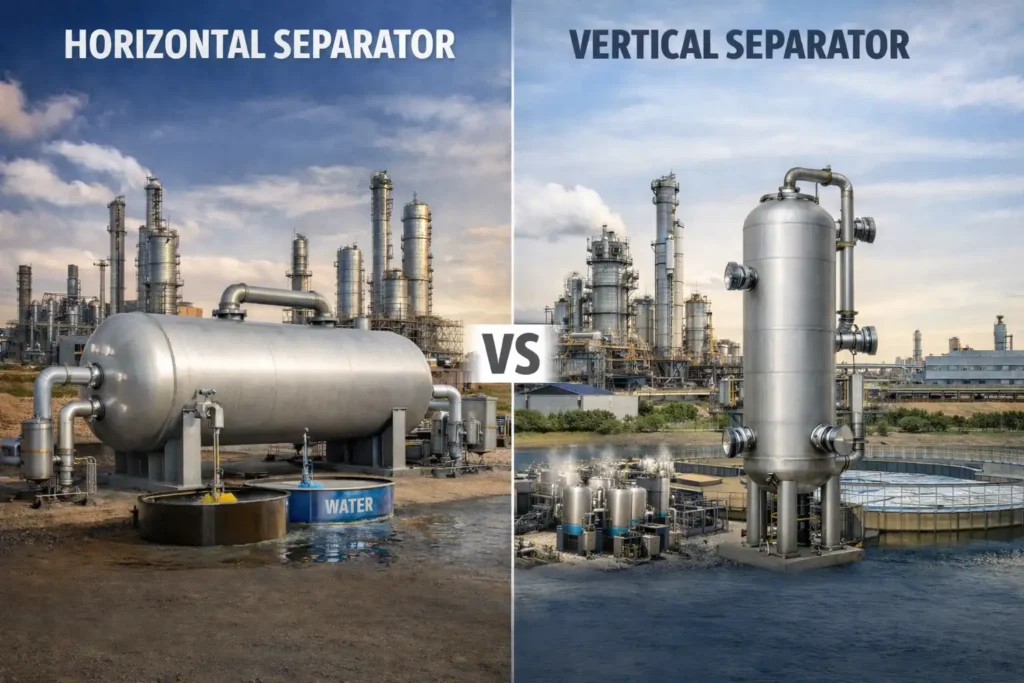
Horizontal separators are ideal for high-volume applications with ample floor space, offering better liquid-handling and easier maintenance. Vertical separators are compact and better suited for limited spaces or processes with fluctuating flow rates and low liquid content. Choosing between them depends on your operational needs, space constraints, and long-term performance goals.
What Are Horizontal and Vertical Separators?
Navigating the complexities of pressure vessel applications requires expertise in horizontal and vertical separators. At Red River, selecting the right separator can significantly improve your operation’s efficiency and safety.
Overview of Horizontal Separators
Horizontal separators are commonly used where space is not a limitation and managing large fluid volumes is critical. These separators maximize floor space, enabling the efficient separation of fluids, gases, and particulates. Their sturdy design makes them ideal for industries such as oil and gas, where high flow rates and large liquid volumes need to be managed effectively. Learn more about pressure vessel fabrication and their role in industrial applications.
Overview of Vertical Separators
Vertical separators are the preferred choice when space is limited or operations involve fluctuating flow rates. These separators excel in environments where liquid content is low but effective separation of gases is essential. Industries like chemical processing and power generation often rely on vertical separators due to their compact design and superior performance. Explore Red River modular skids for tailored solutions.
Key Differences Between Horizontal and Vertical Separators
The choice between horizontal and vertical separators depends on your operational needs. Horizontal separators are better for large packages and open spaces, providing robust separation capabilities. In contrast, vertical separators work well in tight spaces or with low liquid content, offering a flexible and compact solution.
Factors to Consider When Choosing Between Horizontal and Vertical Separators
Application-Specific Considerations
Your specific use case is key. Horizontal separators are ideal for high-flow operations, such as in oil and gas, where separating large volumes of liquid from gases is critical. Vertical separators are better for low-liquid operations, like chemical processing or power generation, where compact designs are preferred.
Space and Installation Requirements
Space limitations heavily impact your choice. Horizontal separators need more floor space but offer higher separation capacity. In contrast, vertical separators are compact and easier to install, making them suitable for facilities with restricted space.
Cost Implications of Horizontal vs Vertical Separators
Cost is another important consideration. Horizontal separators may have higher upfront costs due to their size but can provide long-term value in high-volume operations. Vertical separators, though often less expensive to install, may require additional maintenance in some applications, impacting overall efficiency.
Common Industries and Applications for Horizontal and Vertical Separators
Oil and Gas Industry: Best Practices
Horizontal separators are commonly used in oil and gas to handle large fluid and gas volumes. They ensure efficient separation of oil, gas, and water, protecting extracted resources. Best practices include using separators designed to withstand harsh environments and fluctuating pressures, ensuring reliable operation.
Chemical Processing: Separator Usage
In chemical processing, vertical separators are often the go-to. They efficiently manage chemical mixtures, ensuring secure separation of additives. Red River’s vertical separators are engineered for durability and reliability to meet stringent demands.
Water Treatment: Optimal Separator Choice
In water treatment, the choice depends on facility size and needs. Horizontal separators handle large-scale operations, while vertical separators are ideal for compact setups, providing efficient separation in tight spaces.
When to Choose Horizontal Separators
Pros and Cons of Horizontal Separators
Horizontal separators are well-suited for high-volume environments. Their layout supports large floor areas, making them effective in industries like oil and gas. They are ideal for processing large fluid quantities efficiently. While easy to maintain due to accessibility, they often require more space and have higher upfront costs than vertical separators.
Case Studies: Effective Use of Horizontal Separators
At Red River, horizontal separators have transformed operations. For example, a client in oil and gas struggled with inefficient fluid separation. By implementing a custom-engineered horizontal separator, they improved processing efficiency, reduced downtime, and lowered operational expenses. Another energy sector client used horizontal separators for cooling water management, boosting equipment performance and reliability.
When to Choose Vertical Separators
Advantages and Drawbacks of Vertical Separators
Vertical separators are compact, ideal where ground space is limited. Their design allows effective separation of gases and liquids, especially in operations with lower liquid content, such as chemical processing or natural gas treatment. They handle fluctuating flow rates well but may be less efficient with large liquid volumes and require careful maintenance due to vertical orientation.
Real-World Examples of Vertical Separator Applications
Red River has successfully implemented vertical separators across industries. In a chemical plant with confined space, a vertical separator provided a compact solution maximizing performance. In the natural gas industry, vertical separators efficiently separated gas from low-volume liquids, ensuring reliable operation.
Ready to Optimize Your Separation Systems?
At Red River, we specialize in custom-designed horizontal and vertical separators that maximize efficiency and reliability. Whether you’re looking to improve fluid handling, save space, or enhance performance, our team can help.
Contact us today to discuss your needs and discover the best separator solution for your operation.
Frequently Asked Questions
1. What are the primary factors that affect the efficiency of horizontal and vertical separators?
The performance of horizontal and vertical separators depends on numerous key factors, together with the flow price of the fluids being processed, the bodily homes of the fluids (together with viscosity and density), and the separator’s layout, along the dimensions of the inlet and outlet, and the inner additives used for separation. For horizontal separators, retaining a consistent glide rate is critical to save you liquid carryover and fuel blow-by. For vertical separators, the performance is often stimulated using the height-to-diameter ratio, which influences the retention time and separation efficiency. Proper sizing and design tailored to the precise utility are vital to making sure that the separator operates at top performance.
2. How do horizontal and vertical separators handle changes in flow charges?
Horizontal separators are usually highly perfect to deal with steady, excessive-quantity glide costs, which makes them best for programs where the float is steady and the liquid volumes are considerable. On the opposite hand, vertical separators are greater adaptable to fluctuating glide charges, as their design allows for higher management of variable liquid stages. This flexibility makes vertical separators a favored choice in operations wherein float rates can alternate regularly or unpredictably. However, it’s essential to word that drastic changes in flow fees can affect the separation technique in each sort of separator, so it’s essential to lay out the device with those variations in thoughts.
3. What renovation considerations ought to be taken into account for horizontal and vertical separators?
Maintenance for each horizontal and vertical separator is important to ensure their longevity and performance. Horizontal separators usually provide easier entry for preservation because of their orientation, making it less complicated to look into and clean inner components. However, because they regularly deal with large volumes of fluids, they will require greater frequent preservation to prevent problems consisting of corrosion or buildup of particulates. Vertical separators, at the same time slightly extra tough to get entry to for renovation because of their height, typically handle decreased volumes of liquid, which can reduce the frequency of required maintenance. Regular inspections, cleaning, and tracking of separator overall performance are crucial for both types to save you sudden downtime and keep operational efficiency.
4. Are there any particular industries where horizontal or vertical separators are not encouraged?
While horizontal and vertical separators are versatile and broadly used across many industries, there are sure eventualities where one type won’t be advocated. For example, in industries with very tight space constraints, consisting of positive pharmaceutical or biotechnology packages, the footprint of a horizontal separator may be too large, making a vertical separator or even a very different separation era more appropriate. Conversely, in industries like oil and fuel wherein dealing with big volumes of beverages is vital, a vertical separator might not provide the desired capacity, leading to inefficiencies. It’s essential to evaluate the particular desires of the application and talk it over with specialists to decide the excellent separation generation.
5. How do horizontal and vertical separators contribute to standard device safety?
Both horizontal and vertical separators play a big position in making sure the protection of business procedures. By effectively setting apart beverages, gases, and solids, they save you from the buildup of pressure and decrease the danger of device failure. Horizontal separators, with their larger potential, can assist in handling massive surges of fluid, which may otherwise crush different device components. Vertical separators, with their potential to address variables, go with the flow quotes, and make certain that fluctuations do now not lead to risky pressure imbalances. Additionally, separators are regularly equipped with safety functions consisting of pressure relief valves and degree controls to similarly enhance device protection. Properly keeping and working these separators is essential to save you from injuries and ensure the safe operation of the whole device.
Key Takeaways
- Horizontal separators are best for high-flow operations and large liquid volumes, offering better separation efficiency and easier maintenance access.
- Vertical separators are ideal for space-constrained environments and processes with high gas-to-liquid ratios or fluctuating flow rates.
- Space availability, fluid composition, and operational flow conditions are key factors when choosing between horizontal and vertical designs.
- Horizontal units typically have higher upfront costs but offer long-term efficiency gains in large-scale industrial applications.
Related Blog Post
How to Vent Condensate Tanks in Steam Systems
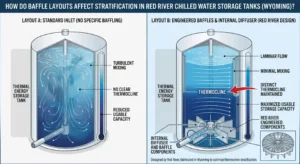
How Do Baffle Layouts Affect Stratification in TES Tanks?
What Delta T Drives Volume in Thermal Storage Tanks?
Industrial Cooling Energy Storage: Systems and Fabrication
Carbon Steel Tanks: The Complete Fabrication Guide
About Author