
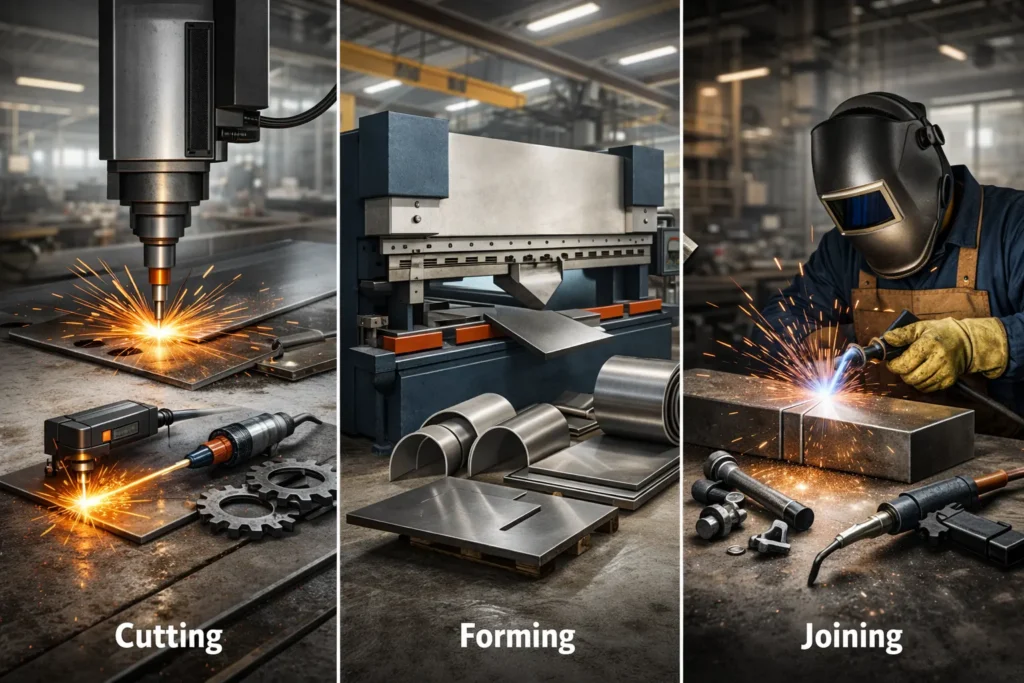
The three types of metal fabrication are cutting, forming, and joining. Understanding how these three types of metal fabrication work together helps ensure strength, precision, and reliable fabrication outcomes.
What Is Metal Fabrication?
Metal fabrication is the process of transforming raw metal materials into finished components or structures. It involves shaping, cutting, and assembling metal to meet specific design and performance requirements.
Most fabrication projects rely on three fundamental types of metal fabrication. While they serve different purposes, they are commonly used together to produce durable, accurate, and functional metal products.
The Three Types of Metal Fabrication Explained
1. Metal Cutting
Metal cutting is the process of separating or shaping metal by removing material. It is usually the first step in fabrication and sets the foundation for accuracy throughout the project.
Cutting operations must follow metal fabrication safety requirements, particularly when working with high heat, sparks, and heavy equipment.
Common Metal Cutting Methods
Laser cutting for high precision and clean edges
Plasma cutting for thicker metals and faster processing
Waterjet cutting for heat-sensitive materials
Shearing and sawing for straight cuts and stock sizing
When Cutting Is Used
Creating flat parts and profiles
Preparing edges for welding
Achieving tight dimensional tolerances
Cutting accuracy directly impacts fit-up quality and downstream fabrication efficiency.
2. Metal Forming
Metal forming reshapes metal without removing material. Instead of cutting away mass, forming changes the metal’s geometry using mechanical force.
Common Forming Processes
Bending to create angles and channels
Rolling for cylindrical and conical shapes
Stamping and pressing for repeatable shapes
Spinning for round or symmetrical components
Why Forming Matters
Reduces the number of welds required
Maintains material strength and continuity
Improves structural integrity and appearance
Forming is essential for tanks, shells, frames, and pressure-containing components.
3. Metal Joining
Metal joining connects individual components into a complete assembly. This stage determines the final structure’s strength, durability, and service performance.
Common Metal Joining Methods
Welding such as MIG, TIG, and submerged arc welding
Brazing for thinner or dissimilar materials
Bolting and fastening for assemblies requiring maintenance access
Riveting for vibration-resistant joints
Importance of Quality Joining
Ensures structural integrity
Prevents leaks and failures
Supports fatigue resistance
Meets applicable codes and standards
Poor joining can compromise even the best cutting and forming work.
How the Three Types Work Together
Most real-world fabrication projects use all three types:
Metal is cut to size
Components are formed into shape
Parts are joined into a final assembly
Understanding how cutting, forming, and joining interact helps ensure efficient production and consistent quality.
Choosing the Right Fabrication Approach
Selecting fabrication methods depends on:
Material type and thickness
Required tolerances
Production volume
Structural or pressure requirements
A well-planned fabrication strategy balances performance, cost, and manufacturability.
Industries That Rely on Metal Fabrication
The three types of metal fabrication support:
Oil and gas
Chemical processing
Power generation
Construction
Aerospace
Industrial manufacturing
Each industry applies these fabrication methods differently based on operating conditions and compliance needs.
Why Understanding Fabrication Types Matters
Cutting, forming, and joining are the backbone of metal fabrication. While each process serves a unique role, their combined application enables the creation of strong, precise, and reliable metal components. Understanding these three types of metal fabrication helps engineers, buyers, and project managers make better decisions, reduce risk, and achieve consistent results.
Ready to Start Your Fabrication Project?
Whether your project requires precision cutting, complex forming, or high-integrity joining, Red River delivers expert metal fabrication solutions for demanding industrial applications. From pressure vessels to skid packages and custom assemblies, our team brings craftsmanship, experience, and quality to every project.
Contact Red River today to discuss your pressure vessel fabrication services need and get a custom solution built right the first time.
Frequently Asked Questions
1. What are the three types of metal fabrication?
The three types of metal fabrication are cutting, forming, and joining. These processes are used together to create finished metal components.
2. What is the most common metal fabrication process?
Cutting is often the first and most common process, as it prepares material for forming and joining.
3. Is welding considered metal fabrication?
Yes. Welding is a metal joining process and a core part of metal fabrication.
4. Do all fabrication projects use all three types?
Most projects use a combination of cutting, forming, and joining, though complexity varies by application.
5. Which fabrication method is best?
The best method depends on material, tolerances, design complexity, and performance requirements.
Key Takeaways
Metal fabrication is built around cutting, forming, and joining
Cutting defines accuracy and material preparation
Forming reshapes metal without removing material
Joining determines structural strength and durability
Most projects use all three fabrication types together
Related Blog Post
Condensate Tanks: Types, Fabrication, and ASME Code
Which Tests Validate Deaeration in Pressure Systems?
Equalization Tanks: Design, Sizing, and Fabrication
What Are Thermal Storage Testing Standards for TES Vessels?
What Hydro Tests Are Required for Pressure Vessels?
No related articles found.



