
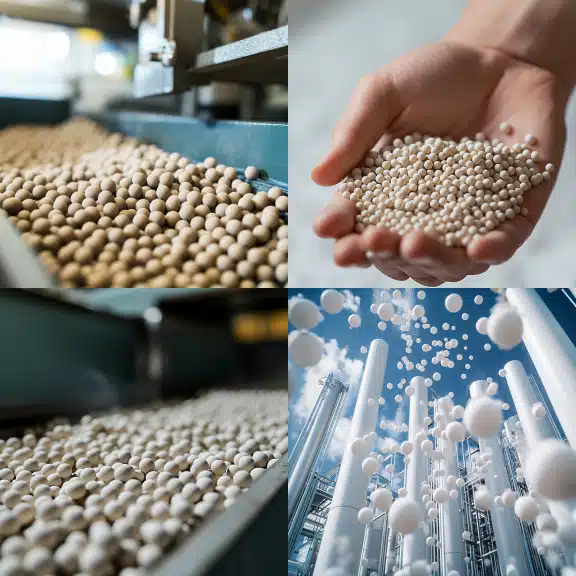
Molecular sieves are critical for purifying breathing air in industrial environments. This article explains how they work, compares types (3A, 4A, 13X), and shows why they outperform traditional filters by removing moisture, CO₂, and H₂S at a molecular level. You’ll also learn how to choose the right sieve, maintain performance, and meet safety standards like OSHA 29 CFR 1910.134 or EN 12021.
Molecular Sieves in Breathing Air Systems
Ensuring the safety and quality of breathing air is critical especially in industries where even trace impurities can endanger lives. Molecular sieves play a key role in achieving this, helping systems meet strict standards like OSHA 29 CFR 1910.134 or EN 12021 for breathable compressed air.
At Red River, we understand the importance of delivering solutions that meet and exceed industry standards. Let’s explore what molecular sieves are, how they work, and their applications in air purification systems.
Definition of Molecular Sieves
Molecular sieves are synthetic crystalline materials, typically zeolites, designed to adsorb specific molecules based on pore size (e.g., 3A = 3 angstroms). In breathing air systems, they remove moisture (H₂O), carbon dioxide (CO₂), and hydrogen sulfide (H₂S) contaminants that can compromise safety or equipment. Their uniform pore structure enables selective adsorption, allowing only purified air to pass through.
For a deeper technical background on how these materials function, explore Understanding Molecular Sieves: A Quick Overview or learn more about Understanding Molecular Sieves and Their Role in industrial systems.
How Molecular Sieves Purify Breathing Air
In air purification systems, molecular sieves remove contaminants that could harm health. They adsorb moisture and other impurities as air flows through the device. This purification process is vital in industries like oil and gasoline, electricity generation, and public works, wherein smooth, secure breathing air is non-negotiable.
These systems often work alongside compressed air equipment, making it important to understand Air Compressor Capacity and Air Supply when designing reliable air purification systems.
This ensures the air remains dry and free from harmful substances. Industries like oil and gas, power generation, and public services depend on clean air for safe operations.
Types of Molecular Sieves Used in Air Purification
Different types of molecular sieves are tailored for specific applications:
| Type | Pore Size | Removes | Ideal Use |
| 3A | 3 Å | Moisture only | Corrosion prevention in compressed air |
| 4A | 4 Å | Moisture + some gases | General air purification |
| 13X | 10 Å | CO₂, H₂S, VOCs | Highly contaminated environments |
Note: 1 Å (angstrom) = 0.1 nanometers
If you’re exploring pore-size performance and adsorption behavior, see Understanding 4A Molecular Sieves and Where Are Molecular Sieves Used? Understanding Their Applications and Benefits.
Why Molecular Sieves are Essential for Safe Breathing Air
Molecular sieves are vital for ensuring air purity in industries where safety is a priority. They efficiently remove moisture, carbon dioxide, and other contaminants. This enhances safety for workers and prolongs the lifespan of equipment.
Many purification systems also rely on upstream filtration technologies such as Understanding Coalescing Filters to remove oil aerosols and liquid droplets before air reaches the sieve bed.
The Role of Molecular Sieves in Air Filtration
By adsorbing unwanted particles and moisture, molecular sieves help maintain high-quality breathable air. Their precise pore structure captures specific molecules, ensuring smooth and safe inhalation.
In many industrial facilities, these systems are integrated with pressure vessels and air receivers, which are essential components in compressed air infrastructure. Learn more in Understanding Air Receiver Tanks as Pressure Vessels.
This is especially crucial in industries like oil and gas, where even minor impurities pose significant risks.
Benefits of Molecular Sieve Technology for Respiratory Health
Using molecular sieves in air systems offers numerous health and safety benefits. They help remove harmful contaminants, reduce exposure risks, and ensure compliance with safety regulations, making them an essential component in industries that prioritize health and safety.
In moisture-sensitive environments, molecular sieves are also part of broader humidity control strategies such as Desiccant Driven Humidity Control.
Molecular Sieves vs. Other Air Purification Methods
Compared to standard air filters, molecular sieves offer better performance and reliability. While traditional filters capture larger particles, molecular sieves target contaminants at a molecular level. This ensures a more thorough purification process, making them ideal for industries where air quality cannot be compromised.
Choosing the Right Molecular Sieve for Your Breathing Air Needs
Selecting the right molecular sieve depends on various factors, such as the type of contaminants, environmental conditions, and system requirements. At Red River, we help you find the best solution tailored to your needs.
Factors to Consider When Selecting Molecular Sieves
When choosing a molecular sieve, consider the type of impurities and the required level of purification. For example:
- 3A sieves: Best for moisture removal.
- 13X sieves: Effective for removing carbon dioxide and sulfur compounds.
Additionally, ensure the operating temperature and pressure conditions align with the sieve’s capabilities for optimal performance.
Best Practices for Maintaining Molecular Sieves in Breathing Air Systems
Regular maintenance of molecular sieves is crucial. This includes monitoring pressure drops, checking for contamination, and replacing sieves when necessary.
For a deeper understanding of molecular sieve performance and system setup, review the Molecular Sieve Device Guide.
Proper care extends their lifespan and ensures consistent air purity. Red River provides expert guidance to keep your air purification system running efficiently.
Ensure Safe, Pure Breathing Air with Red River
Protect your workforce and equipment with precision-engineered molecular sieves. At Red River, we provide expertly designed solutions for breathing air systems, including selection guidance, maintenance support, and full compliance with safety standards.
Contact our team today to discover how American-made quality and expertise can keep your operations safe and efficient.
Frequently Asked Questions
1. What are the number one contaminants that molecular sieves cast off from breathing air?
Molecular sieves are incredibly powerful at removing particular contaminants from respiratory air, which include water vapor, carbon dioxide (CO2), hydrogen sulfide (H2S), and various other impurities. The removal of water vapor is specifically critical because moisture can lead to corrosion and other troubles within air systems. Additionally, by getting rid of CO2 and H2S, molecular sieves assist to prevent respiratory troubles and make sure that the air meets safety standards. The particular type of molecular sieve used can target special contaminants based on the pore length and cloth composition.
2. How long do molecular sieves close in a respiratory air system before they need to be replaced?
The lifespan of molecular sieves in a respiration air machine relies upon several elements, along with the running situations, the kind of contaminants’ gift, and the frequency of regeneration. Under optimal conditions, molecular sieves can final several years. However, regular renovation is critical to display their overall performance. Indicators which include increased pressure drops or reduced adsorption performance generally signal the need for replacement. It’s additionally essential to comply with producer hints on regeneration cycles, that could appreciably enlarge the lifespan of the sieves.
3. Can molecular sieves be used in stationary and transportable respiration air systems?
Yes, molecular sieves are versatile and may be utilized in stationary and portable respiratory air structures. In desk-bound structures, molecular sieves are frequently a part of a bigger air purification setup designed for continuous operation in commercial environments. For transportable structures that are utilized in applications like emergency response or fieldwork, molecular sieves are designed to be compact and efficient, making sure that they offer the essential air purification even in mobile settings. The key is to pick the right kind of sieve that suits the operational needs of the device, whether or not stationary or transportable.
4. What are the variations between molecular sieves and different desiccants like silica gel or activated alumina?
While molecular sieves, silica gel, and activated alumina are all desiccants used for air purification, they have exceptional houses and packages. Molecular sieves are zeolite-based and feature uniform pore sizes that allow them to selectively adsorb precise molecules, making them especially green for removing water vapor and certain gases. Silica gel, however, has large, non-uniform pores and is broadly speaking used for moisture control as opposed to gasoline purification. Activated alumina is every other type of desiccant that is effective at getting rid of moisture however lacks the selectivity of molecular sieves. Overall, molecular sieves offer the best stage of precision and performance for air purification, in particular in vital programs like respiratory air structures.
5. How do molecular sieves compare to other air purification technologies in terms of electricity efficiency?
Molecular sieves are generally extra energy-efficient as compared to other air purification technologies, especially whilst used in regenerative structures. The adsorption procedure itself does not now require sizable energy entry; power intake in most cases occurs throughout the regeneration segment, wherein warmness or vacuum is implemented to get rid of the adsorbed contaminants and repair the sieve’s adsorption potential. Compared to different techniques like cryogenic separation or membrane filtration, molecular sieves offer a balanced approach with excessive performance and relatively low operational expenses, making them a desired preference for many commercial applications. Their power efficiency may be further optimized by choosing the right sieve type and ensuring the right system design and preservation.
Key Takeaways
- Molecular sieves use uniform pore structures to selectively remove contaminants like moisture, CO₂, and H₂S from breathing air.
- 3A, 4A, and 13X sieves differ in pore size and target impurities choose based on application and contaminant type.
- They outperform standard filters by adsorbing at the molecular level, ensuring higher air purity for safety-critical operations.
- Regular maintenance and monitoring (e.g. pressure drop checks, regeneration cycles) extends their lifespan and efficiency.
- Using molecular sieves supports compliance with industry standards like OSHA 29 CFR 1910.134 and EN 12021.
- Both stationary and portable air systems can benefit from properly selected and maintained molecular sieves.
Related Blog Post
Condensate Tanks: Types, Fabrication, and ASME Code
Which Tests Validate Deaeration in Pressure Systems?
Equalization Tanks: Design, Sizing, and Fabrication
What Are Thermal Storage Testing Standards for TES Vessels?
What Hydro Tests Are Required for Pressure Vessels?
About Author



