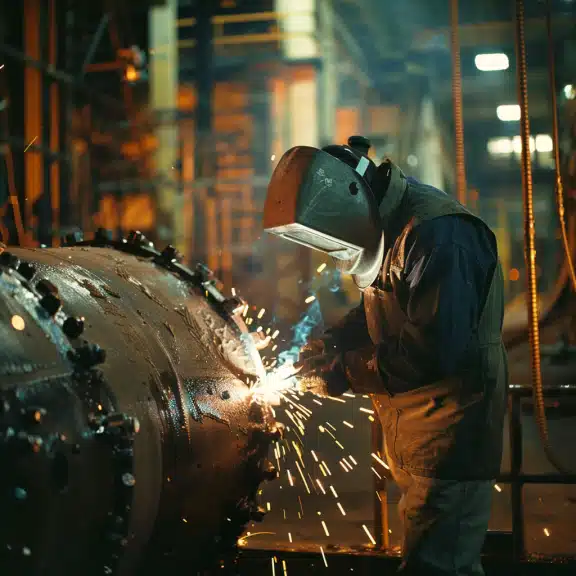
Pressure vessel welders are skilled specialists who fabricate containers designed to hold pressurized gases or liquids, following strict safety and quality standards like ASME codes. At Red River, our welders combine technical expertise with advanced materials and modern welding technologies to serve industries like oil, gas, biogas, and power. This article covers their responsibilities, required skills and training, common vessel types, welding methods, and the latest innovations plus answers to key FAQs on maintenance, customization, and industry challenges.
Pressure Vessel Welder Role
Pressure vessel welding is both an art and a technology. It involves joining metals to create containers designed to hold gases or liquids at pressures significantly different from ambient conditions. At Red River, we specialize in the design and manufacturing of high-performance pressure vessels, along with related components such as prefabricated spools and skid packages. Our fabrication process follows strict engineering practices outlined in guides such as this comprehensive overview of pressure vessel design and fabrication.
The Importance of Pressure Vessels in Industry
Pressure vessels are critical assets across industries including oil and gas, power generation, chemical processing, and biogas production. According to a 2024 industry report by Grand View Research, the global pressure vessel market is projected to reach $72.3 billion by 2027 due to growing energy demand and stricter regulatory compliance.
Understanding the fundamentals of pressure vessels is essential for engineers and fabricators responsible for designing safe systems. These vessels operate under strict design criteria governed by industry standards such as ASME Section VIII pressure vessel codes.
At Red River, every weld must meet performance requirements while complying with rigorous codes, including those explained in ASME welding qualification standards.
Overview of a Pressure Vessel Welder’s Responsibilities
Pressure vessel welders are highly trained specialists responsible for ensuring structural integrity, safety, and regulatory compliance.
Their core responsibilities include:
- Selecting base metals and filler materials compliant with ASME Section IX requirements
- Performing welds using TIG, MIG, and SAW processes
- Conducting non-destructive testing (NDT) such as ultrasonic or radiographic inspections
- Documenting welding procedures according to WPS and PQR documentation standards
- Maintaining quality assurance standards to ensure vessels meet required pressure and temperature ratings
To understand the complete fabrication process, see pressure vessel fabrication steps and the step-by-step process of making vessels from design to fabrication.
The Journey to Becoming a Pressure Vessel Welder
Required Qualifications and Skills
Professional pressure vessel welders combine technical knowledge with practical experience. The role demands mastery of specialized welding techniques and an understanding of materials used in high-pressure environments.
Key skills include:
- Mastery of welding techniques such as GTAW, SMAW, and FCAW
- Knowledge of welding metallurgy and blueprint interpretation
- Certification in ASME welding procedures
- Understanding of OSHA safety standards and confined-space work protocols
Professionals interested in advancing their welding career often explore different welding certifications and their requirements and the mandatory qualification tests for welders required for industrial fabrication.
Soft skills like attention to detail, stamina, and communication are equally important in high-stakes fabrication environments.
Educational Pathways and Training Programs
Training programs and apprenticeships help aspiring welders develop the expertise needed to work with pressure vessels safely and effectively. Those interested in the profession can learn more about essential welding skills for fabrication success and explore career opportunities through employment at Red River.
Types of Pressure Vessels
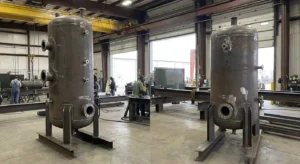
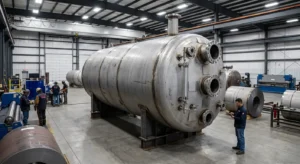
Pressure vessels come in multiple configurations depending on operating pressure, temperature, and industrial application. Engineers must carefully design vessels using proven principles such as Barlow’s formula for pressure vessel design and structural analysis methods.
Design considerations also include vessel geometry. For example, engineers often avoid flat surfaces because of stress distribution concerns explained in why pressure vessels are not rectangular in shape.
Understanding the classification of pressure vessel design helps engineers determine the most appropriate configuration for each application.
Common Materials Used in Pressure Vessels
The material selected for a pressure vessel can drastically affect its longevity, safety, and suitability for certain environments. Common materials include:
- Carbon Steel: A cost-effective material widely used for moderate-pressure applications. Learn more about carbon steel for pressure vessels.
- Stainless Steel: High corrosion resistance, used in chemical and food industries.
- Chromoly (Chrome-Molybdenum): Known for its high strength and excellent performance in high-temperature environments.
Engineers carefully evaluate factors like temperature limits, corrosion exposure, and pressure conditions using guides such as choosing the best metal for high-pressure applications and material selection for high-temperature pressure vessels.
Different Designs and Their Applications
Each pressure vessel must be engineered according to its intended use. Industries rely on specialized designs ranging from storage vessels to separators and reactors.
Understanding industries and uses of pressure vessels helps engineers determine how vessels operate across various sectors.
Additionally, selecting the right vessel geometry is critical. Engineers often consult resources like finding the ideal shape for pressure vessels to optimize safety and efficiency.
Latest Innovations in Welding Technology
Pressure vessel welding continues to evolve with advanced manufacturing technologies. Some of the most significant innovations include:
- Automated orbital welding systems that improve consistency and precision
- AI-assisted monitoring systems that analyze weld pool behavior in real time
- Friction stir welding processes that reduce heat distortion and defects
- Smart welding helmets and augmented reality tools for improved safety and training
These innovations align with broader industry trends discussed in how automation and AI are transforming pressure vessel manufacturing.
Looking for a Trusted Pressure Vessel Fabricator?
Red River designs and manufactures ASME-compliant pressure vessels for industries that demand safety, durability, and precision. From custom vessel fabrication to prefabricated spools and skid packages, our certified welders deliver solutions built to meet strict pressure and performance requirements.
Contact Red River today to discuss your pressure vessel project and get expert guidance from a team that prioritizes quality, compliance, and reliability.
Frequently Asked Questions
1. What are the maximum vital factors to consider when designing a pressure vessel?
The design of a pressure vessel hinges on several important elements. Firstly, the supposed use and the form of cloth it’s going to incorporate are paramount, as those dictate the selection of materials and layout specifications. Secondly, the working pressure and temperature ranges are essential for making sure structural integrity is below operating conditions. Thirdly, compliance with industry requirements, which include ASME codes, is critical for safety and legal requirements. Lastly, factors like corrosion resistance, ease of renovation, and durability play significant roles within the usual design process.
2. How does the selection of cloth impact the performance of a pressure vessel?
Material choice is crucial in pressure vessel creation because it at once influences the vessel’s durability, resistance to corrosion, and ability to resist excessive pressures and temperatures. Common substances include carbon metallic for its electricity and affordability, and stainless-steel for its corrosion resistance. The desired fabric needs to align with the vessel’s supposed contents and operating situations to ensure the most useful overall performance and protection.
3. What are the state-of-the-art advancements in pressure vessel welding generation?
Recent improvements in pressure vessel welding generation consist of computerized welding tactics, which enhance precision and efficiency. Techniques like friction stir welding are gaining traction for his or her potential to supply outstanding, disorder-unfastened welds. Additionally, the mixing of digital technology and AI for actual-time monitoring and first-rate management is revolutionizing the welding process, mainly to step forward protection and consistency in pressure vessel manufacturing.
4. Can pressure vessels be customized for particular enterprise wishes?
Absolutely, pressure vessels can be notably customized to meet specific enterprise requirements. This customization can range from length and form changes to the incorporation of specialized linings, coatings, or inner additives. Industries frequently require specific specs primarily based on their operational desires, along with particular pressure ratings, temperature tolerances, or chemical resistance, all of which can be accommodated within the design and production procedure.
5. What are the commonplace demanding situations in pressure vessel maintenance and the way they can be addressed?
Common demanding situations in pressure vessel renovation encompass corrosion, fabric fatigue, and seal integrity. Regular inspections are important for figuring out capacity troubles early. Employing non-unfavorable testing strategies, which include ultrasonic checking out or radiography, helps in detecting internal and external flaws. Addressing corrosion can involve applying shielding coatings or the use of more corrosion-resistant materials.
Key Takeaways
- Pressure vessel welders play a critical role in industrial safety, compliance, and performance especially in regulated sectors like oil, gas, and power.
- Certifications like ASME Section IX and hands-on skills in TIG, MIG, and NDT are essential for welders to meet today’s industry demands.
- Material selection (carbon steel, stainless, chromoly) depends on factors like corrosion risk, temperature, and pressure.
- Modern welding technologies including automation, AI-driven monitoring, and friction stir methods are transforming quality control.
- Red River combines technical expertise with American-made values, delivering pressure vessels that meet both performance and compliance standards.
Related Blog Post
Which Materials Suit Make-Up Water Service?
How Big Should Make-Up Water Tanks Be?
Make-Up Water Tanks: Design, Sizing, and Fabrication
When to Spec Equalization Tanks for Industrial Systems
How Do Equalization Tanks Balance Flow?
No related articles found.
About Author