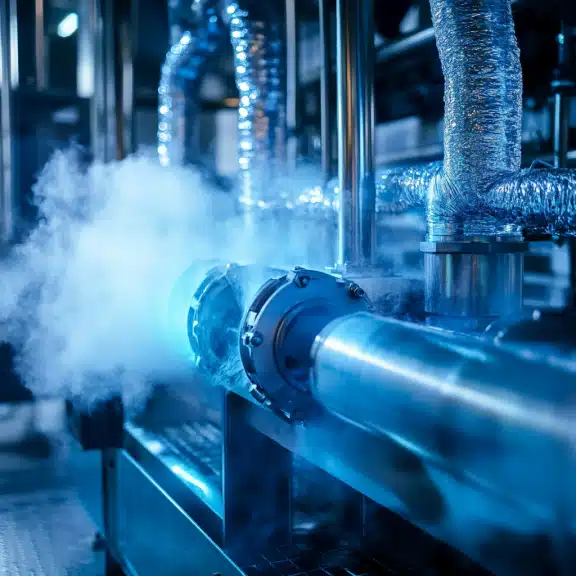
Cryogenic temperatures are crucial for various scientific and industrial applications. From ultra-low temperature storage and cooling systems to advanced cryogenic technologies like liquid nitrogen and helium, these temperatures enable groundbreaking advancements. Properly designed cryogenic vessels ensure safe storage and handling of cryogenic liquids, driving progress in aerospace, healthcare, food processing, and research.
Exploring Cryogenic Temperatures
Cryogenic temperatures refer to extreme cold, typically below -150°C (-238°F), where molecular motion nearly ceases. Such conditions reach absolute zero (-273.15°C or -459.67°F), representing the coldest theoretical temperature.
Significance of Ultra-Low Temperatures
Cryogenic cooling achieves ultra-low temperatures, enhancing material properties and enabling superconductivity. Moreover, these conditions provide insights into phenomena that are otherwise impossible to observe at higher temperatures, driving technological advancements.
Applications of Cryogenic Temperatures
Cryogenic temperatures play a crucial role in various industries. For example, they are essential in preserving biological specimens, conducting experiments in particle physics, and manufacturing semiconductors and superconducting materials. Learn more about how these conditions are managed through engineered storage systems → Understanding Cryogenic Vessels
Types of Cryogenic Cooling Technologies
Liquid Nitrogen Cooling
Liquid nitrogen, with its low boiling point and wide availability, serves as a preferred choice for cryogenic cooling across commercial and scientific fields. Explore how coolant choice impacts performance → Cryogenic Cooling: Liquid Selection & Equipment Performance
Helium Cooling Systems
Helium cooling systems, on the other hand, are indispensable for achieving even lower temperatures, particularly in applications like superconducting magnets and advanced clinical imaging devices.
Hydrogen Cooling Systems
Hydrogen cooling systems deliver exceptionally low temperatures, making them essential for specialized medical studies and space exploration. These systems provide reliable cooling solutions for highly advanced applications.
Components of Cryogenic Cooling Systems
Cryogenic cooling systems rely on critical components such as compressors, heat exchangers, and growth valves. Each part plays a vital role in maintaining and efficiently regulating temperatures. For insight into how pressure and temperature work together in cryogenic vessel design → Cryogenic Temperature and Pressure in Pressure Vessels
Temperature Range for Cryogenic Cooling
Defining the Temperature Range for Cryogenic Cooling
Cryogenic cooling operates across a broad temperature range, from nearly absolute zero (-273.15°C) to approximately -150°C. This range accommodates the diverse requirements of cryogenic applications.
Lower Limits of Cryogenic Temperatures
Absolute Zero
At absolute zero (-273.15°C), all thermal energy ceases. This theoretical limit marks the point where temperature reduction is no longer possible.
Kelvin Scale
Cryogenic temperatures are commonly measured in Kelvin, where 0K represents absolute zero. This scale offers a precise and universal standard for quantifying ultra-low temperatures.
Upper Limits of Cryogenic Temperatures
Critical Point of Gases
The upper limits of cryogenic temperatures depend on the critical points of gases. Beyond these limits, gases cannot be liquefied through pressure alone, making them key thresholds in cryogenic science.
Practical Limits for Cryogenic Applications
Although cryogenic temperatures can theoretically approach absolute zero, practical applications operate within limits defined by technical feasibility and material constraints.
Need a reliable partner?
Red River specializes in the design and manufacturing of pressure vessels. We also fabricate related items such as prefabricated spools and skid packages.
Reach Out to us today and experience the Red River difference. Where American Made and American Values come together, we care more.
Frequently Asked Questions
Can pressure vessels be designed specifically for cryogenic use?
Yes vessels for cryogenics are built with materials and welds that maintain strength and ductility at ultra-low temperatures, ensuring both performance and safety.
What industries benefit most from cryogenic technology?
Industries like aerospace, healthcare, energy, and semiconductor manufacturing rely on cryogenics for material preservation, superconductivity, and specialized cooling.
How are cryogenic materials stored safely?
Cryogenic storage requires insulated, pressure-rated vessels designed to minimize heat transfer. This prevents boil-off and maintains the ultra-low temperatures needed for preservation or experimentation. See our Expert Tips for Handling and Storing Cryogenic Fluids
Why is helium used in cryogenic applications?
Helium remains a liquid at extremely low temperatures and under atmospheric pressure, making it ideal for superconducting magnets, quantum computing, and advanced medical imaging technologies.
What is the difference between cryogenic cooling and traditional refrigeration?
Traditional refrigeration operates above -40°C, while cryogenic cooling goes below -150°C. Cryogenic systems use gases like nitrogen or helium in liquid form to reach these temperatures, enabling unique scientific and industrial processes.
What are the important thing elements to recall while deciding on materials for pressure vessels?
When selecting substances for pressure vessels, several factors must be taken into consideration, which include the working temperature and pressure, the chemical properties of the substances being contained, corrosion resistance necessities, and mechanical houses consisting of strength and ductility. It’s essential to pick substances that can withstand the unique situations of the application even to ensure protection and durability.
Key Takeaways:
- Cryogenic temperatures are essential for a wide range of applications, including material preservation, scientific research, and advanced cooling systems.
- Cryogenic vessels are designed to safely store and manage cryogenic liquids, preventing heat transfer and maintaining ultra-low temperatures.
- Technologies like liquid nitrogen, helium, and hydrogen cooling systems enable precision temperature control for specialized industries.
- Ensuring cryogenic vessel integrity involves regular inspections, choosing appropriate materials, and adhering to safety standards.
- Proper cryogenic liquid storage and handling are critical for industries in healthcare, aerospace, and food processing to ensure efficiency and safety.
Related Blog Post
Pressure Vessel Design & Engineering: Concept to Launch

What is Pressure Vessel Design and Engineering: Code-Ready Guide
What are the Key Factors in Pressure Vessel Engineering
How Do You Design a Pressure Vessel: A Step-By-Step Guide
What is Pressure Vessel Fabrication and Manufacturing
No subpillar set for this blog post.
About Author