Cryogenic tank insulation combines traditional materials like perlite with cutting-edge technologies such as aerogels and vacuum insulation to efficiently maintain ultra-low temperatures. At Red River, we lead the industry with innovative solutions that ensure the highest quality, sustainability, and performance. We continuously explore the latest advancements to deliver the most reliable and cost-effective insulation options for cryogenic tanks.
The Science Behind Cryogenic Insulation
Cryogenic tank insulation blends traditional methods with cutting-edge technologies, creating solutions that are both effective and efficient. For example, it’s a unique combination of time-tested techniques and present-day high-tech materials. From the traditional use of perlite to the innovative application of aerogels, Red River is at the leading edge of this technology. As a result, we ensure that the tanks we provide are of the highest quality.
Materials Used in Cryogenic Tank Insulation
Overview of Insulation Materials
At Red River, we use a diverse range of high-tech materials, from old-school to modern solutions. We are committed to sourcing and using only the highest quality materials. This dedication ensures that the tanks we manufacture are both reliable and efficient. Learn more about the materials used in vessel construction.
Innovations in Insulation: From Perlite to Aerogels
Innovation drives us to develop the most advanced insulation technologies. By combining aerogels with traditional insulators, our tanks achieve unmatched thermal performance. Continuous research allows us to provide high-performance pressure vessel solutions that stay ahead of industry standards.
The Role of Vacuum Insulation
Vacuum insulation represents a critical advancement in cryogenic tank technology. This technique significantly reduces heat transfer, increasing efficiency while maintaining safety. Our approach integrates precision engineering to ensure optimal performance. For a deeper understanding, explore the working principle of cryogenic tanks.
Partner with Red River for Advanced Cryogenic Solutions
Ensure your cryogenic tanks achieve peak performance, efficiency, and sustainability. At Red River, we combine innovative insulation technologies with precision engineering to deliver reliable, American-made solutions.
Contact us today to discuss your project and experience the Red River difference in quality, expertise, and value.
Frequently Asked Questions
1. What are the most commonly used insulation materials for cryogenic tanks, and why?
The only insulation material for cryogenic tanks is usually a combination of materials, consisting of perlite, vacuum insulation, and advanced aerogels. Each has its own set of benefits. For example, perlite is a traditional, price-powerful alternative that provides suitable thermal insulation. Vacuum insulation extensively reduces the warmness switch via conduction and convection, making it a great preference for retaining extremely low temperatures. Aerogels, however, are a modern-day, space-age answer that offers superior thermal resistance with minimal thickness.
2. How do the homes of stored materials have an impact on the selection of insulation for cryogenic tanks?
The properties of stored substances, along with their boiling factors, thermal conductivity, and reactivity, have an extensive effect on the choice of insulation. Cryogenic liquids with extremely low boiling points, such as liquid helium and hydrogen, require more advanced insulation solutions, including vacuum insulation or the use of advanced composites like aerogels, to save you speedy warmth ingress. Substances with higher boiling points, like liquid nitrogen, can be correctly contained with perlite or foam insulation.
3. Can the design of a cryogenic tank affect its insulation performance?
Absolutely. The design of a cryogenic tank, consisting of its form, the substances utilized in its construction, and the integration of the insulation device, performs a crucial position in its average insulation overall performance. Tanks designed with a vacuum jacket or double-walled with a vacuum space among the partitions offer superior insulation by way of minimizing heat transfer. The surface vicinity to extent ratio of the tank is also a vital factor; a design that minimizes the floor area exposed to ambient temperatures can assist reduce thermal inflow.
4. What is the role of R&D in the development of new cryogenic tank insulation technologies?
Research and Development (R&D) is the force at the back of the innovation of recent and improved cryogenic tank insulation technology. It enables the development of new substances, together with nano-insulation or subsequent-generation aerogels, that provide better thermal resistance, reduced weight, and increased price effectiveness. R&D also performs a key position in improving the performance of current materials, including refining the application of vacuum insulation or the compositing of various insulative substances to maximize their insulative homes.
5. How does the fee of cryogenic tank insulation affect the final product, and what are the maximum price-powerful strategies?
The value of cryogenic tank insulation can have a full-size impact on the final price of the tank, in addition to the working and lifestyle cycle prices of the device. High-overall performance materials, like aerogels or vacuum panels, whilst tremendously powerful, can be greater expensive. However, the value must be weighed towards the material’s lengthy-time period financial savings in the form of reduced boil-off, energy savings, and the cost of the cryogenic liquid itself. The maximum fee-effective strategies regularly involve an alternate-off between the initial fee of the cloth and the fee for the material’s long-term period of use.
Key Takeaways:
- Cryogenic Tank Insulation Materials: A combination of materials like perlite, aerogels, and vacuum insulation are used to maintain ultra-low temperatures effectively.
- Innovation in the Industry: Red River stays ahead by integrating both traditional and advanced technologies, ensuring the most efficient and sustainable insulation solutions.
- Customization for Specific Needs: The choice of insulation depends on the properties of the stored cryogenic liquids, with different materials suited for different temperature ranges and requirements.
- Importance of Design: The tank’s design, including features like vacuum jackets, plays a significant role in insulation performance and overall efficiency.
- Cost vs. Efficiency: While high-performance materials like aerogels and vacuum insulation can be more expensive initially, they provide long-term savings in energy and maintenance costs.
Related Blog Post
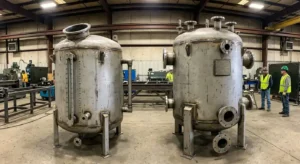
Condensate Tanks: Types, Fabrication, and ASME Code
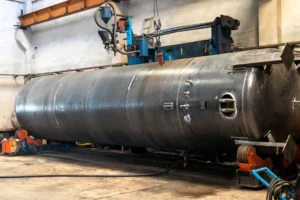
Which Tests Validate Deaeration in Pressure Systems?
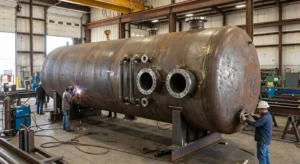
Equalization Tanks: Design, Sizing, and Fabrication
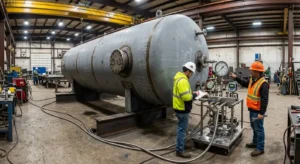
What Are Thermal Storage Testing Standards for TES Vessels?
What Hydro Tests Are Required for Pressure Vessels?
No related articles found.
About Author