A pressure vessel is a specially engineered container that safely holds gases or liquids at pressures far from ambient conditions. This guide explains what pressure vessels are, how they work, and why precise descriptions matter for safety and compliance. It covers major types (storage vessels, heat exchangers, reactors, boilers), key standards like ASME BPVC Section VIII, and design fundamentals. Includes trusted educational links and best practices for clarity and regulatory alignment.
Pressure Vessel Description: Clear Definition, Types, and Standards
A pressure vessel description is a precise explanation of a container designed to safely hold gases or liquids at pressures significantly different from ambient conditions. These vessels must comply with rigorous safety standards, such as the ASME Boiler & Pressure Vessel Code (BPVC) Section VIII, which outlines the rules for construction. These guidelines ensure safety and reliability across industries—from energy to manufacturing.
In this guide, you’ll find:
- A clear definition and working principle of pressure vessels.
- A breakdown of common types like storage vessels, heat exchangers, reactors, and boilers.
- Insights into applications and compliance requirements.
- Industry best practices with educational links for deeper learning.
What Is a Pressure Vessel?
A pressure vessel is a robust container engineered to withstand internal or external pressures significantly higher or lower than atmospheric pressure. For helpful diagrams and technical details, see this comprehensive Wikipedia overview of pressure vessels. These vessels are essential in industrial systems for storing and handling fluids under pressure, classified by their function, construction, and regulatory requirements.
Types of Pressure Vessels
- Storage Vessels are used in industries like petrochemical and food processing for safe, high-pressure containment. Learn more about different types of pressure vessels.
- Shape-Based Variants include cost-effective but stress-intensive cylindrical designs and more uniform-stress spherical vessels. Explore these differences on our types guide.
- Specialized Vessels such as heat exchangers, boilers, reactors, and distillation columns are explored thoroughly in our detailed vessel breakdown.
- Why Pressure Vessel Description Matters
Accurate description and classification are essential not only for clarity but for regulatory compliance. Misclassifying components like pipes as pressure vessels can lead to safety issues and non-compliance. Learn more from our article on pipes vs pressure vessels.
Standards and Compliance
Pressure vessels must meet stringent guidelines outlined in ASME BPVC Section VIII, covering divisions for various pressure categories. Additional design insights are available in our comprehensive design guide and this detailed engineering lecture. Internationally, European standards like the Pressure Equipment Directive align with similar safety principles.
How They Work: The Mechanics
Pressure vessels rely on sound engineering stress analysis, proper wall thickness, rigidity, and non-destructive testing (such as ultrasonic or radiographic inspections). For a step-by-step breakdown, see Understanding Pressure Vessels: Design & Applications.
Concluding Insights (Elegantly Framed)
In Summary: Mastering Pressure Vessel Description
A pressure vessel description must cover its purpose, structure, classification, and applicable standards. By integrating educational external links such as ASME BPVC and Wikipedia, you improve both SEO and content credibility.
Ready to Talk?
Need expert help with pressure vessel design, ASME/PED compliance, or manufacturing? Check out our Contact page to connect with the Red River Team, your trusted partner in precision-engineered vessels.
Frequently Asked Questions
What defines a pressure vessel compared to a standard vessel?
A pressure vessel is constructed to sustain pressures vastly different from ambient see more in the Wikipedia pressure vessel entry.
When should a pipe be classified as a pressure vessel?
If it operates under sustained or elevated pressure, it must meet vessel code requirements. Learn specifics in our pipes vs pressure vessels article.
What materials are commonly used for pressure vessels?
Common materials include carbon steel, stainless steel, and specialty alloys. Learn about material selection in our types of pressure vessels guide.
Key Takeaways
- A pressure vessel description should thoroughly detail function, design, and compliance standards.
- Common types include storage vessels, reactors, heat exchangers, and boilers.
- Design choices (cylindrical vs spherical, thin vs thick walls) significantly affect stress management and safety.
- Compliance with ASME BPVC Section VIII and equivalent international standards is non-negotiable.
- Embedding trusted educational links improves authority and builds reader trust.
Related Blog Post
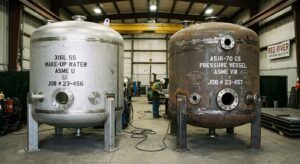
Which Materials Suit Make-Up Water Service?
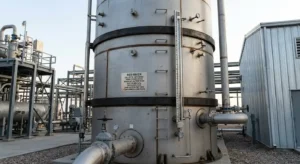
How Big Should Make-Up Water Tanks Be?
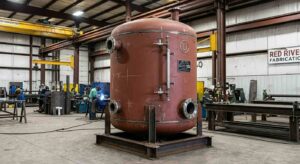
Make-Up Water Tanks: Design, Sizing, and Fabrication
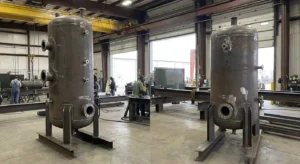
When to Spec Equalization Tanks for Industrial Systems
How Do Equalization Tanks Balance Flow?
- Understanding Pressure Vessel Sizing for Optimal Performance
- Understanding Pressure Vessel Sizing for Optimal Performance
- Understanding the Lifespan of Pressure Vessels: Key Factors & Maintenance
- ASME Factor for Pressure Vessels
- Essential Criteria for Designing a Pressure Vessel
- Preferred Failure Theory in Pressure Vessel Design Explained
About Author