Peak demand charges can account for 30–50% of a facility’s electricity bill and cooling systems are the primary driver. For energy managers, mechanical engineers, and facility operators running chilled water cooling infrastructure, TES tanks offer a proven way to shift that cost burden. This guide explains exactly how TES tanks reduce energy costs, what sizing and material decisions maximize savings, and what the difference looks like operationally between a system with and without thermal storage.
How Can TES Tanks Reduce Energy Costs in Cooling and Thermal Systems
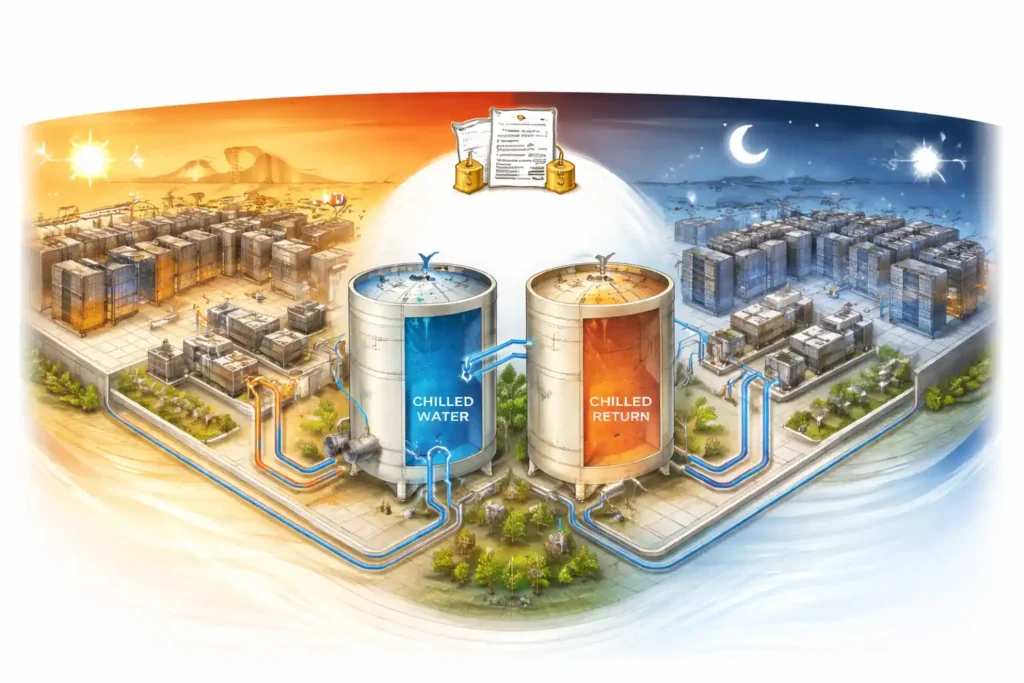
Electricity tariffs in most commercial and industrial markets include demand charges fees based on the highest 15- or 30-minute peak consumption recorded during a billing period. Chillers are the single largest contributor to those peak readings. TES tanks break that connection by producing chilled water at night when rates are lowest and releasing it during the day when demand and rates are highest. The chiller still runs the same total hours but shifts those hours to the cheapest window in the billing cycle.
This makes TES tanks a strategic asset in any chilled water system. They work closely with Chilled Water Storage Tanks, which store large volumes of cooled water for future use. Understanding what is a chilled water storage tank helps clarify how these systems reduce energy consumption. When both systems are used together, they provide consistent chilled water availability without requiring constant chiller operation.
To maximize efficiency, engineers must also consider how much volume is needed for chilled water storage, because the tank’s storage capacity directly affects how much energy can be saved. Additionally, choosing the right materials matters. Knowing which materials suit chilled water service ensures that the tank remains efficient and structurally sound over time.
Peak Demand Charges and How TES Tanks Reduce Them
Demand charges are calculated on peak consumption not total consumption. A facility that runs its chillers at 800 tons for 15 minutes during a peak period pays a demand charge based on that 800-ton reading regardless of how efficiently it operates the rest of the month. TES tanks cap that peak by supplying stored chilled water during high-demand windows, reducing the chiller’s contribution to the peak reading and lowering the demand charge on the monthly bill.
TES tanks enable energy load shifting by offering:
- The ability to produce chilled water at night or during off-peak times
- Reduced chiller usage during high-rate periods
- A more stable energy consumption curve throughout the day
- Less dependency on oversized chiller equipment
- Greater predictive control over cooling loads
- Decreased wear on mechanical systems due to smoother operation
The ASHRAE thermal energy storage design guide provides reference data on load-shifting strategies and sizing methodologies.
How TES Tanks Reduce Chiller Runtime and Wear
Chillers operate most efficiently at a steady, consistent load. Frequent cycling starting and stopping in response to fluctuating demand increases compressor wear, refrigerant stress, and energy consumption per ton of cooling produced. TES tanks absorb those demand fluctuations, allowing chillers to run at a stable setpoint for longer periods. Fewer start cycles means lower maintenance frequency, longer compressor life, and better chiller coefficient of performance (COP) over the operating year.
TES tanks reduce mechanical strain by providing:
• Cooling reserves during sudden heat load spikes
• Pre-cooled water that supplements chiller output
• A thermal buffer that prevents rapid cycling
• More predictable cooling loads for chillers and pumps
• Longer equipment life due to reduced stress
Because chillers do not need to constantly accelerate and decelerate, facilities save energy and reduce maintenance costs over time.
Hydronic Stability and Flow Efficiency With TES Tanks
An unstable chilled water loop one with pressure surges, temperature swings, or inconsistent flow forces control systems to constantly compensate. Variable frequency drives ramp up and down, control valves hunt for setpoint, and chilled water temperatures at end-use equipment vary. TES tanks add thermal mass to the loop that dampens those fluctuations, giving the system a stable thermal reference that improves temperature control at every air handler and cooling coil.
TES tanks improve hydronic stability by offering:
• Additional thermal mass that evens out temperature fluctuations
• Better flow balance throughout the chilled water system
• More consistent temperatures delivered to end-use equipment
• Smoother transitions between load conditions
When paired with Chilled Water Storage Tanks, TES tanks create a more controlled environment that helps cooling systems operate with less energy waste.
The US Department of Energy outlines how thermal storage reduces peak demand in commercial buildings.
Material Selection for Long-Term TES Tank Performance
A TES tank that corrodes internally loses insulation value, contaminates the chilled water loop, and requires early replacement eliminating any energy savings the system was designed to generate. Red River fabricates these as ASME-certified pressure vessels with full material documentation. Stainless steel grades 304L and 316L are specified where glycol concentrations, low-pH water treatment, or high-purity requirements make carbon steel unsuitable.
Materials that suit chilled water service include:
• Carbon steel with internal coatings to prevent corrosion
• Stainless steel for environments with aggressive water chemistry
• Composite linings when enhanced durability is required
• Welded structural shells designed for long-term pressure stability
Choosing the correct materials reduces heat gain, improves internal water quality, and minimizes long-term maintenance all factors that support energy efficiency.
Sizing TES Tanks for Maximum Energy Savings
Tank volume determines how many hours of off-peak chilling can be stored and discharged during peak demand. A common starting point is sizing for 4–6 hours of peak cooling load at the design delta-T between supply and return temperatures. Undersizing the tank limits the discharge window and reduces demand charge savings. Oversizing increases capital cost and thermal loss without proportional benefit. Red River works with engineers during the design phase to model storage volume against load profiles and utility rate structures before fabrication begins. The U.S. Department of Energy’s thermal energy storage program provides publicly available guidance on TES sizing methodologies and load-shifting strategies for commercial and industrial facilities.
Choosing the correct tank volume helps:
• Maximize off-peak cooling production
• Provide sufficient thermal backup for daily operations
• Reduce the need for oversized chiller systems
• Ensure stable energy use during periods of high load
A properly sized TES tank ensures the facility saves energy consistently rather than sporadically.
Partner With Red River to Lower Your Facility’s Cooling Energy Costs
To explore custom TES tank fabrication or chilled water storage solutions, Contact Red River to discuss TES tank fabrication and thermal storage system design.
Building an Energy-Efficient Cooling System With TES Tanks
The energy case for TES tanks is straightforward shift chiller runtime to off-peak hours, cap peak demand readings, and stabilize the hydronic loop. The financial case depends on getting the sizing, material selection, and system integration right from the start. An undersized tank limits savings. The wrong material degrades water quality and increases maintenance cost. Poor integration creates hydraulic issues that offset efficiency gains. Red River fabricates ASME-certified TES tanks sized and configured for each project’s specific load profile and utility rate structure. Contact our team to discuss your facility’s requirements.
Frequently Asked Questions
1. How do TES tanks support data center cooling?
TES tanks store chilled water during low-demand periods and release it when server loads spike, stabilizing the cooling loop and preventing thermal overload without requiring immediate chiller response.
2. What ASME Section VIII applies to TES tanks?
Most TES tanks operating above 15 psig fall under ASME Section VIII Division 1, which governs pressure vessel design, material selection, weld quality, and hydrostatic testing requirements.
3. What materials are best for TES tanks in chilled water service?
Materials such as carbon steel, stainless steel, and properly lined composite structures often suit chilled water service.
4. How do I know how much volume is needed for chilled water storage?
Engineers calculate volume based on cooling load, energy goals, and discharge duration requirements.
5. Do TES tanks extend chiller lifespan?
Yes. TES tanks reduce chiller workload, helping the equipment operate more smoothly and last longer.
6. Can TES tanks support peak cooling operations?
They provide stored energy that can be used during high-demand periods, reducing the need for chiller overuse.
Key Takeaways
- Peak demand charges based on 15- or 30-minute peak readings are the primary energy cost TES tanks address by discharging stored chilled water during peak windows, facilities reduce their highest consumption readings and lower monthly demand fees.
- Chillers operating at a steady load produce more cooling per kWh than chillers cycling on and off TES tanks provide the thermal buffer that enables steady-state chiller operation and improves COP across the operating year.
- Tank sizing for maximum savings starts at 4–6 hours of peak cooling load at design delta-T undersizing limits the discharge window while oversizing increases capital cost without proportional benefit.
- Carbon steel with internal lining suits most chilled water TES applications stainless steel 304L or 316L is required where glycol concentrations or aggressive water treatment chemistry creates corrosion risk.
- Red River fabricates ASME-certified TES tanks with full documentation sized and configured against each facility’s load profile and utility rate structure before fabrication begins.
Related Blog Post
Condensate Tanks: Types, Fabrication, and ASME Code
Which Tests Validate Deaeration in Pressure Systems?
Equalization Tanks: Design, Sizing, and Fabrication
What Are Thermal Storage Testing Standards for TES Vessels?