
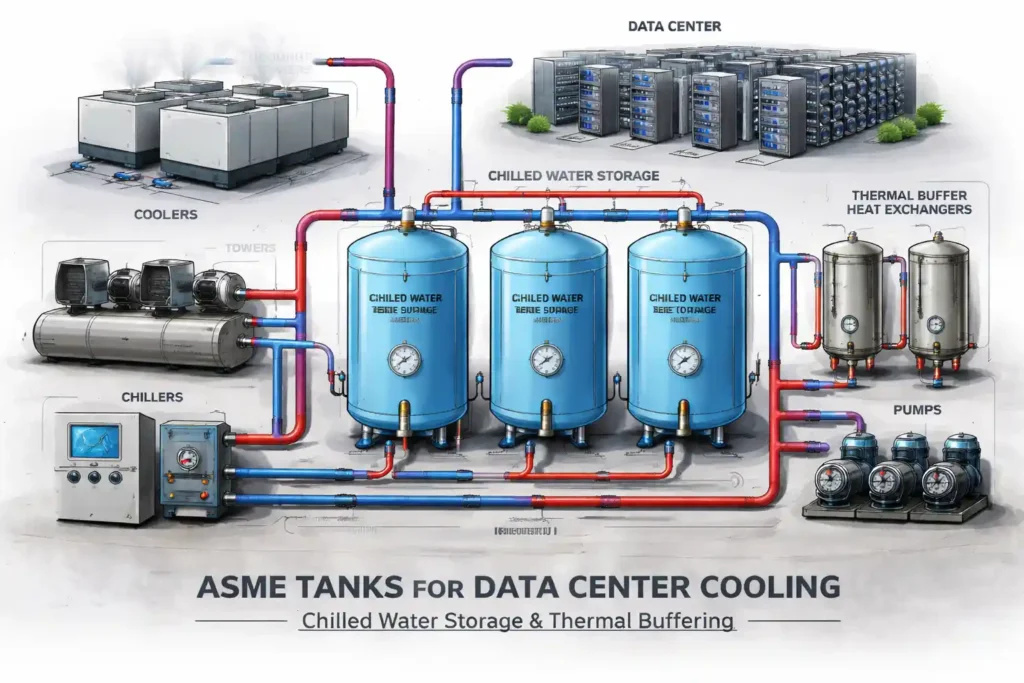
ASME Tanks for Data Center Cooling
Data centers that lack adequate thermal buffering face chiller short-cycling, pump cavitation, and temperature spikes that can take critical systems offline. This guide is for engineers and system integrators designing chilled water infrastructure for high-density computing environments. You’ll learn how ASME-certified tanks function as thermal buffers, how they integrate with chilled water storage systems, and what material and volume considerations govern their design.
How ASME Tanks Function in Data Center Thermal Infrastructure
High-density computing environments generate heat loads that fluctuate rapidly — a single rack can swing from 50% to 100% utilization in seconds. Standard chilled water loops without buffering struggle to absorb these swings fast enough, causing temperature instability that forces thermal throttling or emergency shutdowns.
ASME-certified buffer tanks solve this by adding thermal mass to the cooling loop. They store chilled water and release it during demand spikes, giving chillers time to ramp up without exposing servers to temperature excursions. They also balance hydraulic flow across the loop, eliminating pressure inconsistencies that cause pump cavitation and flow starvation at remote coils.
These tanks frequently work alongside dedicated chilled water storage tanks larger vessels that hold hours of cooling reserve rather than minutes. Understanding the difference between a buffer tank and a storage tank is important for engineers sizing these systems correctly: buffer tanks handle short-duration transients, while storage tanks support sustained load-shifting strategies.
Red River fabricates ASME U-stamp certified pressure vessels and thermal tanks used in data center cooling infrastructure, providing engineers and system integrators with code-compliant components backed by full material traceability and certified weld documentation.
Why Thermal Buffering Is Critical for Data Centers
Data centers operate continuously, and their cooling systems must match that uptime requirement precisely. Even brief temperature spikes can push server inlet temperatures beyond safe thresholds, triggering thermal throttling or automatic shutdowns. ASME-certified tanks provide the thermal mass needed to absorb those spikes, buying time for chillers to respond without allowing temperatures to climb to dangerous levels. They also stabilize hydraulic flow, preventing pump cavitation and pressure surges that damage equipment and increase maintenance frequency.
These tanks support reliable operations by providing:
- A stable volume of chilled water for thermal consistency
- Enhanced flow stability to prevent pump cavitation or surges
- Thermal buffer capacity during load changes
- Backup cooling support during equipment transitions
- Integration compatibility with chilled water storage methods
- Long-term durability through ASME-certified construction
During equipment transitions such as chiller switchovers or maintenance windows these tanks provide backup thermal capacity that keeps the cooling loop stable without requiring emergency chiller starts. This reduces mechanical wear and extends equipment service life. The result is a cooling system that handles both predictable load changes and unexpected demand spikes without compromising uptime.
For further information on pressure vessels, you can explore our detailed guide on ASME pressure vessels. This guide covers everything from material selection to fabrication standards.
Engineering Principles That Govern ASME Cooling Tank Design
ASME tanks for data center cooling are designed and fabricated to meet strict engineering standards, ensuring they can withstand pressure, temperature cycling, and continuous hydraulic motion. These tanks are built according to ASME Section VIII, which guarantees their safety and stability during operation. Their robust construction ensures they perform reliably in mission-critical environments, where consistent cooling is essential to avoid hardware failure and downtime. By adhering to these stringent standards, ASME tanks are engineered to handle the demanding conditions of data centers, providing long-term durability and performance.
Important engineering considerations include:
- Required pressure capacity and tank diameter
- Shell and head thickness based on design conditions
- Weld procedures certified to ASME standards
- Allowance for thermal expansion and contraction
- Placement for optimal mixing and hydraulic performance
- Inlet and outlet configurations that reduce turbulence
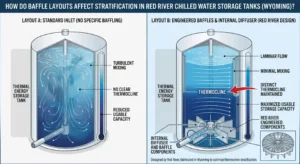
- Internal baffles for improved thermal stratification if needed
- Access points for internal inspection and service
These engineering decisions ensure the tanks remain robust and dependable across the full service life of the cooling system. For a deeper dive into pressure vessel design and its various considerations, check out our guide to pressure vessel design.
Integrating ASME Tanks With Chilled Water Storage Systems
ASME tanks for data center cooling are often integrated with Chilled Water Storage Tanks to create a hybrid thermal storage and buffering system. This combination enhances cooling capacity by providing a stable chilled water source during peak demand times. When ASME buffer tanks are paired with chilled water storage tanks, the system gains both short-term surge absorption and longer-term thermal reserve capacity. The buffer tank handles immediate flow and pressure stabilization, while the storage tank provides sustained cooling output during peak demand or planned maintenance windows. This combination reduces chiller cycling frequency one of the primary drivers of mechanical wear and energy waste in large cooling plants.
For more on this integration, explore our detailed guide on chilled water systems.
These integrated systems provide:
- A reliable thermal reserve that supports peak cooling demand
- A buffer that reduces chiller cycling and energy waste
- A secondary cooling source during maintenance
- Enhanced flow stability
- Load shifting capability through thermal energy storage
- Improved efficiency for data center cooling loops
Understanding what is a chilled water storage tank helps clarify its purpose: it holds large quantities of chilled water that can be released into the cooling loop as needed. These systems are useful when chilling reserves are needed immediately without waiting for chillers to ramp up. To determine appropriate tank sizing, engineers evaluate how much volume is needed for chilled water storage based on cooling loads, desired discharge duration, and operational redundancy. When ASME tanks for data center cooling are partnered with well-designed chilled water storage solutions, the system becomes significantly more resilient.
Material Selection for Chilled Water Service
Material selection is critical for the durability and performance of ASME tanks for data center cooling. These tanks need to be compatible with various fluids, such as treated water, corrosion inhibitors, or glycol mixtures, which are commonly used in chilled water systems. The right material ensures the tanks can resist the chemical properties of these substances without degrading or affecting system efficiency. Corrosion resistance is particularly crucial, as it prevents tank failure and extends the lifespan of the cooling infrastructure. Additionally, the chosen material must withstand the pressure and temperature variations typical in data center cooling systems. By selecting high-quality, compatible materials, ASME tanks for data center cooling maintain optimal performance, reliability, and longevity. Selecting the wrong material particularly in systems using aggressive glycol concentrations or low-pH water treatment leads to internal corrosion that compromises structural integrity long before the design service life is reached.
When choosing which materials suit chilled water service, engineers evaluate properties such as:
- Corrosion resistance to treated water and glycol
- Strength at chilled temperatures
- Weldability and structural integrity
- Cleanability and resistance to scaling
- Long-term exposure to water chemistry
Common materials used in chilled water applications include:
- Carbon steel with internal coatings
- Stainless steel for high-purity or corrosive environments
- Coated steel options where protective linings reduce corrosion risks
Red River works with data center engineers to select materials matched to their specific fluid chemistry, operating temperature range, and maintenance requirements. Carbon steel with internal lining suits most standard chilled water applications. Stainless steel is specified where water purity requirements are strict or where glycol concentrations and pH levels create elevated corrosion risk. You can explore more on this topic through ASME Pressure Vessel Codes and Standards, or learn about the material selection for pressure vessels.
Operational Efficiency Gains From ASME Tanks for Data Center Cooling
Chiller plants consume the most energy of any mechanical system in a data center facility. One of the most effective ways to reduce that consumption is increasing the water volume in the cooling loop which is exactly what buffer tanks provide. A larger water volume means slower temperature rise during demand spikes, which translates directly into fewer chiller start cycles. Each avoided startup cycle reduces compressor wear, refrigerant stress, and peak electrical demand. For facilities paying demand-based electricity tariffs, fewer startup cycles can produce measurable reductions in monthly operating costs. Learn more about energy efficiency considerations for pressure vessels.
These tanks improve efficiency by:
- Providing thermal mass that reduces rapid temperature changes
- Helping chillers operate at steady-state conditions
- Supporting load-shifting strategies with chilled water storage
- Reducing pump cavitation risks through stable pressure
- Improving overall system control responsiveness
When chilled water is stored during overnight off-peak hours and discharged during the peak cooling demand window, mechanical chiller runtime drops significantly. This load-shifting strategy reduces peak electricity demand charges one of the largest operating cost line items for data center facilities. ASME-certified tanks support this strategy by maintaining water quality and structural integrity through thousands of thermal cycles over their service life.
Redundancy and Reliability in Chilled Water Networks
Buffer tanks add a layer of redundancy to chilled water networks by storing cooling reserve that can be released immediately when primary chiller capacity is reduced or interrupted. During planned maintenance windows or unexpected equipment failures, this stored volume keeps the cooling loop stable without requiring emergency chiller starts or load shedding.
The stored chilled water stabilizes loop temperatures, prevents thermal overloads, and reduces the risk of system failure during transitions. For data center operators running uptime SLAs, this reserve capacity is the difference between a seamless maintenance window and a cooling emergency. To better understand how redundancy plays a role, you can review this guide to pressure vessel failure.
These tanks enhance reliability by:
- Offering additional runtime during equipment transitions
- Reducing stress on pumps and chillers
- Supporting chilled water storage solutions that add capacity
- Stabilizing hydronic performance under varying loads
- Helping maintain precise temperatures during peak usage
ASME certification means the tank has been designed, fabricated, and inspected to a documented standard not just built to the lowest cost specification. For data center operators who must meet uptime SLAs and demonstrate infrastructure reliability to clients and auditors, that documentation trail matters. Red River fabricates vessels with full material traceability, certified weld procedures, and U-stamp certification available on request.
Flow Stabilization and Thermal Buffering
ASME tanks for data center cooling play a crucial role in stabilizing chilled water flow within loop systems. Without proper buffering, flow surges can lead to pump cavitation, temperature fluctuations, and excessive strain on equipment. By providing a reliable storage source, ASME tanks for data center cooling absorb these surges, ensuring smooth and consistent water flow throughout the system. This stabilization helps maintain optimal cooling conditions, preventing the negative effects of pressure fluctuations that can cause system inefficiencies or damage. Proper inlet and outlet placement along with internal baffles where thermal stratification is needed determines how effectively the tank performs this buffering function. A poorly configured tank can actually introduce turbulence rather than reduce it. Red River’s engineering team specifies these configurations based on flow rate, tank geometry, and system pressure requirements before fabrication begins.
These tanks improve flow consistency by:
- Absorbing sudden surges
- Reducing the impact of load oscillations
- Creating a predictable hydraulic environment
- Supporting thermal stratification in chilled water storage tanks
Understanding how much volume is needed for chilled water storage plays a major role in determining the level of buffering required for smooth operation.
Volume Planning for Chilled Water Tank Systems
Volume planning is one of the most consequential engineering decisions in chilled water system design. Too little storage volume and the system cannot absorb demand spikes without chiller intervention. Too much and capital cost rises unnecessarily while thermal losses increase.
Designers calculate required volume based on several key factors:
- Desired thermal response time
- Anticipated peak cooling load
- Chiller cycling patterns
- Required discharge duration from thermal storage
- Storage temperature levels
- Pumping capacity and flow rates
A common starting point for buffer tank sizing is 10 gallons per ton of installed chiller capacity, though this varies based on load profile and desired thermal response time. Thermal storage tanks are sized differently based on the number of hours of discharge needed and the delta-T between supply and return temperatures.
Getting this calculation right early in the design phase prevents costly modifications later. Red River works directly with engineers during the specification stage to validate volume requirements against system load data and redundancy targets before fabrication begins.
Energy Reduction Strategies Using Thermal Storage
Thermal storage is one of the most effective tools for reducing a data center’s peak energy draw. By pre-cooling water during nighttime off-peak hours when electricity rates and ambient temperatures are lower and discharging that stored cooling during daytime peak demand, facilities reduce both their energy consumption and demand charges. The tanks holding that stored chilled water must be structurally sound, thermally efficient, and compatible with the water chemistry used in the system. Material compatibility with glycol mixtures and treated water chemistry must be confirmed before specifying any tank for thermal storage duty particularly where freeze protection additives are used year-round.
Energy strategies supported by ASME tanks include:
- Nighttime chilling for off-peak efficiency
- Thermal storage for reducing on-peak chiller use
- Integrated energy-saving control sequences
- Reduced chiller cycling through increased thermal mass
Building a Reliable Data Center Cooling System With ASME Tanks
Thermal buffering is not optional in high-density data center environments it is the difference between a cooling system that handles load transitions gracefully and one that forces emergency responses during peak demand. ASME-certified tanks provide the structural reliability, material traceability, and engineering documentation that data center operators need to meet uptime requirements and satisfy client audits. Red River fabricates these vessels to specification, with U-stamp certification and full documentation available. Contact our team to discuss your project requirements.
Partner With RedRiver LLC for Premium ASME Cooling Tanks
Discover how RedRiver LLC’s ASME-certified tanks can enhance your data center cooling infrastructure. Contact us today for expert fabrication and reliable, mission-critical solutions.
Frequently Asked Questions
1. How do TES tanks support data center cooling?
TES tanks store excess thermal energy during off-peak hours and release it when cooling demand is high, ensuring stable temperatures and reducing the load on chillers in data centers.
2. What is a chilled water storage tank?
A chilled water storage tank holds cooled water for cooling systems, storing it during low demand and using it during peak hours to reduce chiller operation and improve energy efficiency.
3. How do buffer tanks prevent chiller short cycling?
Buffer tanks store chilled water and maintain a stable cooling load, preventing chillers from turning on and off frequently, which extends their lifespan and improves efficiency.
4. How do expansion tanks control loop pressure?
Expansion tanks absorb pressure changes from thermal expansion, maintaining stable pressure and preventing system damage from excessive buildup.
5. What causes pressure surge in cooling loops?
Pressure surges, or water hammer, occur due to sudden flow changes, like rapid valve closures or pump starts, which can damage system components.
6. When are modular tanks better than single tanks?
Modular tanks offer flexibility, scalability, and redundancy, making them ideal for systems that need expansion or are prone to maintenance, reducing downtime risks.
Key Takeaways
- ASME buffer tanks absorb hydraulic surges and temperature spikes that would otherwise cause pump cavitation, chiller short-cycling, and thermal overload in high-density computing environments.
- Chilled water storage tanks paired with ASME buffer tanks reduce chiller cycling frequency lowering compressor wear and peak electricity demand charges simultaneously.
- Carbon steel with internal lining suits most standard chilled water applications stainless steel is required where glycol concentrations or low-pH water treatment creates elevated corrosion risk.
- Buffer tank sizing starts at 10 gallons per ton of installed chiller capacity; thermal storage tanks are sized separately based on discharge duration and supply-return delta-T.
- Red River fabricates U-stamp certified tanks with full material traceability and certified weld procedures the documentation data center operators need for client audits and uptime SLA compliance.
Related Blog Post
Can Condensate Storage Improve Reliability?
Where Do Condensate Tanks Fit in a Steam System?
Which Nozzles Simplify Maintenance on Pressure Vessels?
How to Vent Condensate Tanks in Steam Systems
How Do Baffle Layouts Affect Stratification in TES Tanks?
About Author



