Knowing when to combine storage with free cooling can significantly cut chiller runtime and peak demand costs for facility engineers and energy managers. This guide covers the conditions that make the combination worth designing and what the fabrication scope must include.
What Free Cooling Actually Is
Free cooling, also called economizer mode, uses a heat exchanger to transfer cooling capacity from an ambient source, typically outdoor air or a ground loop, directly to the chilled water system without running the compressor-based refrigeration cycle. When outdoor air temperature is low enough relative to the required chilled water supply temperature, the heat exchanger alone can provide all or part of the required cooling load at a fraction of the energy cost of mechanical refrigeration.
The threshold at which free cooling becomes viable depends on the required chilled water supply temperature and the heat exchanger approach temperature. A system requiring 44°F supply can access free cooling when outdoor air drops to approximately 35 to 40°F.
Rocky Mountain and high plains locations, including Wyoming, have some of the most favorable free cooling availability in the continental United States. NOAA’s U.S. Climate Normals provide historical temperature data that supports annual free cooling hour estimates for any project site.
Why Pairing Free Cooling with Thermal Storage Multiplies the Value
Free cooling alone is limited by timing. Ambient temperatures are lowest at night, which does not always coincide with peak cooling demand. This is the core reason facility engineers evaluate when to combine storage with free cooling. Thermal storage removes that timing constraint. When free cooling is available, the system charges the storage tank passively, building up a reserve of chilled water without running the chiller plant. During peak demand hours when ambient temperatures no longer support free cooling, the facility draws from stored capacity instead of running chillers at full load. For more on how storage handles peak demand discharge, see how does storage shift cooling load and can TES tanks reduce energy costs.
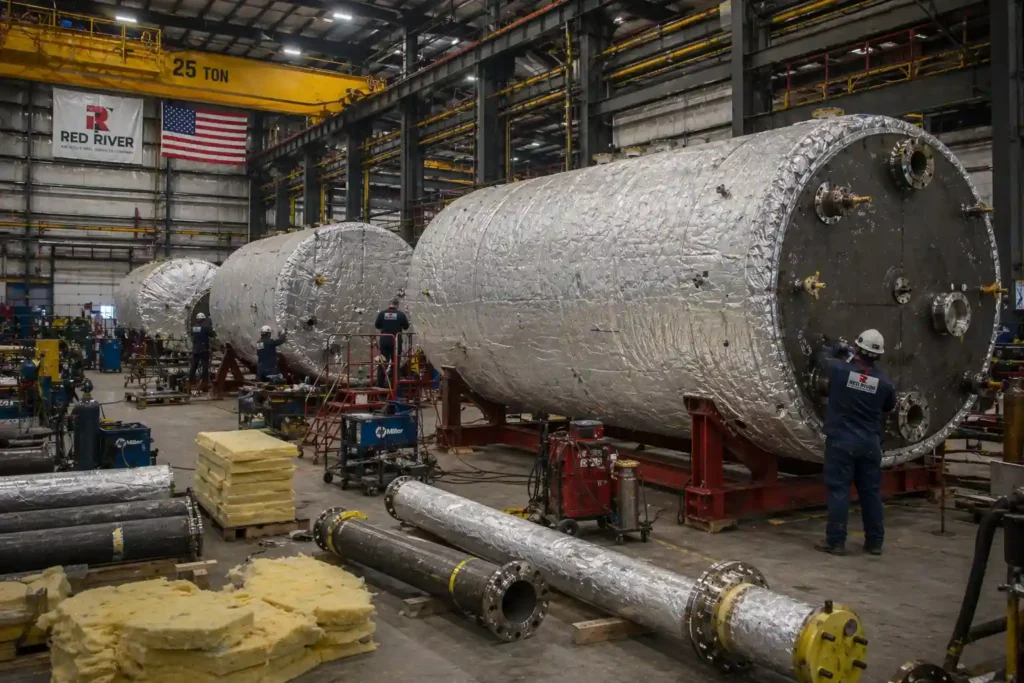
The combination produces three compounding financial benefits: reduced chiller runtime, lower peak demand charges, and extended chiller maintenance intervals. Red River fabricates the insulated thermal storage vessels and modular skid packages that anchor these combined systems, built to ASME standards with full documentation on every project.
The Conditions That Determine When to Combine Storage with Free Cooling
When to combine storage with free cooling: climate requirements
The primary condition is a climate with sufficient annual free cooling hours to justify the heat exchanger and controls investment. Annual bin temperature data for the project site provides the basis for this analysis. Annual bin temperature data weighted against the facility’s cooling load profile determines the potential free cooling contribution. The U.S. Department of Energy provides climate data resources that support this analysis.
Required chilled water supply temperature
A higher chilled water supply temperature requirement expands the free cooling window because the heat exchanger approach temperature is more easily achieved with warmer ambient air. Systems requiring 50 to 55 degree Fahrenheit supply water have significantly more free cooling availability than systems requiring 40 to 44 degree Fahrenheit supply at the same site. Confirming the required supply temperature before evaluating free cooling potential prevents designing around an assumption the process cannot meet.
Utility rate structure
Free cooling combined with storage delivers the greatest financial return at sites with significant demand charge exposure or time-of-use rate differentials. Sites on flat-rate utility tariffs without demand charges see a smaller financial benefit. The U.S. Environmental Protection Agency provides guidance on demand charge management strategies for facilities evaluating load shifting investments.
What the Fabrication Scope Needs to Include
A combined free cooling and thermal storage system requires fabrication provisions that a standalone vessel does not. These must be designed into the scope from the start.
Heat exchanger sizing
The heat exchanger that allows free cooling to charge the storage tank must be sized for the free cooling capacity the system is designed to deliver. Undersizing the heat exchanger limits free cooling contribution and reduces the financial return on the combined system investment.
Independent controls interface
The controls interface between the free cooling source, the heat exchanger, and the storage charging system must allow the free cooling circuit to charge storage independently of the chiller plant. Without that independence, free cooling can only operate when the chiller is also running, which eliminates the energy savings that justify the combined system.
Insulation system provisions
Vapor barrier integrity is critical in combined systems because the vessel surface temperature can vary more widely across operating modes than in a chiller-only system. Insulation provisions must account for the lower charging temperatures that free cooling may produce compared to mechanical refrigeration.
Red River’s prefabrication services cover heat exchanger integration within modular skid packages, allowing the free cooling heat exchanger, storage vessel, and associated piping to be pre-assembled and pre-tested before shipping. For a breakdown of what the storage vessel needs to handle, see what is a chilled water storage tank.
When the Combination Is Not the Right Call
Understanding when to combine storage with free cooling also means knowing when not to. Free cooling integrated with thermal storage adds capital cost and system complexity. Sites in warm humid climates with limited free cooling hours, systems with very low supply temperature requirements that rarely fall within free cooling range, and facilities on flat-rate utility tariffs without meaningful demand charges are all cases where standalone thermal storage without free cooling integration is the more practical choice.
The decision should be based on a site-specific analysis of annual free cooling hours, load coincidence, and utility rate exposure, not a general preference for system sophistication. Red River works through this analysis before the system design is finalized. That means confirming when to combine storage with free cooling makes financial sense for your specific site, utility tariff, supply temperature requirement, and operating conditions.
Ready to Evaluate When to Combine Storage with Free Cooling?
Knowing when to combine storage with free cooling requires a site-specific analysis of annual free cooling hours, supply temperature requirements, and utility rate exposure. Red River works through all three before the system design is finalized. That means reviewing bin temperature data for the project site, confirming the required chilled water supply temperature, modeling the utility tariff for demand charge and time-of-use exposure, and identifying the fabrication provisions that must be built into the storage vessel scope from the start.
Request a quote or call 1-307-257-5332 to discuss free cooling integration before the system design is finalized.
Frequently Asked Questions
1. How does storage shift cooling load?
Chillers run overnight during off-peak hours to generate and store chilled water. During peak demand hours, the facility draws from that stored capacity instead of running chillers at full load. In a fully load-shifted system, chillers can be taken offline entirely during the most expensive rate periods, reducing peak demand charges without reducing cooling output.
2. Which storage medium works best?
Water is the correct choice for the vast majority of chilled water thermal storage applications. It has high specific heat capacity, is non-toxic, widely available, and compatible with standard carbon steel and stainless steel vessel materials. Phase-change materials offer higher energy density in less volume but add system complexity and cost that is only justified when space constraints make a water-based system impractical.
3. Does free cooling require a separate storage vessel or can it charge an existing tank?
Free cooling can charge an existing thermal storage vessel provided the controls and piping allow the free cooling circuit to deliver chilled water independently of the chiller plant. Retrofitting requires confirming that the existing vessel’s insulation, nozzle sizes, and diffuser configuration can handle the free cooling charge rate without degrading thermocline quality.
4. How does ASHRAE address free cooling integration in chilled water system design?
ASHRAE 90.1 includes requirements for economizer controls in applicable climate zones. ASHRAE application guides also cover chilled water system design and free cooling integration, providing the design basis for system sizing and controls.
5. Can free cooling be added to a thermal storage system after it is installed?
Yes, but retrofitting is more expensive than designing for it from the start. Adding free cooling requires installing a heat exchanger, modifying piping, adding controls logic, and confirming that the existing vessel’s insulation and connection provisions support the modified operating modes.
Key Takeaways
- Free cooling uses ambient air or ground temperature to charge thermal storage without running mechanical refrigeration, reducing chiller runtime and peak demand exposure when ambient conditions are favorable.
- The combination multiplies value by removing the timing constraint of free cooling. Storage captures passive cooling capacity when available and delivers it during peak demand hours when ambient conditions no longer support free cooling.
- Rocky Mountain and high plains climates have some of the highest free cooling availability in the continental United States due to significant day-to-night temperature differentials even during summer months.
- Fabrication provisions for the combined system, including heat exchanger sizing, independent controls interface, and extended vapor barrier requirements, must be designed into the fabrication scope from the start.
- When climate, supply temperature, and utility rate conditions do not align, standalone thermal storage without free cooling integration is the more practical and cost-effective choice.
Related Blog Post
Can Condensate Storage Improve Reliability?
Where Do Condensate Tanks Fit in a Steam System?
Which Nozzles Simplify Maintenance on Pressure Vessels?
How to Vent Condensate Tanks in Steam Systems
How Do Baffle Layouts Affect Stratification in TES Tanks?
About Author