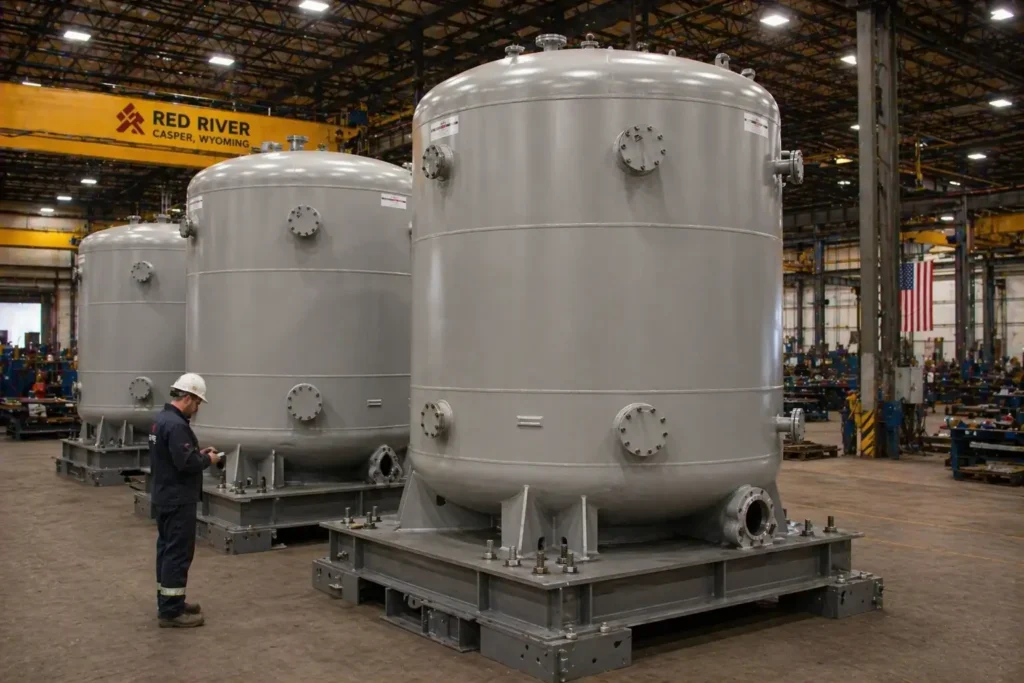
Seismic rated storage tanks are required in any seismically active region where local codes mandate earthquake design. This guide covers what seismic rating means, which codes apply, how requirements change the fabrication scope, and what to ask a fabricator before issuing a purchase order.
What Seismic Rating Means for a Storage Tank
Seismic rating is not a sticker on the side of a vessel. It is a design classification that defines how a tank is engineered to respond to earthquake-induced forces without losing structural integrity, leaking its contents, or failing its anchorage to the foundation.
A seismically rated storage tank is designed to resist lateral loads from ground motion and vertical forces that can alter the effective weight of the vessel and contents during a seismic event. Fluid inside the tank shifts and sloshes during an earthquake, applying forces to the shell and anchorage that static design alone does not capture. A vessel with a correctly designed shell but an undersized anchor bolt system will still fail in a seismic event.
Every one of those elements has to be right. Red River incorporates seismic design requirements from the first engineering conversation on every pressure vessel and modular skid project in seismically active regions.
The Codes That Govern Seismic Rated Storage Tanks
Seismic Rated Storage Tanks: ASCE 7 Requirements
ASCE 7 defines seismic design categories, site class classifications, and the spectral acceleration values used to calculate design forces. Most local building codes adopt ASCE 7 requirements by reference. For storage tanks and vessels, ASCE 7 defines the importance factor and seismic design category that drive the level of design rigor required. Vessels containing hazardous materials and those above certain size thresholds are typically assigned higher importance factors, which increase the design loads.
ASME Section VIII and Seismic Loading
The ASME Boiler and Pressure Vessel Code Section VIII governs pressure vessel fabrication but does not itself define seismic design loads. Instead, it requires that the vessel design account for all applicable loadings, including wind, seismic, and other site-specific forces. The seismic loads from ASCE 7 or the applicable local code are applied to the ASME vessel design to confirm that the shell, heads, nozzles, and supports can carry the combined loading.
Red River fabricates all pressure vessels under an active ASME U Stamp certification. For seismically rated vessels, the design basis includes the applicable seismic loads and the fabrication quality system ensures the vessel is built to the engineered design.
API 650 for Atmospheric Storage Tanks
For large atmospheric storage tanks, API 650 governs design and fabrication. API 650 Appendix E specifically addresses seismic design for aboveground storage tanks, including the sloshing behavior of stored liquids, freeboard requirements to prevent overtopping, and anchorage design for tanks subject to seismic uplift.
API 650 tanks are common in oil and gas storage applications. The seismic design requirements under Appendix E require fabricators and engineers familiar with liquid sloshing dynamics and seismic anchorage design.
How Seismic Requirements Change the Fabrication Scope
Shell and head thickness: Seismic loading adds to the combined stress state in the vessel shell. For tall vertical vessels with high aspect ratios, the seismic overturning moment can drive shell thickness requirements beyond what operating pressure alone would require. The design calculation must confirm the shell can carry pressure loading and seismic bending simultaneously without exceeding allowable stress.
Nozzle reinforcement and connection design: Nozzles on seismically rated vessels must handle the additional loads imposed by seismic movement, both from the vessel itself and from attached piping that may move independently during a seismic event. Piping flexibility analysis is often required to confirm that forces transmitted to vessel nozzles remain within allowable nozzle load limits.
Anchorage and base plate design: Anchor bolt systems and base plates for seismically rated vessels are engineered components, not standard hardware selections. The anchor bolt size, embedment depth, spacing, and material must be designed to resist the seismic overturning moment and shear forces at the base of the vessel. Base plates must distribute those forces into the foundation without overstressing the concrete or structural steel. Red River’s structural fabrication and prefabrication capabilities cover the full anchorage system, including base plates, anchor chairs, and structural skid frames designed for seismic loading.
Documentation and third-party review: Seismically rated vessels typically require a higher level of design documentation than standard vessels. Depending on the jurisdiction and seismic design category, design calculations may require review and approval by a licensed structural engineer. Red River delivers complete documentation packages for all seismically rated vessel projects, supporting the permitting and inspection process from the start.
Seismic Design Categories and What They Mean
ASCE 7 assigns every structure, including storage tanks and pressure vessels, to a Seismic Design Category (SDC) from A through F. SDC A and B represent low seismic hazard and require minimal seismic design. SDC C introduces more specific design and detailing requirements. SDC D, E, and F represent moderate to high seismic hazard and require the most rigorous design, detailing, and anchorage.
A vessel containing a hazardous substance is typically assigned a higher risk category, which can push a project into a higher SDC even at a site with moderate seismic hazard. Knowing your project’s SDC before the fabrication scope is finalized determines which code provisions apply, what anchorage design is required, and what documentation the permitting authority will require.
What to Ask a Fabricator About Seismic Capability
Not all ASME-certified fabricators have seismic design experience. Before committing to a vendor, ask these questions.
Can they produce a seismic design basis document? A fabricator with seismic experience should be able to articulate what inputs are needed, which code applies, and how seismic loads are incorporated into the vessel design calculation.
Do they have experience with anchorage design? Anchor bolt systems and base plates for seismically rated vessels are engineered components. Ask whether anchorage design is in-scope or left to the client’s civil or structural engineer after fabrication.
Have they fabricated vessels for high-seismic regions before? California, Alaska, and the Pacific Northwest all have significant seismic hazards. Experience in those markets means familiarity with local code overlays and permitting processes.
Can they support third-party structural review? Many jurisdictions require seismic design calculations to be stamped by a licensed structural engineer. A fabricator who coordinates that review as part of the project scope reduces the coordination burden on the client.
Industries Where Seismic Rated Storage Tanks Are Commonly Required
Oil and gas: Operations in California, Alaska, and other seismically active producing regions routinely specify seismic rated storage tanks for produced water, crude storage, and process vessels. Red River’s oil and gas fabrication work includes vessels designed to seismic requirements for clients operating in high-hazard regions.
Power generation: Facilities classified as essential under IBC risk category IV face the most stringent seismic requirements. A vessel that fails in a seismic event can compromise post-earthquake emergency response infrastructure.
Biogas and renewable energy: Facilities in seismically active regions require seismic design for storage and process vessels. Red River’s biogas vessel fabrication capability includes design coordination for seismically rated vessels serving anaerobic digestion and biogas upgrading applications.
Chemical and industrial process: Facilities with vessels containing hazardous materials face both seismic code requirements and consequence-based design criteria that drive anchorage and containment design beyond the base code minimum.
Get Your Seismic Rated Tank Fabricated to Code
Seismic rating has to be built into a project from the first engineering conversation, not added after fabrication. Red River has fabricated vessels for clients in seismically active regions across the United States, incorporating applicable code requirements from the start. Whether the project involves a single custom pressure vessel or a full modular skid package, the team is ready to discuss seismic design requirements before fabrication begins.
Ready to Discuss Your Seismic Rated Storage Tank Project?
Request a quote or call 1-307-257-5332 to discuss your project’s seismic design category, site conditions, and fabrication requirements with Red River’s team.
Frequently Asked Questions
1. What is the difference between a seismic rated tank and a standard ASME vessel?
A standard ASME pressure vessel is designed to resist internal pressure and other static loads. A seismically rated vessel adds lateral and vertical earthquake loads to the design basis, which affects shell thickness, nozzle reinforcement, support design, and anchorage. The ASME fabrication quality system applies to both. The seismic rating defines what loads the vessel must resist in addition to its operating pressure.
2. How is the seismic design category determined for a storage tank project?
The seismic design category is determined by the site’s mapped seismic hazard and the risk category of the vessel. ASCE 7 provides the methodology for combining these inputs into a category from A through F. A geotechnical report establishing the site class is typically required as part of this determination.
3. Does every storage tank in a seismic zone need to be seismically rated?
Not always. Low-risk vessels at sites with low seismic hazard may fall into SDC A or B, which require minimal seismic design. High-risk vessels or those at high-hazard sites fall into SDC D, E, or F, which require full seismic design and anchorage. The applicable local building code and permitting authority determine the requirement for a specific installation.
4. Can an existing tank be retrofitted to meet seismic requirements?
Yes, in some cases. Retrofitting typically involves upgrading the anchorage system, adding anchor bolts or anchor chairs, and in some cases stiffening the shell or adding seismic restraints. The scope of a retrofit depends on the current vessel condition, the applicable code requirements, and the gap between the existing anchorage design and what the seismic loads require. Red River holds the NBBI R Stamp certification for repair and alteration work, which covers seismic retrofit modifications to existing coded vessels.
5. What documentation is required for a seismically rated storage tank?
At a minimum, the documentation package should include the seismic design basis statement, ASCE 7 site class and seismic design category determination, design calculations showing the vessel and anchorage under combined operating and seismic loads, the ASME Manufacturer’s Data Report (Form U-1), and any third-party structural engineer review records required by the permitting authority.
Key Takeaways
- Seismic rating is a design classification that defines how a storage tank resists earthquake-induced lateral and vertical forces. It affects shell design, nozzle reinforcement, anchorage, and documentation requirements.
- ASCE 7, ASME Section VIII, API 650 Appendix E, and local building codes all play a role in seismic tank design depending on vessel type, contents, and jurisdiction.
- Seismic Design Category (SDC) determines the level of design rigor required. Vessels containing hazardous materials are typically assigned higher risk categories, which can increase the SDC even at moderate seismic hazard sites.
- Anchorage design, including anchor bolt sizing, embedment, and base plate design, is an engineered scope, not a standard hardware selection. It must be included in the fabrication scope for seismically rated vessels.
- Documentation for seismically rated vessels includes the seismic design basis, load calculations, anchorage design, and any third-party structural review records required by the permitting authority.
- Not all ASME-certified fabricators have seismic design experience. Ask specifically about seismic design basis capability, anchorage design scope, and experience in high-seismic jurisdictions before committing to a vendor.
Related Blog Post
Can Condensate Storage Improve Reliability?
Where Do Condensate Tanks Fit in a Steam System?
Which Nozzles Simplify Maintenance on Pressure Vessels?
How to Vent Condensate Tanks in Steam Systems
How Do Baffle Layouts Affect Stratification in TES Tanks?
About Author