
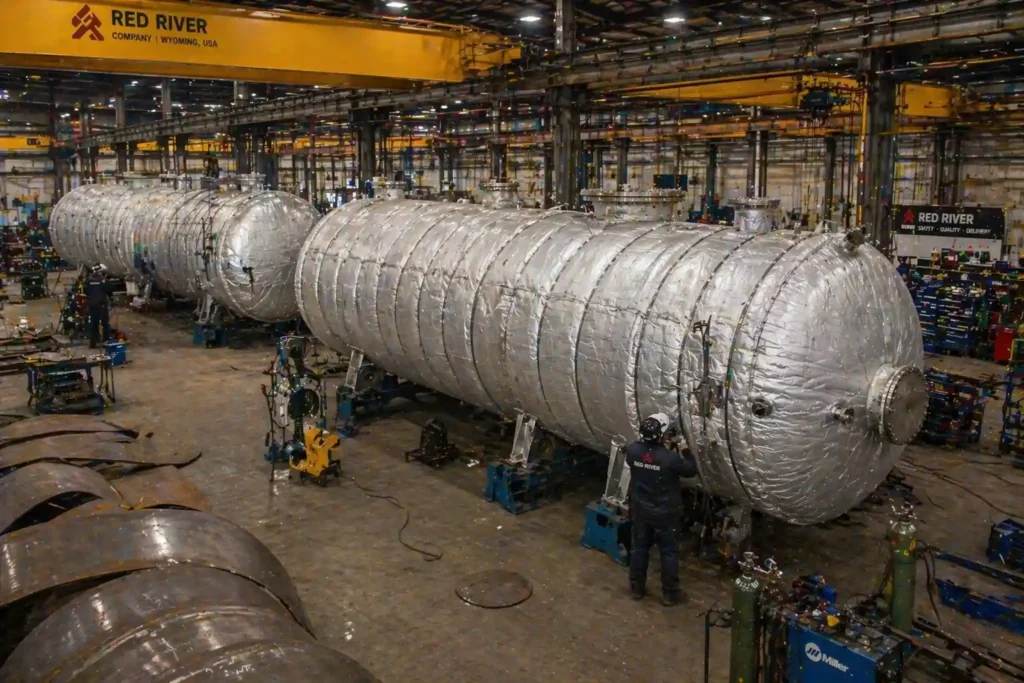
Poorly specified industrial tank insulation systems create safety risks, compliance gaps, and long-term corrosion problems that do not show up until serious damage is done. This guide is for procurement managers and project engineers specifying industrial tank insulation, covering material selection, system components, and what to confirm before fabrication begins.
Why Industrial Tank Insulation Is Treated as an Afterthought
Insulation is frequently specified late and installed after the vessel is already in place. By that point, nozzle projections, support configurations, and coating systems are locked in none designed with insulation in mind. That creates clearance problems, compromised vapor barriers, and support details that cause the exact corrosion the insulation was supposed to prevent.
An undersized system loses heat continuously. A system that traps moisture accelerates corrosion under insulation (CUI), one of the most costly maintenance problems in the process industries. A system that ignores thermal cycling fails earlier than expected.
Red River’s pressure vessel fabrication process incorporates insulation planning from the design phase. Clients who bring insulation requirements into the early project conversation get vessels built to support the insulation system rather than fight it.
The Primary Functions of an Industrial Tank Insulation System
Not all industrial tank insulation systems serve the same purpose. Getting the primary function wrong leads to mismatched materials, incorrect thickness, and systems that underperform from day one.
Process temperature maintenance
The most common application in industrial tank work. For heated fluids, the goal is limiting heat loss to reduce energy consumption and maintain viscosity or reactivity. For chilled or cryogenic fluids, the goal shifts to limiting heat ingress to prevent product degradation, boil-off, or pressure buildup.
Personnel protection
Required on any vessel surface above approximately 60 degrees Celsius. In many jurisdictions, personnel protection insulation is a regulatory requirement regardless of whether the process itself requires thermal control.
Freeze protection
A real operational requirement across Wyoming and the Rocky Mountain region. Tanks containing aqueous fluids or process chemicals with elevated freeze points can freeze during cold weather shutdowns or low-flow periods. Insulation combined with heat tracing keeps fluid temperature above the freeze threshold.
Condensation and corrosion control
Applies to vessels operating below ambient dew point. Proper insulation prevents condensation from forming on the exterior, which accelerates corrosion and creates slip hazards from dripping or pooling water in some environments.
Types of Industrial Tank Insulation Materials
Material selection is the technical core of industrial tank insulation systems design. Each material class has distinct thermal performance, moisture resistance, mechanical strength, temperature limits, and compatibility with vessel coatings.
Mineral wool (rockwool and fiberglass)
The most widely used material in industrial tank applications. Handles continuous service temperatures up to approximately 650 degrees Celsius, making it suitable for most hot service applications in oil and gas, power generation, and chemical processing. Moisture sensitivity is its primary limitation. Wet mineral wool accelerates CUI significantly, so correct vapor barrier and cladding installation are non-negotiable on outdoor applications. Red River’s fabrication capabilities include detailed coordination between vessel coating and insulation material selection to manage this risk from the start.
Cellular glass
A rigid, closed-cell material with outstanding moisture resistance. Does not absorb water, does not support microbial growth, and does not contribute to CUI when installed correctly. Preferred for cold service applications, cryogenic tanks, and any application where CUI risk is the primary concern. More expensive and more brittle than mineral wool, and not suited for applications above approximately 480 degrees Celsius.
Calcium silicate
Offers high compressive strength and good performance up to approximately 650 degrees Celsius. Commonly used on high-temperature piping and vessels where the insulation must support mechanical loads. Calcium silicate is hydrophilic and can hold water against vessel surfaces if not correctly installed. Being replaced by alternative materials in new construction for this reason.
Aerogel blanket
Delivers significantly higher thermal resistance per unit thickness than conventional materials. Where space constraints limit insulation thickness, aerogel achieves the required performance in a thinner profile. Used in offshore applications, subsea equipment, and congested piping arrangements where conventional thicknesses are not practical. The cost premium is significant, so aerogel is typically applied selectively rather than as a standard system specification.
Polyurethane and polyisocyanurate foam
Used primarily in cold service and cryogenic applications. Spray-applied polyurethane foam handles complex geometries including heads, nozzles, and transitions that are difficult to insulate with rigid materials. Both materials are limited in temperature range, which restricts their use to cold and ambient service.
How to Select the Right Industrial Tank Insulation System for Your Application
Six variables drive material selection. Working through each one systematically produces a defensible specification rather than a default choice.
Operating temperature range
The first filter in any insulation selection. The material must be rated for continuous service at maximum process temperature, with margin for upset conditions.
Ambient environment
Drives vapor barrier and cladding requirements. Rocky Mountain sites present specific challenges: wide temperature swings, UV exposure, wind-driven precipitation, and freeze-thaw cycling all affect system service life in ways that indoor installations do not face.
CUI risk profile
Critical for vessels operating in the 60 to 150 degree Celsius range, which is the most active CUI temperature window. Applications in this range require careful material selection, coating specification, and cladding detail design to manage moisture ingress.
Insulation thickness
A calculation, not a rule of thumb. Determined from the required heat flux limit, the material’s thermal conductivity, and the temperature differential between process fluid and ambient environment. Undersized insulation misses its performance target. Oversized insulation adds weight and cost without proportional benefit.
Mechanical and access requirements
Determine whether rigid or flexible insulation is appropriate, and whether removable blankets are needed at inspection or maintenance points.
Regulatory and code requirements
Must be confirmed before specifying materials. API 583 addresses CUI on process vessels specifically. Project specifications may also reference ASTM International material standards for insulation products and cladding systems. Confirming applicable requirements before design begins prevents compliance gaps that are costly to fix after installation.
Insulation System Components Beyond the Insulation Material
A complete set of industrial tank insulation systems components extends beyond the insulation layer itself.
Vessel coating and surface preparation
Where the system starts. Coatings under insulation must resist wet, warm conditions and be compatible with the insulation material. Surface preparation quality determines coating adhesion and therefore CUI protection performance.
Vapor barrier
The most critical component on cold service vessels. A continuous, correctly detailed vapor barrier prevents ambient moisture from migrating through the insulation to the cold vessel surface. Vapor barrier failures at nozzles, supports, and termination points are the leading cause of CUI on cold service equipment.
Insulation jacketing and cladding
Aluminum or stainless steel jacketing protects insulation from physical damage, weather exposure, and UV degradation. Cladding joint overlap, sealant specification, and drainage provisions all affect weather resistance and service life.
Support rings and standoffs
Prevent insulation on vertical vessels from compressing under its own weight and prevent thermal bridging between the insulated vessel and the support structure. Frequently overlooked and a common source of localized CUI and energy loss.
Red River’s prefabrication services support insulation system planning by completing as much insulation-related detailing as possible in the shop, where every component can be inspected before field exposure.
Maintenance, Inspection, and Service Life
Industrial tank insulation systems are not install-and-forget assets. They require periodic inspection and maintenance to hold performance and manage CUI risk over the vessel’s service life.
Visual inspection of cladding condition, sealant integrity, and support ring condition should be conducted annually on outdoor installations. Infrared thermography can identify areas of degradation or moisture ingress without removing cladding. Direct inspection of insulation and vessel coating condition should follow a risk-based schedule informed by operating temperature range, service history, and CUI risk profile.
The National Board of Boiler and Pressure Vessel Inspectors provides guidance on in-service inspection requirements for pressure vessels that informs planning for insulated vessels. Insulation removal and replacement should be budgeted as a planned maintenance activity, not treated as an emergency response to visible damage.
Red River’s modular skid packages are designed with maintenance access provisions built in so insulation inspection and replacement can be performed without major disruption to surrounding systems.
Ready to Specify the Right Industrial Tank Insulation System for Your Project?
If you are specifying industrial tank insulation systems for a new vessel or retrofitting an existing one, Red River works through insulation requirements as part of the vessel design conversation before fabrication begins. That means confirming nozzle projections, support configurations, coating system compatibility, vapor barrier details, and cladding provisions are all built into the fabrication scope from the start rather than addressed as field modifications after the vessel is complete.
Getting insulation planning into the design phase is the single most effective way to avoid CUI problems, clearance conflicts, and compliance gaps that are expensive to fix after the vessel is built.
Request a quote or call 1-307-257-5332 to discuss your project with Red River’s fabrication team.
Frequently Asked Questions
1. What is corrosion under insulation and why is it a concern on industrial tanks?
Corrosion under insulation (CUI) occurs when moisture penetrates an insulation system and accumulates against the vessel surface, accelerating wall corrosion. CUI is most aggressive in the 60 to 150 degree Celsius range because the vessel surface is warm but not hot enough to dry out quickly. Damage is often invisible until cladding is removed for inspection, by which point significant wall thinning may have occurred.
2. How is insulation thickness determined for a pressure vessel?
Insulation thickness is calculated from three inputs: the required heat flux limit, the thermal conductivity of the selected material, and the temperature differential between process fluid and ambient environment. A fabricator or insulation engineer should run this calculation for each vessel rather than applying a standard thickness.
3. What is the difference between hot service and cold service insulation systems?
Hot service systems limit heat loss from vessels above ambient temperature. Design concerns include thermal performance, material stability, and CUI management in the 60 to 150 degree Celsius range. Cold service systems limit heat ingress to vessels below ambient temperature. Primary concerns are vapor barrier continuity, material performance at low temperatures, and cryogenic fluid compatibility.
4. Can insulation be added to a vessel that is already in service?
Yes, but retrofitting is more difficult and expensive than designing for insulation from the start. Working around existing nozzles, platforms, and supports creates real complications. In some cases, nozzle extensions or support modifications are required before insulation can be installed correctly.
5. What standards govern industrial tank insulation systems?
Key references include API 583 for CUI management, ASTM material standards for insulation products and cladding systems, and OSHA requirements for personnel protection insulation. Confirming applicable standards before beginning design prevents compliance gaps that are costly to correct after installation.
Key Takeaways
- Insulation system selection must happen during the vessel design phase, not after fabrication is complete. Nozzle projections, support configurations, and coating systems are all affected by insulation requirements.
- The primary function of the insulation system (process temperature maintenance, personnel protection, freeze protection, or CUI control) drives material selection before any other variable is considered.
- CUI is the most costly long-term consequence of incorrect insulation specification or installation. Vessels in the 60 to 150 degree Celsius range carry the highest risk.
- Mineral wool is the most widely used material for hot service. Cellular glass is preferred for cold service and CUI-sensitive applications. Aerogel delivers maximum performance per unit thickness where space is constrained.
- A complete insulation system includes vessel coating, vapor barrier, insulation material, support rings and standoffs, and exterior cladding. Each component contributes to system performance and service life.
Related Blog Post
Can Condensate Storage Improve Reliability?
Where Do Condensate Tanks Fit in a Steam System?
Which Nozzles Simplify Maintenance on Pressure Vessels?
How to Vent Condensate Tanks in Steam Systems
How Do Baffle Layouts Affect Stratification in TES Tanks?
About Author



