
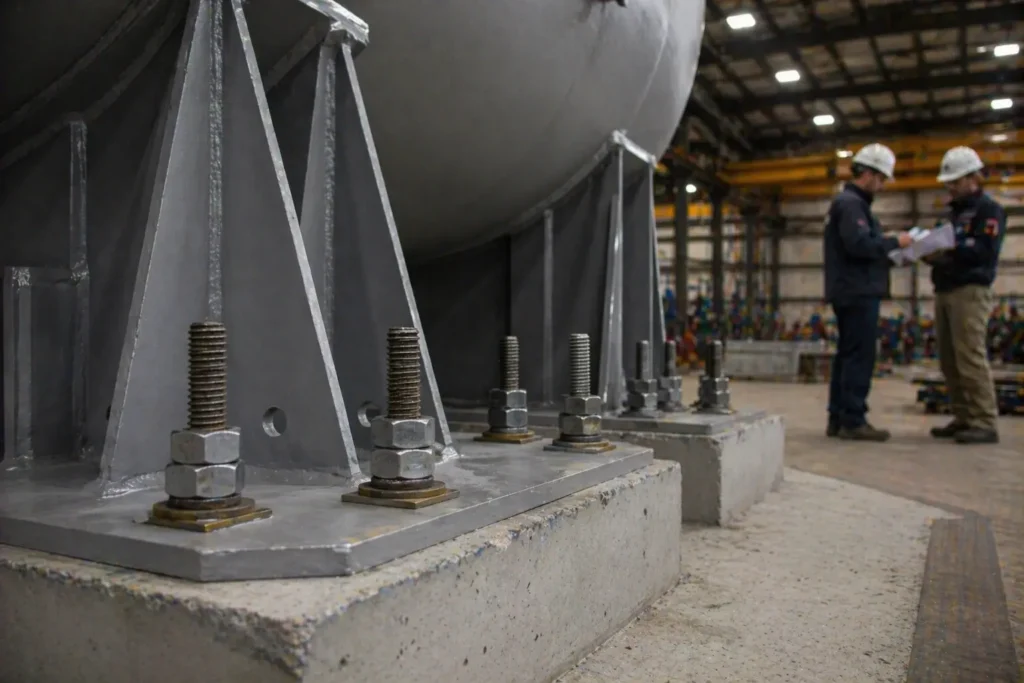
Anchorage details are one of the most commonly flagged items during pressure vessel and storage tank installation reviews. This guide covers what inspectors look for, what causes submittals to get rejected, and how to structure anchorage documentation that passes the first time.
Why Anchorage Review Is a Separate Discipline from Vessel Fabrication
Vessel fabrication and anchorage design are governed by different codes and carried out by different disciplines, but they have to work together precisely. The fabricator is responsible for vessel geometry, nozzle loads, and support configuration. The structural engineer of record handles the anchorage design. The inspector checks that both are correct and compatible.
Where anchorage submittals fail is usually at the intersection of these two scopes: vessel loads based on an earlier revision, bolt patterns that do not match what was embedded, or base plate thickness that does not match the fabricated support detail. Red River coordinates vessel load data and support geometry on every pressure vessel project to prevent these conflicts from surfacing during installation review.
The Anchorage Details That Reviewers Check First
Anchor bolt size, grade, and embedment depth: The anchor bolt specification is the first thing a reviewer will check against the structural calculation. Bolt diameter, grade (typically ASTM F1554 Grade 36, 55, or 105 for industrial applications), and embedment depth all need to match the calculation exactly. An anchor bolt that is the right diameter but the wrong grade, or the correct grade but insufficient embedment depth, fails review regardless of how well everything else is documented.
Embedment depth is particularly important for vessels subject to uplift, seismic loading, or wind overturning. Shallow embedment adequate for gravity loads may not satisfy combined load cases. The calculation must show sufficiency for the governing load combination.
Base plate dimensions and thickness: The base plate connects the vessel support leg or skirt to the anchor bolt pattern and transfers load into the foundation. Reviewers check that base plate dimensions match the bolt pattern, that plate thickness is consistent with the bending calculation, and that the weld between the base plate and support leg or skirt is specified and detailed correctly.
A common rejection point is a base plate detail sized for concentric load only when the actual load case includes a significant moment. If the calculation does not address moment at the base plate, the detail will not pass.
Load data completeness and load combinations: The structural calculation must include all applicable loads: operating weight, empty weight, test weight, wind load, seismic load, and any dynamic or thermal loads specific to the application. Reviewers check that the governing load combination has been identified and that the anchorage is designed for it.
A submittal that provides operating weight only, without addressing wind or seismic, will be returned for revision in almost every jurisdiction. ASCE 7 defines the applicable load combinations for pressure vessel anchorage. Compliance is a baseline expectation, not an optional enhancement.
Concrete foundation capacity: The anchorage calculation must demonstrate that concrete breakout capacity, side-face blowout capacity, and pullout capacity all exceed the design demand with the required factor of safety. ACI 318 Chapter 17 is the governing standard for anchor design in concrete. A calculation that sizes the anchor bolt correctly but omits concrete breakout is incomplete and will not pass review.
Documentation That Reviewers Expect in the Submittal Package
A complete anchorage submittal includes the following. Missing any of these is the fastest way to get a review rejection.
Anchorage plan and detail drawings: Bolt pattern, bolt size and grade, base plate dimensions and thickness, weld callouts, and foundation interface dimensions. Must be dimensioned and to scale.
Structural calculations: All applicable load cases, governing load combination, anchor bolt demand and capacity, base plate bending, weld capacity, and concrete breakout and pullout capacity. Must be stamped by a licensed structural engineer in the installation jurisdiction.
Vessel load data from the fabricator: Operating weight, empty weight, test weight, center of gravity, and nozzle loads. Must match the current vessel drawing revision, not a preliminary estimate.
Material certifications for anchor bolts: ASTM F1554 bolts require mill certifications confirming grade and mechanical properties. Generic threaded rod does not meet industrial anchorage requirements regardless of diameter.
Red River provides complete vessel load data packages as part of standard fabrication documentation. Red River’s prefabrication and modular skid packages are coordinated under the same system, keeping support geometry and load data consistent across all fabricated components.
The Most Common Reasons Anchorage Details Fail Review
Load data from a preliminary vessel design: Vessel loads provided to the structural engineer were from an earlier revision that was subsequently updated. The anchorage design then does not reflect the actual vessel being installed.
Anchor bolt pattern laid out before vessel geometry was finalized: Creates a mismatch between embedded bolts and the base plate requiring foundation coring or support redesign.
Gravity loads only, no wind or seismic: Omitting wind overturning and seismic load combinations is incomplete in virtually every jurisdiction.
Concrete breakout calculation omitted: Sized the bolt correctly but did not address the concrete failure mode. Reviewers flag this consistently.
Out-of-state engineer stamp: Engineering seals are state-specific. A stamp from a different state than the installation jurisdiction is a rejection point that is entirely avoidable with early planning.
Each of these is avoidable with proper coordination from the start of detailed design. Red River’s fabrication capabilities include full load data coordination to support a clean anchorage review from the first submittal.
Start Anchorage Coordination Before the Foundation Is Poured
Anchorage details that pass review on the first submittal come from complete vessel load data delivered early, structural engineering that addresses all applicable load cases, and a drawing package that matches what is actually being built. Red River coordinates load data and support geometry for every pressure vessel and skid fabrication project so the structural engineer has what they need before the foundation is poured.
Ready to Make Sure Your Anchorage Details Pass Review?
Request a quote or call 1-307-257-5332 to discuss your project’s anchorage coordination requirements with Red River’s fabrication team.
Frequently Asked Questions
1. What ASTM standard applies to anchor bolts for pressure vessel installations?
ASTM F1554 is the primary standard for anchor bolts in pressure vessel and storage tank anchorage, covering Grade 36, Grade 55, and Grade 105. The grade required depends on the bolt demand from the structural calculation. Mill certifications confirming grade and mechanical properties are required as part of the submittal package.
2. Does the structural engineer of record need to be licensed in the state where the vessel is installed?
Yes in most jurisdictions. Engineering seals are state-specific, and most building departments and inspection authorities require the stamp of an engineer licensed in the state where the work is being performed. Using an out-of-state stamp is one of the more common and easily avoided rejection points in anchorage submittals.
3. What is a concrete breakout and why does it matter for anchorage review?
Concrete breakout occurs when an anchor bolt pulls a cone of concrete out of the foundation rather than the bolt yielding. Governed by ACI 318 Chapter 17, it must be checked for tension, shear, and combined loading. Reviewers flag missing concrete breakout calculations consistently because it controls anchorage design in many practical cases, particularly for vessels with significant uplift or overturning loads.
4. How does seismic zone affect anchorage requirements?
Higher seismic design categories impose more stringent requirements including ductility requirements for anchor bolts, minimum embedment depths, and special inspection during anchor installation. Projects in moderate to high seismic zones need anchorage calculations that explicitly address seismic load combinations, not just gravity and wind.
5. What vessel load data does Red River provide to support anchorage design?
Red River provides operating weight, empty weight, hydrostatic test weight, center of gravity location, and nozzle loads as part of the standard vessel documentation package, formatted to give the structural engineer what they need without additional requests. Red River coordinates directly with the structural engineer to confirm load data matches the current vessel revision before the anchorage design is finalized.
Key Takeaways
- Anchorage review checks anchor bolt size, grade, and embedment; base plate dimensions and thickness; load data completeness; load combinations; and concrete breakout capacity. All must be addressed or the submittal will be returned.
- The governing load combination, not just operating weight, must drive the anchorage design. Wind, seismic, and uplift loads are baseline expectations in most jurisdictions.
- Vessel load data provided to the structural engineer must match the current revision of the vessel drawing. Preliminary estimates that were never updated are a common and avoidable rejection cause.
- Concrete breakout and pullout capacity per ACI 318 must be addressed in the calculation. Sizing the bolt correctly without addressing the concrete is an incomplete submittal.
- Structural calculations must be stamped by a licensed engineer in the installation jurisdiction. Out-of-state stamps are a frequent rejection point.
- Early coordination between the fabricator and the structural engineer of record eliminates the mismatches between vessel geometry and anchor bolt layout that cause the most costly rejections.
Related Blog Post
Can Condensate Storage Improve Reliability?
Where Do Condensate Tanks Fit in a Steam System?
Which Nozzles Simplify Maintenance on Pressure Vessels?
How to Vent Condensate Tanks in Steam Systems
How Do Baffle Layouts Affect Stratification in TES Tanks?
About Author



