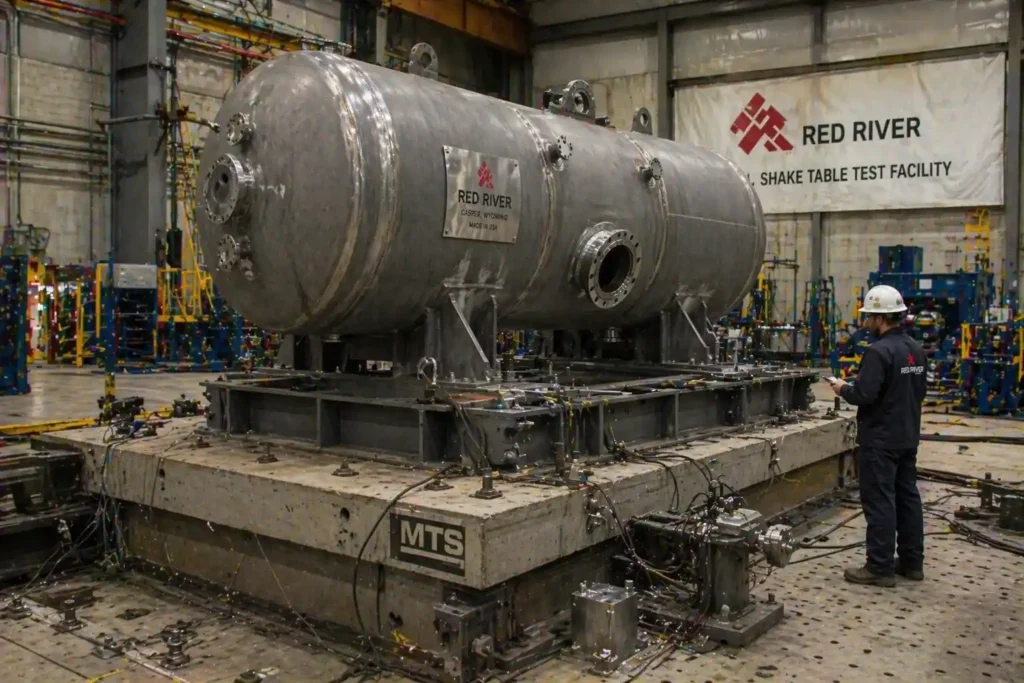
Shake table tests are required when applicable standards, regulatory authorities, or project specifications demand physical seismic qualification rather than analysis alone. This guide covers which standards drive those requirements and what they mean for equipment design and fabrication.
What Shake Table Testing Actually Is
A shake table test subjects a piece of equipment to simulated seismic motion to demonstrate it can survive and remain functional through a defined ground motion event. The equipment is mounted on a platform that replicates the acceleration, frequency, and duration characteristics of a target earthquake, and its structural and functional response is measured and recorded throughout.
The result is a qualification record: documented evidence that the equipment performed within acceptable limits under the specified seismic input. That record becomes part of the equipment’s permanent documentation and is used to demonstrate code compliance to regulators, plant owners, and inspectors over the equipment’s service life.
Shake table testing is one of several seismic qualification methods. Analysis-based qualification is more common for standard industrial equipment. Shake table testing is specifically required when analysis alone is not sufficient to demonstrate qualification, or when the applicable standard, project specification, or regulatory authority explicitly requires it. Red River incorporates seismic qualification requirements into the design review process for every pressure vessel and modular skid project where they apply.
The Standards That Drive Shake Table Test Requirements
When Are Shake Table Tests Required: IEEE 344 and Nuclear Applications
IEEE 344 is the primary standard governing seismic qualification of equipment for nuclear power plants. It applies to safety-related electrical and mechanical equipment that must remain functional following a seismic event. IEEE 344 explicitly recognizes shake table testing as one of the acceptable qualification methods and is often the standard that drives physical testing requirements rather than analysis alone.
For equipment installed in nuclear facilities or supplied to nuclear-adjacent projects, IEEE 344 compliance is frequently a contractual requirement. Shake table testing may be the only acceptable qualification method for certain equipment categories.
ASCE 7 and Building Code Requirements
ASCE 7 governs seismic design loads for structures and nonstructural components in the United States and is adopted by reference in the International Building Code and most state building codes. Under ASCE 7, nonstructural components in Seismic Design Categories D, E, and F, which correspond to high seismic hazard zones, are subject to equipment seismic qualification requirements.
For most standard industrial equipment in these categories, analysis-based qualification is acceptable. Shake table testing becomes a requirement when the equipment is complex, when its dynamic behavior cannot be reliably modeled analytically, or when the specifying authority requires physical test evidence rather than calculated results.
ASME Standards and Pressure Vessel Applications
The ASME Boiler and Pressure Vessel Code addresses seismic design in several sections, particularly for equipment in nuclear applications under Section III. For pressure vessels in non-nuclear industrial applications, seismic loads are typically addressed through ASCE 7-based equivalent static force analysis applied in accordance with the applicable ASME design section.
Shake table testing of pressure vessels arises in projects where the vessel is part of a larger assembly that must be qualified as a unit, or where the project specification explicitly requires physical seismic qualification. Red River’s ASME-certified pressure vessel fabrication is built around full documentation compliance, which includes accommodating seismic qualification requirements when they are part of the project scope.
When Shake Table Tests Are Specifically Required
Nuclear safety-related equipment: Under IEEE 344 or 10 CFR 50 Appendix B requirements, physical testing is frequently required or preferred by the plant owner or regulator, particularly for first-of-a-kind designs or equipment without an established qualification basis.
High seismic hazard installations: Where the project specification or authority having jurisdiction requires physical test evidence. More common in California, the Pacific Northwest, Alaska, and other high seismic activity regions where regulators have established physical test requirements for critical equipment.
Complex or irregular equipment assemblies: Where finite element analysis or hand calculations cannot reliably predict dynamic behavior. When equipment geometry, mass distribution, or internal component interaction creates analytical uncertainty, shake table testing resolves what analysis cannot.
Equipment without a relevant qualification basis: If the equipment is a new design, a novel configuration, or a modification of an existing qualified design that changes its dynamic characteristics, a new shake table test may be required to establish the qualification basis.
Skid-mounted systems and modular packages: Where multiple components must be qualified together as an assembled unit. Individual component qualification by analysis may not be sufficient to demonstrate that the assembled skid performs acceptably. Red River’s modular skid fabrication process accounts for these requirements during the design phase so seismic qualification needs are identified before the skid is built.
What Shake Table Testing Means for Fabrication and Design
When shake table testing is part of the project scope, it changes how equipment is designed, fabricated, and documented. Nozzle reinforcement, support structure geometry, internal component mounting, and connection details all need to be reviewed with the seismic input in mind. A fabricator not involved in those design conversations until after drawings are approved creates risk that shows up during testing.
The test itself also has to be planned early. Shake table facilities have their own scheduling constraints and lead times. Test fixtures must be designed and fabricated. The test specification, which defines the required input motion, must be developed and agreed before testing begins. All of this takes time that has to be built into the project schedule.
Red River’s prefabrication services and fabrication capabilities are structured to support the full qualification record, including third-party test coordination when shake table testing is part of the scope.
Identify Seismic Qualification Requirements During Design, Not After
Seismic qualification requirements must be identified during the design phase, not after fabrication. They affect structural design decisions, connection details, support configurations, and project schedule. Identifying them after fabrication is underway creates expensive and time-consuming redesign. Red River incorporates these requirements into the design review process from the start so the equipment is built right the first time.
Ready to Discuss Seismic Qualification Requirements for Your Project?
Request a quote or call 1-307-257-5332 to discuss your project’s specific seismic qualification requirements with Red River’s fabrication team.
Frequently Asked Questions
1. What is the difference between shake table testing and seismic analysis?
Seismic analysis uses mathematical models to predict how equipment will behave under a defined seismic input. Shake table testing physically subjects the equipment to simulated seismic motion and measures its actual response. Analysis is faster and less expensive. Shake table testing provides physical evidence of performance that some standards, regulators, and project specifications require when analysis alone is not sufficient.
2. Do pressure vessels typically require shake table testing?
Not typically for standard industrial applications. Pressure vessels in non-nuclear industrial service are usually qualified through ASCE 7-based equivalent static force analysis within the ASME design framework. Shake table testing arises most commonly in nuclear applications, in projects where the vessel is part of a larger assembly requiring unit qualification, or where the project specification explicitly requires physical test evidence.
3. How early in a project should seismic qualification requirements be identified?
As early as possible, and no later than the start of the detailed design phase. Seismic qualification requirements affect structural design decisions, connection details, support configurations, and project schedule. Identifying them after fabrication is underway creates expensive redesign. Identifying them during conceptual design gives the project team the full range of options for addressing them efficiently.
4. Can existing equipment be retroactively qualified by shake table testing?
Yes, in principle. If an existing piece of equipment needs to be demonstrated as seismically qualified for a new application or regulatory review, shake table testing of the as-built configuration is one available method, provided the equipment can be safely tested and the test input matches the required qualification basis. The practicality depends on equipment size, available test facility capacity, and cost relative to alternatives.
5. Does Red River fabricate equipment to seismic specifications?
Yes. Red River fabricates pressure vessels, modular skid packages, and custom industrial equipment to project-specific seismic design requirements. When seismic qualification is part of the project scope, the team incorporates those requirements into the design review and documentation process from the start.
Key Takeaways
- Shake table tests are specifically required when applicable standards, regulatory authorities, or project specifications mandate physical seismic qualification rather than analysis alone.
- IEEE 344 governs seismic qualification for nuclear safety-related equipment and frequently requires shake table testing as the primary or preferred qualification method.
- ASCE 7 sets seismic design requirements for nonstructural components in high seismic hazard zones. Physical testing is required when analytical qualification is not sufficient or not accepted.
- Complex assemblies, novel designs, and skid-mounted systems where individual component qualification does not address assembled system behavior are common triggers for shake table testing.
- Shake table testing requirements must be identified during the design phase, not after fabrication, because they affect structural design, connection details, and project schedule.
- A fabricator who understands seismic qualification requirements from the start is a project risk reducer. One who learns about them at delivery is a problem.
Related Blog Post
Can Condensate Storage Improve Reliability?
Where Do Condensate Tanks Fit in a Steam System?
Which Nozzles Simplify Maintenance on Pressure Vessels?
How to Vent Condensate Tanks in Steam Systems
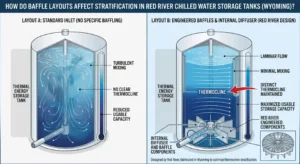
How Do Baffle Layouts Affect Stratification in TES Tanks?
About Author