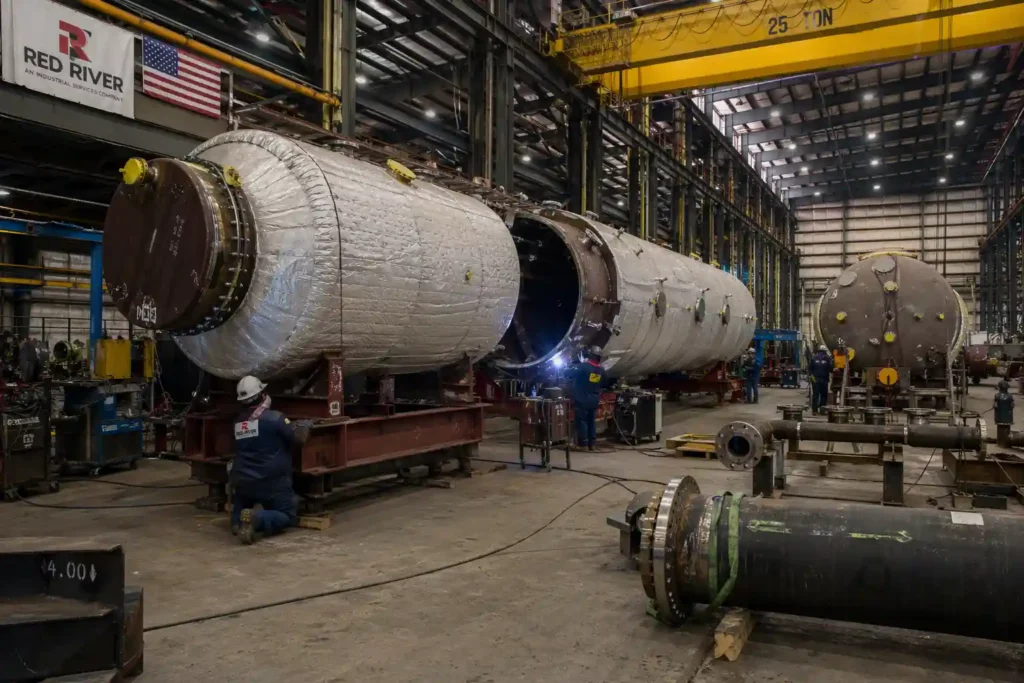
Thermal energy storage solutions cut peak demand costs by decoupling energy production from consumption. This guide is for procurement managers and engineers specifying TES vessels for power generation, data center cooling, biogas, or industrial process applications, covering fabrication standards, material selection, and what to confirm before the RFQ goes out.
What Thermal Energy Storage Actually Does
Thermal energy storage captures energy in the form of heat or cold during periods of low demand or low cost, then releases that stored energy when demand peaks or when operational conditions make live generation less practical. The storage medium is typically water, though phase-change materials and molten salts are used in specialized high-temperature applications.
In a chilled water thermal storage system, the plant generates chilled water during off-peak hours, stores it in an insulated tank, and draws from that stored capacity during peak cooling demand. The result is a flatter load profile, reduced peak electrical demand charges, and the ability to right-size chilling equipment for average load rather than peak load. For a detailed breakdown of how this works in practice, see how TES tanks support data center cooling and can TES tanks reduce energy costs.
The vessel that holds the thermal storage medium is the physical core of any thermal energy storage solutions package. Its design, material specification, insulation system, and connection configuration determine how well the system performs over its service life. Getting the fabrication right is not a secondary consideration. It is the foundation the entire system sits on.
Industries That Use Thermal Energy Storage Solutions
Thermal Energy Storage Solutions: Power Generation and Combined Heat and Power
Power plants and combined heat and power (CHP) facilities use thermal storage to buffer fluctuations in thermal output. When electrical demand is low and the prime mover is operating at reduced load, excess thermal energy is captured and stored. When demand spikes, stored thermal capacity supplements live generation without requiring the prime mover to cycle up immediately. This improves equipment efficiency, extends service intervals, and reduces fuel consumption on a per-output basis.
Data Centers and Critical Facilities
Data centers generate consistent, high-density heat loads that must be managed continuously. Chilled water thermal storage allows cooling systems to charge during overnight low-rate electricity periods and discharge during peak rate hours. For facilities with high power density and utility demand charge structures, the financial case for thermal storage is typically straightforward.
The fabrication requirements for data center thermal storage vessels are demanding: large diameter, heavily insulated, and designed for decades of continuous cycling service. For more on chilled water storage in data center applications, see what is a chilled water storage tank and how much volume is needed for chilled water storage.
Bio Gas and Anaerobic Digestion
Anaerobic digestion processes operate best within tight temperature ranges. Thermal energy storage allows digester heating systems to run efficiently even when feedstock variability or ambient conditions create thermal demand spikes. Red River’s pressure vessel fabrication capability extends naturally into thermal storage vessels for digester applications, where corrosion-resistant material selection and tight temperature control are both critical design requirements.
Oil and Gas Processing
Process heating and cooling in upstream and midstream oil and gas operations benefit from thermal storage where process temperature stability reduces chemical treatment costs or improves separation efficiency. Fuel gas conditioning systems, in particular, often incorporate heat exchange and thermal buffer capacity to maintain consistent gas temperatures through variable ambient and load conditions.
Fabrication Standards That Apply to Thermal Storage Vessels
Thermal storage vessels are not exempt from pressure vessel codes simply because their operating pressure is modest. Any vessel operating above 15 PSI internal pressure falls under ASME Section VIII requirements. A fabricator without an active ASME U Stamp certification cannot legally manufacture a pressure-rated thermal storage vessel for commercial or industrial use in most U.S. jurisdictions.
Red River holds an active ASME U Stamp certification and NBBI R Stamp certification covering new vessel construction and repair and alteration work. Every thermal storage vessel is built under third-party authorized inspection, with a complete documentation package including the Manufacturer’s Data Report (ASME Form U-1), certified mill test reports, weld records, NDE reports, and pressure test records.
For atmospheric thermal storage tanks operating below the ASME pressure threshold, fabrication typically follows API 650 or API 12F standards depending on the application. Confirming the applicable standard before design begins is a required step, not an assumption.
Material Selection for Thermal Storage Vessels
Carbon steel
Typically ASTM A516 Grade 70 plate for fabricated vessels and ASTM A106 Grade B for associated piping. The standard material for closed-loop chilled water and hot water thermal storage systems. Cost-effective, widely available, and performs reliably in properly treated closed-loop systems with maintained corrosion inhibitor chemistry. The condition attached to carbon steel in thermal storage service is the chemical treatment program. An open or inadequately treated system will corrode carbon steel from the inside, creating maintenance costs and eventual failure that are far more expensive than a stainless specification would have been.
Stainless steel
Type 304 and 316L stainless steel are specified for thermal storage applications where water chemistry, chloride exposure, or system cleanliness requirements make carbon steel unsuitable. Stainless eliminates the dependence on chemical treatment programs and provides significantly better resistance to external condensation corrosion in chilled water applications. For a detailed breakdown of which grades apply in chilled water service, see which materials suit chilled water service.
Insulation system integration
The insulation system on a thermal storage vessel is as important as the vessel material itself. In chilled water applications, inadequate insulation or a compromised vapor barrier allows condensation to form on the vessel shell, driving external corrosion and thermal losses that degrade system performance over time. Red River designs insulation provisions into the vessel fabrication scope, including insulation support rings, vapor seal weld details, and nozzle extension lengths that accommodate insulation thickness without creating thermal bridges.
Modular and Skid-Mounted Thermal Storage Systems
Many thermal storage applications benefit from a modular delivery approach, where the storage vessel, associated piping, pumps, heat exchangers, and instrumentation are pre-assembled and pre-tested at the fabrication facility before shipping to site.
Modular skid packages for thermal storage systems reduce field installation time, improve quality control by moving assembly into a controlled shop environment, and simplify commissioning by allowing pre-commissioning testing before the unit leaves the facility. For remote sites or projects with tight construction schedules, a pre-tested thermal storage skid arriving ready for utility connections is a meaningful logistical advantage.
Red River fabricates complete thermal energy storage solutions as skid packages, integrating pressure vessel fabrication, pipe fabrication and prefabrication, and structural steel work under one quality system and one project team. Clients who source vessel, piping, and skid structure from separate vendors consistently encounter fit-up problems, documentation gaps, and coordination overhead that a single-source fabricator eliminates.
Phased Thermal Storage: Building Capacity Over Time
For facilities where full thermal storage capacity is not needed immediately, or where capital constraints make full installation impractical near-term, phased capacity is a viable approach that reduces upfront capital expenditure without compromising the long-term system design.
A correctly structured phased approach installs the first storage vessel and sizes the civil infrastructure, piping headers, and utility connections for the full intended system capacity from the start. Later phases add vessels as load grows or capital becomes available, connecting to the already-sized infrastructure with minimal disruption to the operating system. The critical requirement is that Phase 1 civil and piping infrastructure is sized for full system capacity from the start, not just Phase 1 vessel volume.
What to Confirm Before Fabrication Begins
Thermal storage vessel fabrication requires several project-specific inputs to be confirmed before design and fabrication can proceed. The key inputs are: storage medium and its operating temperature range, design pressure and applicable code, system type (closed or open loop), water chemistry data including chloride content and pH, site conditions including available footprint and foundation type, insulation system specification and vapor barrier requirements, and phasing intent if full capacity will not be installed in Phase 1.
Red River’s fabrication capabilities cover thermal energy storage solutions from initial design coordination through vessel delivery and documentation across all project stages. Whether the project is a single vessel or a multi-phase system, the team brings all required inputs into the design conversation at the point where they create the most value.
Ready to Discuss Your Thermal Energy Storage Project?
If you are specifying a thermal energy storage vessel for power generation, data center cooling, biogas, or an industrial process application, Red River’s team works through the fabrication scope before the RFQ goes out. That means confirming the applicable code, reviewing the storage medium and operating conditions, coordinating material selection for the specific water chemistry and temperature range, and identifying insulation system provisions that need to be built into the fabrication scope rather than added as field modifications.
Whether the project is a single atmospheric chilled water tank, a pressurized hot water storage vessel, or a complete modular skid package, bringing Red River into the conversation at the specification stage gives you a vessel designed for the actual application, not a generic configuration adapted after the fact.
Request a quote or call 1-307-257-5332 to discuss your thermal energy storage specifications before the fabrication scope is finalized.
Frequently Asked Questions
1. How does storage shift cooling load?
Chillers run overnight during off-peak hours to generate and store chilled water. During peak demand hours, the facility draws from that stored capacity instead of running chillers at full load. In a fully load-shifted system, chillers can be taken offline entirely during the most expensive rate periods, flattening the facility’s electrical demand curve without reducing cooling output.
2. Which storage medium works best?
Water is the correct choice for the vast majority of chilled water thermal storage applications. It has high specific heat capacity, is non-toxic, widely available, and compatible with standard carbon steel and stainless steel vessel materials. Phase-change materials offer higher energy density in less volume but add system complexity and cost that is only justified when space constraints make a water-based system impractical.
3. When should storage be combined with free cooling?
When ambient temperatures drop below the required chilled water supply temperature, free cooling can charge the storage tank without running mechanical refrigeration. The combination is most valuable in climates with significant day-to-night temperature swings, including Rocky Mountain and high plains locations where overnight temperatures frequently enable free cooling even during summer.
4. Can thermal storage vessels be integrated with existing facility systems?
Yes, and this is one of the most common project scenarios. Adding thermal storage capacity to an existing chilled water, hot water, or process system requires careful attention to connection point design, existing header capacity, pump and controls compatibility, and site access for vessel delivery and installation. Red River incorporates existing system integration requirements into the design review for all thermal storage projects connecting to an operating facility.
5. What documentation does Red River provide with a completed thermal storage vessel?
Every pressure-rated thermal storage vessel leaves Red River with a complete documentation package: the ASME Manufacturer’s Data Report (Form U-1), certified mill test reports for all major material components, weld records documenting welders and procedures used, NDE reports, and pressure test records. Atmospheric tanks are delivered with material certifications and fabrication records appropriate to the applicable standard.
Key Takeaways
- Thermal energy storage solutions decouple energy production from energy consumption, allowing facilities to right-size generation equipment and reduce peak demand costs across power generation, data center, biogas, oil and gas, and commercial applications.
- Pressure-rated thermal storage vessels fall under ASME Section VIII requirements and require an ASME U Stamp-certified fabricator. Atmospheric tanks typically follow API 650 or API 12F standards depending on application.
- Carbon steel is appropriate for closed-loop thermal storage systems with properly maintained chemical treatment programs. Stainless steel is required where water chemistry, chloride exposure, or insulation integrity cannot be guaranteed over the vessel’s service life.
- Modular skid packages consolidate vessel, piping, and structural fabrication under one quality system, reducing field installation time, improving quality control, and simplifying commissioning on thermal storage projects.
- Phased thermal storage capacity reduces upfront capex by deferring vessel fabrication costs to future periods, but only works correctly when Phase 1 civil and piping infrastructure is sized for full system capacity from the start.
Related Blog Post
Can Condensate Storage Improve Reliability?
Where Do Condensate Tanks Fit in a Steam System?
Which Nozzles Simplify Maintenance on Pressure Vessels?
How to Vent Condensate Tanks in Steam Systems
How Do Baffle Layouts Affect Stratification in TES Tanks?
- Equalization Tanks: Design, Sizing, and Fabrication
- What Are Thermal Storage Testing Standards for TES Vessels?
- What Hydro Tests Are Required for Pressure Vessels?
- What Are Thermal Storage Tank Design Parameters?
- What Is Thermal Energy Storage System Manufacturing?
- Thermal Storage Tanks for Industrial Use
About Author