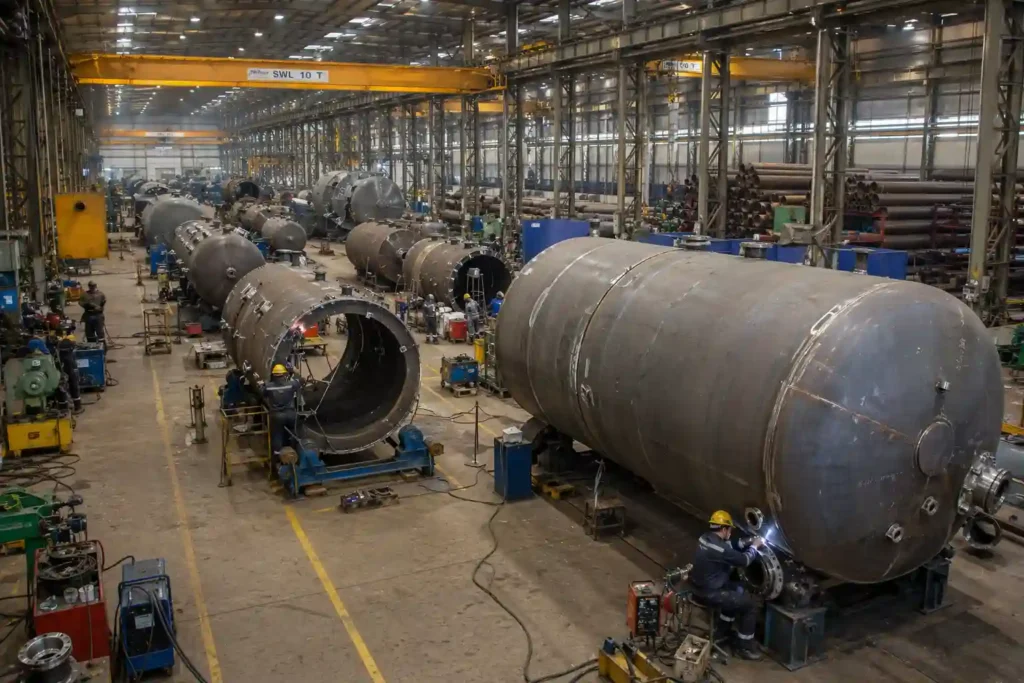
Can phased capacity cut capex on large tank projects? This guide is for project engineers and procurement managers evaluating phased delivery, covering where phasing delivers real savings and what Phase 1 must get right.
What Phased Capacity Actually Means in a Tank Project
Can phased capacity cut capex without building something undersized? Yes, but only if it is structured correctly. Phased capacity is not the same as building something undersized and fixing it later. Done correctly, it means designing the full intended system from the start and installing only the first increment of vessel capacity in Phase 1, with the remaining capacity added in planned future phases as load grows or capital becomes available.
The distinction matters because the civil infrastructure, piping headers, structural supports, and utility connections that support the full system need to be sized and built for the ultimate capacity in Phase 1, even if only one vessel is going in the ground. Designing Phase 1 civil work for Phase 1 capacity only is a false economy. Retrofitting undersized headers, foundations, and structural steel in Phase 2 costs far more than oversizing them the first time.
Red River works through phased capacity planning with clients as part of early project design. Red River’s pressure vessel fabrication and modular skid capabilities are well suited to phased delivery, where vessels are fabricated and delivered in sequence rather than all at once. All phased vessel fabrication follows the ASME Boiler and Pressure Vessel Code, ensuring every phase meets the same certification standard regardless of when it is delivered.
Where Phased Capacity Delivers Real Capex Savings
The savings in a correctly structured phased project come from one place: deferring vessel fabrication and associated fill or process fluid costs to a future budget cycle.
Can phased capacity cut capex through vessel fabrication deferral?
Deferring one or more vessels to Phase 2 or Phase 3 shifts that expenditure to a future period, aligning with revenue generation or financing milestones. Later phases also benefit from engineering and drawing work completed in Phase 1, reducing non-recurring cost per unit.
Process fluid and fill costs: For thermal storage tanks, produced water vessels, and process storage systems, the fluid that fills the tank is a real project cost. Deferring tank installation defers the cost of procuring, treating, and filling that volume. On large systems this is not a trivial number. See can TES tanks reduce energy costs for more on how storage sizing connects to operating cost across the full system lifecycle.
Site exposure hours and field labor: Fewer vessels installed in Phase 1 means less field labor, fewer crane lifts, and fewer on-site exposure hours during the initial construction window. For projects in remote locations or with tight construction schedules, compressing the Phase 1 field scope reduces both cost and schedule risk.
What Must Be Right in Phase 1 to Protect Phase 2
This is where phased projects succeed or fail. The decisions made in Phase 1 determine whether Phase 2 is a straightforward expansion or an expensive retrofit.
Size civil and structural infrastructure for full capacity: Foundation footprints, pile systems, grade slabs, and structural steel supports must be designed and built for the full ultimate system capacity, not just Phase 1. Adding foundation capacity later requires working around operating equipment, which is disruptive and expensive. The incremental cost of oversizing civil work in Phase 1 is almost always a fraction of the cost of retrofitting it in Phase 2.
Design piping headers and connections for expansion: Piping headers, manifolds, nozzle connections, and isolation valve locations must accommodate the Phase 2 vessels with minimal modification. Stub-out connections, capped flanges, and correctly sized headers all need to be in place at the end of Phase 1. A header sized for one vessel that has to be replaced to serve three in Phase 2 is a costly and avoidable problem. For how this applies to chilled water storage specifically, see chilled water storage tanks for efficient cooling systems.
Specify identical or compatible vessels across phases: Where possible, Phase 2 and Phase 3 vessels should be specified to match Phase 1 as closely as the process allows. Identical vessels share drawings, weld procedures, material specifications, and inspection records, which reduces engineering cost and procurement lead time on later phases.
Red River’s prefabrication services support phased delivery by maintaining project documentation across phases, so later vessel fabrication builds on the established quality record rather than starting from scratch.
When Phased Capacity Is and Is Not the Right Choice
Phasing works well when load growth is predictable but not immediate, capital is constrained near-term, the facility can operate at reduced Phase 1 capacity, and site conditions allow future vessel installation without major disruption.
Phasing is harder to justify when full capacity is needed immediately, the process cannot tolerate staged commissioning, or site access makes future installation more expensive than doing everything at once.
The answer to can phased capacity cut capex for a specific project requires a detailed look at load profile, site conditions, financing structure, and construction schedule.
How Can Phased Capacity Cut Capex: Structuring Phase 1 for Maximum Flexibility
A Phase 1 scope that preserves maximum flexibility has these elements confirmed before fabrication begins: full-capacity civil and structural design, correctly sized piping with expansion provisions, replicable vessel specifications, and a documentation package that travels across all phases.
The National Board of Boiler and Pressure Vessel Inspectors maintains registration records for all ASME-stamped vessels, creating a permanent compliance trail that carries across every phase of a multi-phase project. Red River’s fabrication capabilities cover the full scope from initial design coordination through phased vessel delivery and documentation across all project stages.
Ready to Evaluate Whether Can Phased Capacity Cut Capex on Your Project?
Whether can phased capacity cut capex for your specific project depends on load profile, site conditions, financing structure, and schedule. Red River works through all four with clients before Phase 1 scope is finalized. That means confirming that civil and piping infrastructure is sized for the full system, that vessel specifications can be replicated in later phases, and that the documentation package travels across every phase without gaps.
Request a quote or call 1-307-257-5332 to work through the numbers with Red River’s team before your Phase 1 scope is finalized.
Frequently Asked Questions
1. How do large-scale tanks balance peak demand?
Large-scale tanks charge during off-peak hours when chiller energy costs are lowest, then discharge stored chilled water during peak demand windows. At sufficient storage volume, the chiller plant can be taken fully offline during peak hours, flattening the facility demand curve without any reduction in cooling output.
2. What site limits affect large tanks?
Four constraints drive the design from the start: available footprint, soil bearing capacity, transport access for oversized components, and height restrictions. Soil bearing capacity is frequently underestimated until a geotechnical report is in hand. Transport access determines whether a vessel can be delivered shop-complete or must be field-assembled on site. Each constraint should be confirmed before vessel geometry is finalized.
3. Can phased capacity apply to modular skid packages as well as standalone vessels?
Yes. Modular skid packages are particularly well suited to phased delivery because they are designed as discrete, self-contained units that can be added to an existing system with defined connection points. A correctly designed Phase 1 skid includes the connection provisions for Phase 2 and beyond, so field integration of later phases is a planned connection rather than an improvised modification.
4. Does phasing affect the ASME documentation and certification for each vessel?
Each vessel fabricated under ASME Section VIII receives its own Manufacturer’s Data Report and U Stamp, regardless of whether it is a Phase 1 or Phase 2 unit. The certification process is the same for each vessel. What carries across phases is the engineering documentation, material specifications, and weld procedure records that Red River maintains as part of the project file, which simplifies inspection and documentation for later phases.
5. How does Red River handle phased projects that span multiple years?
Red River maintains the project documentation, vessel specifications, and drawing set across the full project lifecycle. When Phase 2 is ready to proceed, the team picks up from the established record rather than restarting the engineering and procurement process. That continuity reduces lead time and non-recurring engineering cost on later phases significantly.
Key Takeaways
- Phased capacity reduces upfront capex by deferring vessel fabrication and fill costs to future budget cycles, not by building undersized infrastructure.
- Civil work, structural supports, and piping headers must be designed and built for full system capacity in Phase 1. Retrofitting them in Phase 2 costs more than oversizing them upfront.
- Piping stubs, capped flanges, and correctly sized headers at the end of Phase 1 are the practical provisions that make Phase 2 a straightforward expansion rather than a disruptive retrofit.
- Phasing works best when load growth is predictable, capital is constrained near-term, and the site can accommodate future installation without major disruption to operations.
- The decision to phase a project requires a detailed analysis of load profile, site conditions, financing structure, and construction schedule. It is not always the right answer.
Related Blog Post
Can Condensate Storage Improve Reliability?
Where Do Condensate Tanks Fit in a Steam System?
Which Nozzles Simplify Maintenance on Pressure Vessels?
How to Vent Condensate Tanks in Steam Systems
How Do Baffle Layouts Affect Stratification in TES Tanks?
About Author