
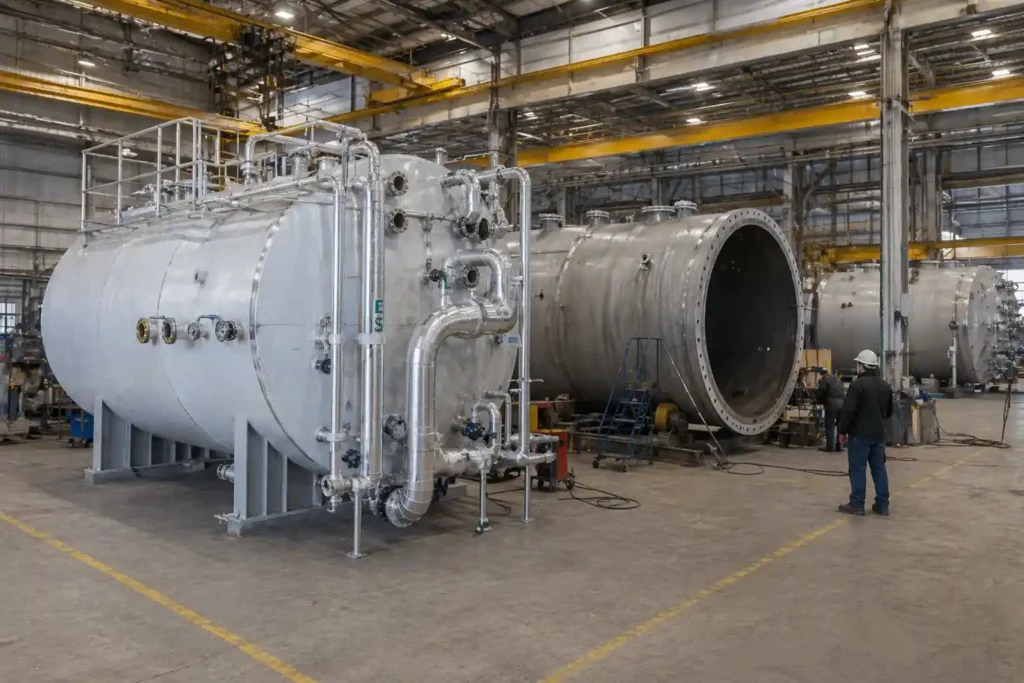
Multi-vessel TES systems fail when fabrication complexity is treated as a single-vessel problem scaled up. This guide is for project engineers and procurement leads specifying large-scale thermal storage tank systems, covering what they need before the design is finalized.
What Makes a Thermal Storage System Large-Scale
Large-scale TES systems go beyond what a standard vessel procurement process can handle. Storage capacity reaches thousands of ton-hours. Physical dimensions exceed standard transport limits. Multiple vessels share piping, controls, and structural infrastructure.
According to the U.S. Department of Energy, large-scale thermal energy storage technologies are a priority research area precisely because scaling storage capacity introduces engineering challenges that smaller systems do not face. Those same challenges apply directly to industrial and data center TES fabrication: material behavior at scale, structural loads, stratification performance, and inspection access all require design attention that scales with system size.
For data center and industrial operators, the practical definition is simpler: a large-scale thermal storage system is one where a single fabrication decision affects the performance of the entire facility’s cooling infrastructure, not just one piece of equipment. For a foundational overview of how TES systems support data center cooling specifically, see how TES tanks support data center cooling.
Engineering Requirements at Scale
Large-scale thermal storage tank systems require engineering discipline across multiple specialties simultaneously. Mechanical, structural, civil, and process engineering teams must coordinate inputs before the fabrication scope is finalized. As a result, gaps between disciplines create field problems that are expensive to fix.
Large-Scale Thermal Storage Tank Systems: Vessel Engineering and Code Compliance
Every vessel in a large-scale TES system must be designed to the applicable code before fabrication begins. For pressurized vessels operating above 15 PSI, that means ASME Section VIII compliance. Design calculations, material specifications, qualified weld procedures, and third-party inspection by an Authorized Inspection Agency (AIA) are all required. For details on how ASME Section VIII applies specifically to TES tanks, see what ASME Section VIII applies to TES tanks.
For atmospheric chilled water tanks, ASME pressure vessel certification is not required, but design rigor still matters. Wall thickness calculations, nozzle reinforcement, shell-to-head joint design, and anchor bolt sizing all require engineering analysis. A tank underdesigned for its operating loads and site conditions will fail before its intended service life regardless of whether it carries an ASME stamp.
Red River’s pressure vessel fabrication covers the full design and fabrication sequence for both pressurized and atmospheric large-scale storage vessels, with documentation packages that satisfy commissioning engineers, insurance reviewers, and regulatory inspectors.
Thermal Stratification Design at Large Volumes
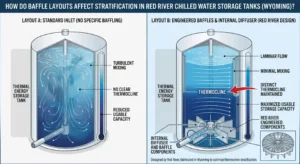
Large chilled water tanks lose thermal stratification more easily than smaller vessels because the volumes involved create higher mixing risk during charge and discharge cycles. Fill and draw operations generate significant hydraulic momentum in tanks storing several million gallons. Without carefully engineered diffuser systems, that momentum destroys the thermal gradient between the cold and warm layers.
Diffuser design for large tanks requires computational fluid dynamics (CFD) analysis or detailed hydraulic calculations to confirm that the diffuser geometry produces laminar flow conditions at the design charge and discharge flow rates. Therefore, specifying a diffuser without flow analysis on a large-scale tank is a fabrication risk that reduces usable capacity from day one. For more on chilled water storage tank design fundamentals, see what is a chilled water storage tank.
Structural Engineering for Large Vessel Systems
Large-scale thermal storage systems place significant structural demands on their foundations. A single large-diameter chilled water tank holding several million gallons of water weighs tens of millions of pounds when full. Engineers must design the foundation and anchor bolt pattern for the full operating load and hydrostatic test load. Wind and seismic forces, plus differential thermal expansion between the vessel and its support structure, must also be addressed.
For multi-vessel systems where tanks are interconnected through piping headers, the structural design must account for more than just static loads. Pipe loads transferred to vessel nozzles, thermal expansion of connecting piping, and dynamic loads from charge and discharge cycling all require analysis. These loads are not always captured in a standard structural design scope unless the mechanical and structural engineering teams are actively coordinating.
Fabrication Scope for Large-Scale Thermal Storage Tank Systems
Large-scale thermal storage tank systems demand fabrication capabilities that extend well beyond vessel construction alone. Shops best positioned to deliver these projects handle the full scope in-house under a single quality system.
Vessel fabrication
For large-diameter tanks, fabrication typically involves field assembly of shell courses transported individually to the site, rather than shop-complete delivery of a finished vessel. Shell courses are rolled and welded in the shop. Workers transport them within standard permitted dimensions, then field-weld them into the complete vessel at the installation site. Field welding on large-diameter tanks requires the same qualified weld procedures, certified welders, and AIA inspection as shop fabrication.
Red River’s prefabrication services cover both shop-complete and field-assembled vessel scopes, with qualified welders and established AIA relationships that keep inspection hold points on schedule regardless of where fabrication occurs.
Modular skid integration
For large-scale TES systems where the storage vessels connect to pump skids, heat exchanger packages, control valve stations, and instrumentation systems, modular skid fabrication consolidates those ancillary systems into pre-tested assemblies that arrive at site ready to connect. This approach reduces field installation time, improves system quality by moving assembly into a controlled shop environment, and allows pre-commissioning testing before the unit ships.
Insulation and protective systems
Large-scale chilled water tanks operating below ambient temperature need insulation and vapor barrier systems engineered for the specific tank geometry, operating temperature range, and site climate. Address insulation thickness, vapor barrier material and lap joint sealing requirements, jacketing and cladding for weather protection, and inspection provisions for holiday testing in the insulation specification.
Quality Systems and Documentation at Scale
Large-scale thermal storage tank systems generate significantly more documentation than single-vessel projects. A large-scale TES system documentation package covers every coded vessel and every weld. ASME Form U-1 manufacturer’s data reports and certified mill test reports (CMTRs) cover materials. Weld procedure specifications (WPS), procedure qualification records (PQR), and welder performance qualification records (WPQRs) cover fabrication. NDE reports and hydrostatic test records complete the package for every pressure-rated vessel and assembly.
Managing this documentation across a large project scope requires a quality management system that is actively maintained, not just documented. The National Board of Boiler and Pressure Vessel Inspectors administers the R Stamp program for pressure vessel repair and alteration, reflecting the standard for active quality system maintenance in pressure vessel fabrication.
Red River’s fabrication capabilities include an active quality management system audited by the AIA, with documentation control processes that produce organized, complete packages for every project regardless of scope size.
Planning and Schedule Management for Large-Scale Projects
Large-scale thermal storage tank systems have longer fabrication schedules than single-vessel projects. More variables can extend those schedules if they are not identified and managed early.
Specialty material procurement is frequently the critical path item on large TES projects. Large-diameter plate in heavy thicknesses, specialty alloys, large-bore forgings, and custom fittings all carry mill or forge lead times that can run 12 to 20 weeks in normal market conditions and longer when demand is high. Identifying long-lead materials at the project inquiry stage is one of the most effective schedule compression strategies available. Beginning procurement before full design approval compresses the schedule significantly.
Field assembly sequencing for large vessels that require on-site shell welding must be coordinated with the overall construction schedule. In addition, building field welding windows into the construction schedule, rather than treating field assembly as a fill-in activity, protects both weld quality and the inspection schedule.
For a detailed look at how volume requirements are calculated before the fabrication scope is finalized, see how much volume is needed for chilled water storage.
Scope Your Large-Scale TES System With Red River
Large-scale thermal storage projects benefit from early fabricator involvement before the engineering design is finalized. Whether the project involves custom pressure vessels only or a complete integrated system with modular skid packages, Red River brings engineering coordination, ASME-certified fabrication, and documentation discipline into the conversation early. That means identifying long-lead materials before design approval, coordinating structural and mechanical scopes from the start, and delivering a documentation package that satisfies commissioning engineers and regulatory inspectors on every vessel in the system.
Ready to Scope Your Large-Scale TES System?
If you are specifying a multi-vessel thermal storage system for a data center, industrial facility, or power generation application, Red River’s team works through the fabrication scope with you before the design is finalized. That means identifying long-lead materials early, coordinating structural and mechanical engineering inputs, confirming ASME code requirements for each vessel, and building a documentation package that satisfies commissioning engineers and regulatory inspectors across every vessel in the system.
Involving Red River before the RFQ goes out means a fabrication scope built for your actual site conditions, transport constraints, and schedule — not a generic specification adapted after the fact.
Request a quote or call 1-307-257-5332 to discuss your large-scale TES system scope, schedule, and site constraints with Red River’s team.
Frequently Asked Questions
1. How do large-scale thermal storage tanks balance peak demand?
Large-scale tanks charge during off-peak hours when chiller energy costs are lowest, then discharge stored chilled water during peak demand windows. At sufficient storage volume, the chiller plant can be taken fully offline during peak hours, flattening the facility demand curve without any reduction in cooling output.
2. What site constraints affect large-scale tank design?
Four site constraints drive the design from the start: available footprint, soil bearing capacity, transport access for oversized components, and height restrictions from zoning or overhead obstructions. Soil bearing capacity determines foundation depth and cost, and is frequently underestimated until a geotechnical report is in hand. Each constraint should be confirmed before vessel geometry is finalized, not after.
3. Can a phased capacity approach reduce capital cost?
Yes. A phased approach designs the foundation, piping headers, and structural infrastructure for the full intended system capacity, then installs only the first vessel or vessels in Phase 1. Additional tanks are added in later phases as load grows or capital becomes available. The upfront cost of oversizing the civil and piping infrastructure is almost always less than retrofitting it later.
4. What information does Red River need to estimate a large-scale TES system?
A preliminary estimate requires storage capacity in ton-hours, storage medium (chilled water, hot water, ice, or other), operating pressure and temperature range, number of vessels, site location and installation conditions, and the required delivery or installation date. With those inputs, Red River can produce a preliminary schedule and budget framework that identifies long-lead risks and key decision points.
5. What does commissioning involve for a large-scale TES system?
Commissioning includes hydrostatic testing of all pressure-rated vessels and piping, flushing and fill water quality verification, stratification performance testing during the first charge-discharge cycle, and control system integration verification against actual facility load conditions. Red River pre-commissions modular skid assemblies at the fabrication facility before shipment. This reduces the on-site commissioning scope and compresses the time between installation and first operational use.
Key Takeaways
- Large-scale thermal storage tank systems require coordinated mechanical, structural, civil, and process engineering inputs before the fabrication scope is finalized. Discipline gaps create expensive field problems.
- Thermal stratification performance in large-volume tanks requires diffuser engineering with CFD or hydraulic analysis. Undersized or poorly designed diffusers reduce usable capacity from the first day of operation.
- Large-diameter vessels often require field assembly of transported shell courses. Field welding requires the same certified procedures, qualified welders, and AIA inspection hold points as shop fabrication.
- Specialty material procurement is frequently the critical path on large-scale TES projects. Identifying long-lead materials at inquiry and beginning procurement before full design approval compresses total project schedule.
- Modular skid integration of ancillary systems reduces field installation time and improves quality by consolidating assembly and pre-commissioning testing in a controlled shop environment.
Related Blog Post
Can Condensate Storage Improve Reliability?
Where Do Condensate Tanks Fit in a Steam System?
Which Nozzles Simplify Maintenance on Pressure Vessels?
How to Vent Condensate Tanks in Steam Systems
How Do Baffle Layouts Affect Stratification in TES Tanks?
About Author



