Undersizing a chilled water storage tank limits the discharge window and reduces demand charge savings. Oversizing increases capital cost and thermal loss without proportional benefit. This guide is for mechanical engineers and facility designers calculating storage volume for chilled water systems in data centers, industrial facilities, and large commercial buildings. You’ll learn the sizing formulas, the variables that drive volume requirements, and how design decisions around delta-T and discharge duration affect the final tank specification.
The Core Variables That Determine Storage Volume
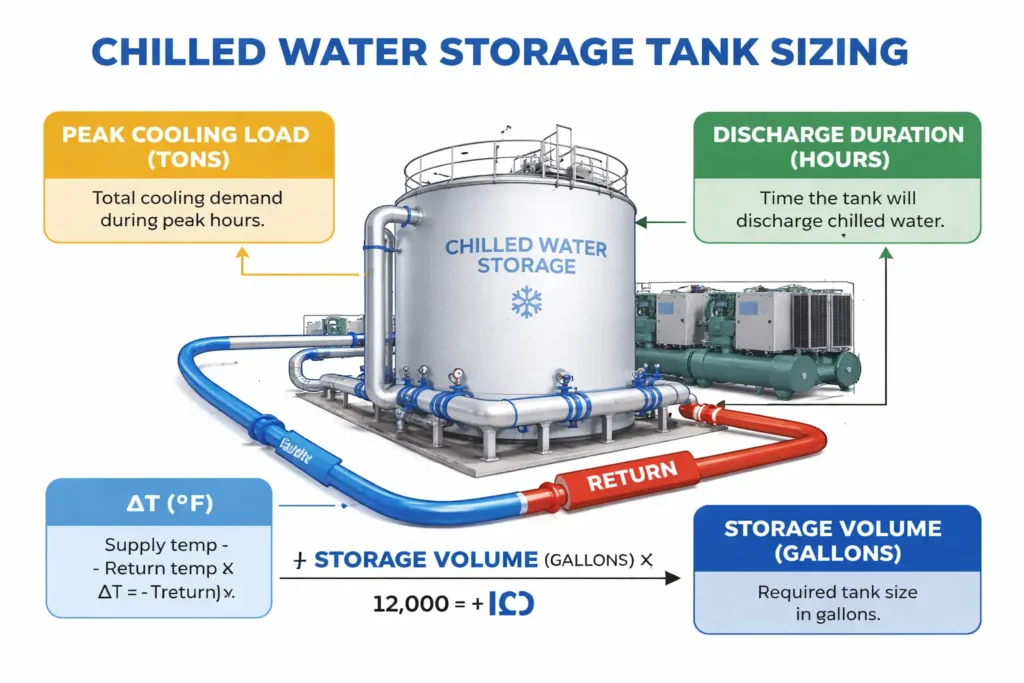
Chilled water storage volume is not a single fixed calculation it depends on four primary variables that interact with each other:
Peak cooling load: the maximum rate of heat removal required by the facility, measured in tons of refrigeration (TR). This establishes how much chilled water the system must deliver per hour during the highest demand period.
Desired discharge duration: how many hours the storage tank must supply chilled water without chiller support. A system designed for 4-hour discharge at peak load needs more volume than one designed for 2-hour discharge.
Delta-T: the temperature difference between supply water leaving the tank and return water coming back from the load. Delta-T is the single most important variable in storage volume calculations. A higher delta-T extracts more cooling energy per gallon of water, directly reducing the volume needed.
System losses: thermal gain through tank insulation and piping increases the effective volume needed. Well-insulated tanks in conditioned spaces lose less stored cooling energy than exposed outdoor tanks.
Understanding how these variables interact is essential before specifying tank size. For more on how ASME standards govern the fabrication of these tanks, see ASME code stamped pressure vessels.
The Sizing Formula for Chilled Water Storage
The standard formula for calculating chilled water storage volume is:
Volume (gallons) = (Cooling Load in tons × Discharge Duration in hours × 12,000 BTU/ton-hr) ÷ (500 × Delta-T in °F)
Breaking this down:
- 12,000 BTU/ton-hr is the conversion factor for tons of refrigeration to BTU per hour
- 500 is a constant derived from water’s specific heat and density (8.33 lb/gal × 60 min/hr × 1 BTU/lb·°F)
- Delta-T is measured in degrees Fahrenheit between supply and return temperatures
Example calculation: A facility with a 500-ton peak cooling load, a 4-hour discharge target, and a 12°F delta-T:
Volume = (500 × 4 × 12,000) ÷ (500 × 12) Volume = 24,000,000 ÷ 6,000 Volume = 4,000 gallons
If the same facility widens its delta-T to 16°F, the required volume drops to 3,000 gallons a 25% reduction in tank size for the same cooling output.
How Delta-T Affects Volume Requirements
Delta-T is the most powerful lever in the sizing equation. Most chilled water systems are designed for a 10–16°F delta-T, though some high-performance systems achieve 20°F or more. The difference in required storage volume between a 10°F and 16°F delta-T system is significant.
For a 500-ton, 4-hour discharge system:
- At 10°F delta-T: 4,800 gallons
- At 12°F delta-T: 4,000 gallons
- At 16°F delta-T: 3,000 gallons
- At 20°F delta-T: 2,400 gallons
Low delta-T syndrome where return water temperature is lower than design, reducing the effective delta-T is one of the most common causes of storage systems that underperform against their design specifications. It occurs when coils are oversized, control valves fail to close fully, or bypass flow exists in the distribution system.
Addressing low delta-T issues before specifying tank size prevents building a tank that is larger than necessary. For reference data on chilled water system delta-T optimization, see the ASHRAE HVAC Systems and Equipment guide.
Buffer Tanks vs Storage Tanks Different Sizing Logic
Buffer tanks and chilled water storage tank use different sizing logic due to their roles. A chilled water storage tank is sized for hours of peak load discharge using the formula above, aiming to shift chiller operation to off-peak hours and reduce demand charges.
A buffer tank is sized to prevent chiller short cycling, typically providing 1–3 minutes of system volume at minimum chiller output, with a rule of thumb of 10 gallons per ton. A 200-ton chiller needs about 2,000 gallons. It stabilizes hydraulics while storage tanks handle sustained peak demand.
Discharge Duration and Operational Strategy
Discharge duration is a design decision that reflects operational strategy, not just engineering math. The right discharge duration depends on:
Utility rate structure: facilities with steep time-of-use rates benefit from longer discharge windows that keep the chiller offline during all peak-rate hours. Facilities with flat rates benefit less from extended discharge.
Peak load profile: a facility with a sharp, predictable daily peak needs a shorter discharge window than one with sustained high loads across multiple hours.
Redundancy requirements: some facilities size storage to provide cooling during chiller maintenance or failure, which requires a much larger discharge duration than pure load-shifting logic would suggest.
Chiller staging: in plants with multiple chillers, partial storage strategies allow some chillers to run during peak hours while the storage tank reduces the total number of chillers needed online. Full storage strategies size the tank to supply 100% of peak load without any chiller operation.
Red River works with engineers during the specification phase to evaluate these operational scenarios and validate volume requirements against load profiles before fabrication begins. Contact our team to discuss your project.
ASME Compliance and Tank Fabrication
Chilled water storage tanks operating above 15 psig are classified as pressure vessels under ASME Section VIII. Most closed-loop chilled water systems operate between 20–150 psig, placing them firmly within ASME Section VIII Division 1 requirements. The U.S. Department of Energy’s thermal energy storage program provides additional reference data on how pressurized thermal storage systems are classified and applied in commercial and industrial facilities.
ASME certification requires hydrostatic testing at 1.3 times MAWP, Authorized Inspector sign-off on Form U-1, and full material certifications for pressure parts. Red River fabricates ASME U-stamp chilled water storage tanks with full traceability, certified welds, hydrostatic test records, and complete Form U-1 documentation for compliance and commissioning.
Need a Reliable Partner?
Red River designs and fabricates ASME-certified chilled water storage tanks sized to your facility’s specific load profile, delta-T, and discharge duration requirements. Contact our team to discuss your storage volume requirements and tank specification.
Getting the Volume Right the First Time
Storage volume that is too small forces the chiller to run during peak hours, reducing demand charge savings. Volume that is too large wastes capital and increases thermal losses. The correct volume emerges from three inputs peak cooling load, discharge duration, and delta-T and is validated against the facility’s utility rate structure and operational redundancy requirements.
Red River’s engineering team reviews these inputs during the specification phase, models the storage volume against projected demand charge savings, and produces tanks that meet the design exactly with full ASME documentation from fabrication through delivery.
Frequently Asked Questions
1. What is the standard formula for chilled water storage volume?
Volume (gallons) = (Cooling Load in tons × Discharge Duration in hours × 12,000) ÷ (500 × Delta-T in °F). This calculates the minimum storage volume needed to supply a given cooling load for a specified duration at a given delta-T.
2. How does delta-T affect storage volume?
Higher delta-T means more cooling energy extracted per gallon directly reducing the volume needed. A system with 20°F delta-T requires half the storage volume of a system with 10°F delta-T for the same cooling output.
3. What is the rule of thumb for buffer tank sizing?
10 gallons per ton of installed chiller capacity is a common starting point. A 200-ton chiller typically requires 2,000 gallons of buffer volume to prevent short cycling at minimum load conditions.
4. What is a Chilled Water Storage Tank?
A Chilled Water Storage Tank is a large container that stores chilled water for later use in cooling systems. It helps reduce peak load demands on chillers and improves energy efficiency.
5. Which materials suit chilled water service?
Carbon steel with internal protective lining suits most standard chilled water applications. Stainless steel grades 304L or 316L are specified where glycol concentrations, low-pH water treatment, or high-purity requirements create elevated corrosion risk.
Key Takeaways
- Chilled water storage volume is calculated using peak cooling load, discharge duration, and delta-T Volume (gal) = (tons × hours × 12,000) ÷ (500 × delta-T °F).
- Delta-T is the most powerful sizing variable doubling the delta-T halves the required storage volume for the same cooling output.
- Buffer tanks are sized differently from storage tanks 10 gallons per ton of chiller capacity prevents short cycling, while storage tanks are sized for hours of peak load discharge.
- ASME Section VIII Division 1 applies to chilled water storage tanks above 15 psig Red River fabricates U-stamp certified tanks with full material traceability, hydrostatic test records, and Form U-1 documentation.
Related Blog Post
Condensate Tanks: Types, Fabrication, and ASME Code
Which Tests Validate Deaeration in Pressure Systems?
Equalization Tanks: Design, Sizing, and Fabrication
What Are Thermal Storage Testing Standards for TES Vessels?