Data center cooling systems face a sizing challenge that standard commercial HVAC systems rarely encounter IT load variability that swings from 20% to 100% of peak capacity within seconds, combined with chillers that cannot run below a minimum output threshold without short cycling. Getting buffer tank sizing wrong in a data center means either a chiller that cycles every few minutes and wears out prematurely, or a tank that is oversized, overpriced, and introduces unnecessary thermal losses. This guide is for data center mechanical engineers and facility managers who need to determine the correct buffer tank size for their specific chiller configuration, IT load profile, and supply temperature stability requirements.
Why Data Centers Need Larger Buffer Tanks Than Standard Facilities
Commercial cooling systems change gradually over hours, needing smaller buffers. Data centers see 20–40% spikes in seconds and sustained low loads, requiring larger buffer volumes to satisfy both operating extremes.
Short cycling protection at low load: During off-peak periods, chiller minimum output can overwhelm limited system volume. Without buffer capacity, it meets low demand too quickly, cycles off, restarts frequently, increasing compressor wear and energy consumption per ton.
Thermal stability during rapid load spikes: During sudden IT load increases, the buffer tank supplies stable chilled water while the chiller ramps up. Without it, supply temperature rises quickly, risking thermal throttling and performance loss.
For more on how pressure vessels are fabricated and certified for data center cooling applications, Red River provides ASME U-stamp certified components.
The Uptime Institute publishes cooling infrastructure standards that inform buffer tank sizing and redundancy requirements for Tier-rated data centers.
The Starting Point 10 Gallons Per Ton of Chiller Capacity
The most widely used rule of thumb is 10 gallons per ton of installed chiller capacity. A 500-ton plant yields 5,000 gallons, about 10 minutes of protection. For data centers, sizing must use cycle time formulas. See how much volume is needed for chilled water storage.
The Cycle Time Formul Sizing for Your Specific System
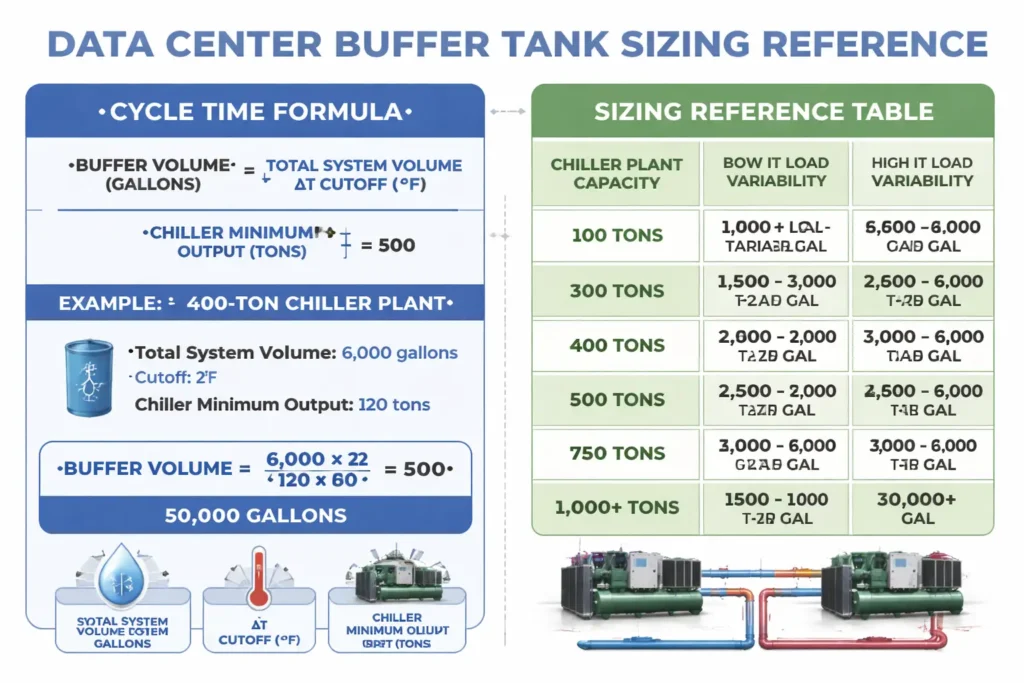
The correct buffer tank size for a data center is the volume that achieves the chiller manufacturer’s minimum off-time at the facility’s lowest anticipated cooling load. The cycle time formula quantifies this:
Cycle Time (minutes) = (Total System Volume in gallons × 8.33 × ΔT cutoff in °F) ÷ (Chiller Minimum Output in BTU/hr ÷ 60)
Data center example:
- Chiller plant: 400 tons installed capacity, 10% minimum load = 40 tons minimum output
- Minimum output in BTU/hr: 40 × 12,000 = 480,000 BTU/hr
- Existing system volume: 800 gallons
- ΔT cutoff: 2°F
- Required minimum cycle time: 15 minutes (per manufacturer specification)
Current cycle time without buffer tank is 1.67 minutes, far below the 15-minute minimum. Required total system volume for 15-minute cycle is 7,200 gallons, resulting in a 6,400-gallon buffer tank after subtracting existing 800 gallons. This exceeds the 4,000-gallon 10 gal/ton rule because the chiller’s 10% minimum load creates more aggressive short cycling risk than standard assumptions account for in typical sizing methods used.
ASHRAE provides reference data on chilled water system volume and minimum chiller cycle protection in the ASHRAE HVAC Systems and Equipment handbook.
Key Variables That Affect Data Center Buffer Tank Size
Four variables drive buffer tank sizing in data centers. Each one must be evaluated against the specific chiller plant and facility before specifying tank volume.
Chiller minimum load percentage: Variable-speed chillers can run at 10% capacity, producing very low cooling output that can overwhelm small system volumes during off-peak periods, increasing short cycling risk compared to higher minimum load designs.
Number of chillers and staging strategy: Data centers with multiple chillers size buffer tanks against the smallest active chiller stage. A system with two 200-ton units operating one at a time must buffer against a 200-ton chiller at 10% minimum load, not full plant capacity.
IT load variability: Hyperscale data centers with dynamic workload scheduling experience faster, larger load swings than colocation facilities, requiring greater buffer volume to absorb rapid demand changes while chiller plants respond at mechanical rates.
Supply temperature stability requirement: Data centers with tight supply temperature bands (±0.5°F) require more buffer volume than wider bands (±2°F) because smaller allowable ΔT reduces response time, increasing required thermal mass to stabilize system operation.
For modular chilled water skid packages that integrate buffer tanks, chillers, and pumps in a pre-engineered assembly, Red River evaluates all four variables during the specification phase.
Typical Buffer Tank Sizes for Data Center Applications
While every installation requires individual calculation, the following ranges represent typical buffer tank specifications for data center cooling systems based on chiller plant size and IT load variability:
| Chiller Plant Size | Low IT Load Variability | High IT Load Variability |
| 100–200 tons | 1,500–2,500 gallons | 2,500–4,000 gallons |
| 200–500 tons | 3,000–6,000 gallons | 5,000–9,000 gallons |
| 500–1,000 tons | 6,000–12,000 gallons | 10,000–18,000 gallons |
| 1,000+ tons | 12,000–20,000 gallons | 18,000–30,000+ gallons |
These ranges assume 10% minimum load and 15-minute off-time; higher loads or longer off-times reduce required volume, while low loads or tighter stability increase it beyond the upper range.
ASME Certification for Data Center Buffer Tanks
Data center buffer tanks operating above 15 psig are classified as pressure vessels under ASME Section VIII Division 1. Most closed-loop chilled water systems in data centers operate between 50–150 psig well within Division 1 requirements.
ASME certification requires hydrostatic testing at 1.3 times MAWP, an Authorized Inspector sign-off on the Manufacturer’s Data Report (Form U-1), and full material certifications for pressure components. For data center operators, this documentation is essential to demonstrate infrastructure reliability to clients, auditors, and insurers.
For a complete overview of ASME certification requirements, see ASME code stamped pressure vessels.
Need a Reliable Partner?
Red River fabricates ASME U-stamp certified buffer tanks for data center chilled water systems sized against each facility’s chiller minimum output, IT load profile, and supply temperature stability requirements. Every tank includes full material traceability, certified weld documentation, and hydrostatic test records. Contact our team to discuss buffer tank sizing and fabrication for your data center project.
Getting Buffer Tank Sizing Right the First Time
An undersized buffer tank allows short cycling, causing compressor wear, higher energy use per ton, and increased maintenance costs. An oversized tank raises capital cost and adds thermal losses that reduce efficiency. Proper sizing requires calculating cycle time based on chiller minimum output, facility minimum load, and minimum off-time requirements. In data centers, this often exceeds the 10 gal/ton rule due to low minimum chiller loads and variable IT demand. Red River validates sizing before fabrication.
Frequently Asked Questions
1. Why do data centers need larger buffer tanks than standard commercial buildings?
Data centers face rapid IT load swings and frequent low-load periods where chiller minimum output overwhelms small volumes. Both conditions require more buffer capacity than standard commercial systems with gradual, predictable load changes.
2. What is the 10 gallons per ton rule and when does it apply to data centers?
The 10 gal/ton rule is a starting point for buffer tank sizing in commercial chilled water systems, but for data centers it often underestimates required volume due to low minimum chiller loads and high IT load variability. Always validate using cycle time calculations before specifying.
3. How does chiller minimum load percentage affect buffer tank size?
A lower minimum load percentage reduces chiller output threshold, overwhelming system volume faster and increasing short cycling risk; a 400-ton chiller at 10% load needs more buffer volume than at 25% load.
4. How do buffer tanks prevent chiller short cycling?
Buffer tanks increase total system water volume, slowing the rate of temperature change in the loop. This gives the chiller time to complete a full run cycle before return water temperature drops to the cutoff setpoint preventing the rapid start-stop cycles that wear out compressors and reduce system efficiency.
5. Which tests verify buffer tank quality?
ASME Section VIII Division 1 requires hydrostatic testing at 1.3× MAWP, weld inspection throughout fabrication, and leak testing at operating pressure. An Authorized Inspector must witness key stages and sign off on the Manufacturer’s Data Report (Form U-1) before the U-stamp is applied.
Key Takeaways
- Data centers require larger buffer tanks due to rapid IT load spikes and low-load periods exceeding chiller minimum output capacity.
- Correct buffer tank size uses the cycle time formula, matching minimum off-time at lowest cooling load for proper chiller operation and stability.
- Chiller minimum load percentage is critical; a 400-ton chiller at 10% load requires more buffer volume than at 25% to maintain equivalent cycle time protection.
- ASME Section VIII Division 1 applies to data center buffer tanks operating above 15 psig Red River fabricates U-stamp certified tanks with Form U-1 documentation, hydrostatic test records, and full material traceability.
Related Blog Post
Condensate Tanks: Types, Fabrication, and ASME Code
Which Tests Validate Deaeration in Pressure Systems?
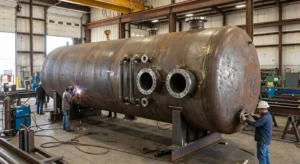
Equalization Tanks: Design, Sizing, and Fabrication
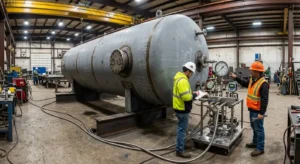
What Are Thermal Storage Testing Standards for TES Vessels?