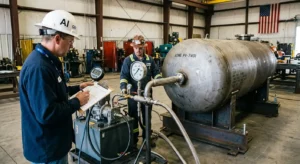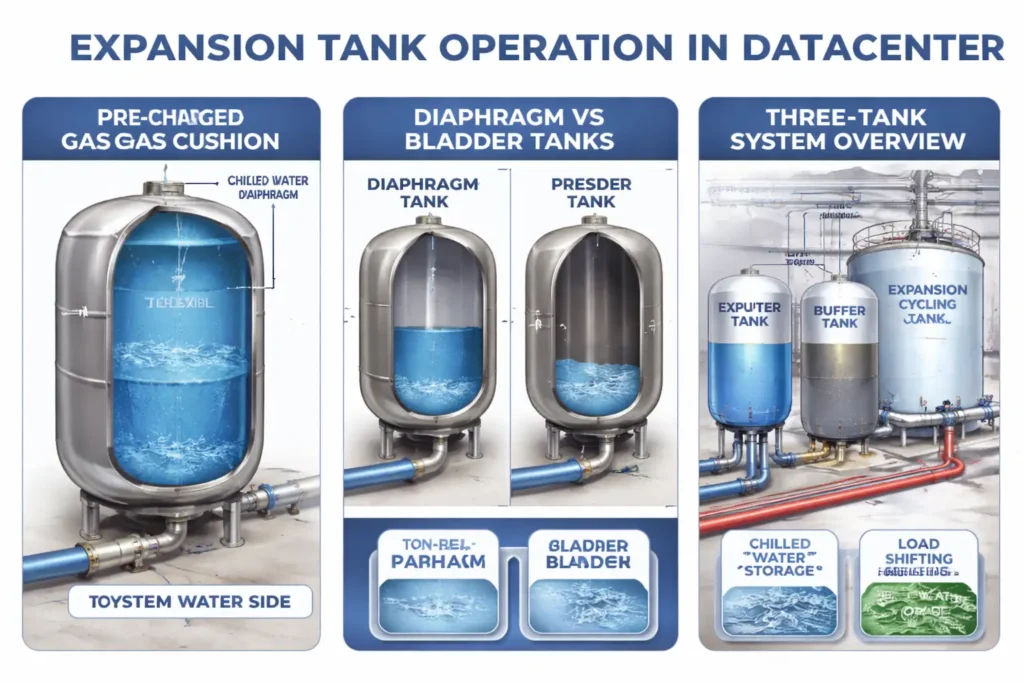
Every chilled water system experiences pressure changes as water temperature rises and falls during operation. Without a vessel designed to absorb those pressure changes, the loop builds pressure until relief valves open, pumps cavitate, or fittings fail. These vessels solve this by providing by providing a compressible air or gas cushion that absorbs the volume change of water as it heats and cools keeping system pressure within the operating range at all times. This guide covers how expansion tanks work in data center HVAC systems, how they differ from buffer tanks and chilled water storage tanks, how they are sized, and what ASME requirements govern their fabrication.
What Is an Expansion Tank and What Does It Do?
An expansion tank is a pressure vessel that accommodates the change in water volume that occurs when chilled water system temperature rises or falls. Water expands when heated and contracts when cooled. In a closed-loop system with no expansion capacity, this volume change translates directly into pressure change a phenomenon that can over-pressurize the system during warmup or create negative pressure that draws air into the loop during cooldown.
The expansion tank contains a compressible medium either an air cushion separated from the system water by a flexible diaphragm or bladder, or a direct air-water interface in older open-type tanks that compresses as system water volume increases and expands as system water volume decreases. This compression and expansion absorbs the pressure variation, keeping the system within its designed pressure range throughout all operating conditions.
In data center HVAC systems, These tanks serve three specific functions specific functions:
Pressure control: maintaining system pressure within the operating range of all installed equipment, including chillers, pumps, heat exchangers, and control valves. Each component has a minimum and maximum operating pressure rating. The expansion tank keeps pressure within those limits under all thermal conditions.
Air elimination support: by maintaining positive pressure throughout the loop at all times, the expansion tank prevents negative pressure conditions that draw air into the system through fittings, valve packing, and pump seals. Air in a chilled water loop causes pump cavitation, control valve noise, and corrosion at air-water interfaces.
System fill volume accommodation: when the system is filled and pressurized at ambient temperature, the expansion tank accepts the additional water volume that enters the loop as temperature stabilizes at operating conditions.
Expansion tanks in pressurized chilled water systems above 15 psig are classified as pressure vessels under ASME Section VIII and must be fabricated to the applicable division requirements.
Types of Expansion Tanks Used in Data Center HVAC
Three types of expansion tanks are used in chilled water systems. The correct type depends on system size, operating pressure, and maintenance access.
Diaphragm expansion tanks: use a flexible membrane to separate the system water from a pre-charged nitrogen or air cushion. The diaphragm flexes as system pressure changes compressing the gas cushion as water volume increases and allowing it to expand as water volume decreases. Diaphragm tanks are the most common type in modern data center HVAC systems because they prevent air absorption into the system water, require no system shutdown for pre-charge verification, and are available in ASME-certified configurations from small inline units to large floor-mounted vessels.
Bladder expansion tanks: use a replaceable rubber bladder inside the pressure vessel shell. The bladder contains the pre-charged gas and separates it from the system water. Bladder tanks allow bladder replacement without replacing the entire vessel an advantage in large systems where vessel replacement would be costly. ASME-certified bladder tanks are available in sizes suitable for large data center chilled water plants.
Open expansion tanks: also called open compression tanks use an unpressurized tank open to atmosphere, typically installed at the highest point in the system. Water level in the tank rises and falls as system volume changes. Open tanks are rarely used in modern data center HVAC because they introduce oxygen into the loop, accelerating corrosion, and cannot maintain the pressures required by modern high-efficiency equipment. They are encountered in older facilities during retrofit projects.
For modular chilled water skid packages that integrate expansion tanks with pumps, chillers, and controls, Red River designs the full system configuration including expansion tank type and sizing before fabrication begins.
How Expansion Tanks Differ From Buffer Tanks and Chilled Water Storage Tanks
Expansion tanks, buffer tanks, and chilled water storage tanks are all pressure vessels used in chilled water systems but they serve entirely different functions and are sized using entirely different methods.
| Factor | Expansion Tank | Buffer Tank | Chilled Water Storage Tank |
| Primary purpose | Pressure control | Prevent short cycling | Load shifting |
| Contains | Gas cushion + water | Water only | Water only |
| Sizing basis | System volume × expansion coefficient | 10 gal/ton chiller capacity | Peak load × discharge hours ÷ (500 × delta-T) |
| Operating pressure | System design pressure | System design pressure | System design pressure |
| Typical volume | 5–500 gallons | 500–5,000 gallons | 10,000–500,000+ gallons |
| ASME required | Yes, above 15 psig | Yes, above 15 psig | Yes, above 15 psig |
All three tank types are often present in the same large data center chilled water system. The expansion tank controls loop pressure. The buffer tank prevents chiller short cycling. The chilled water storage tank provides peak demand reserve. Each must be independently sized for its specific function combining functions in a single vessel requires careful engineering to ensure both requirements are met simultaneously.
Sizing Expansion Tanks for Data Center HVAC Systems
Expansion tank sizing in data center HVAC follows a defined engineering calculation based on system water volume, operating temperature range, system pressure limits, and the pre-charge pressure of the tank’s gas cushion.
The standard sizing formula for a diaphragm or bladder expansion tank is:
Tank Volume (gallons) = System Volume (gallons) × Expansion Factor × [(Pa + 14.7) ÷ (Pa + 14.7 − Pf − 14.7)]
Where:
- System Volume = total water volume in the chilled water loop at fill temperature
- Expansion Factor = the fractional increase in water volume between minimum and maximum operating temperature (approximately 0.0024 per °F for water)
- Pa = acceptance pressure = maximum operating pressure in psig
- Pf = fill pressure = system static pressure at the expansion tank connection in psig
Simplified approach for preliminary sizing: A commonly used approximation for chilled water systems is 1 gallon of expansion tank volume per 100–150 gallons of system water volume for systems with a 20–30°F operating temperature range. This approximation is used for preliminary design only final sizing must use the formula above with actual system parameters.
Data center specific considerations: In large data center chilled water plants with multiple chillers, cooling towers, and extensive distribution piping, system water volume can range from 5,000 gallons in a small edge data center to over 500,000 gallons in a hyperscale facility. The expansion tank must accommodate the full volume change across the system’s operating temperature range from the minimum temperature during normal operation to the maximum temperature during warmup or chiller shutdown.
Data centers also experience more frequent temperature excursions than standard commercial buildings IT load shedding events, chiller stagings, and emergency shutdowns all cause rapid temperature changes that the expansion tank must absorb without allowing system pressure to exceed equipment ratings. ASHRAE’s data center resources provide reference guidance on cooling system design and pressure management for data center HVAC infrastructure.
For precise expansion tank sizing on large data center projects, Red River’s engineering team calculates system volume from the piping and equipment schedule, determines the operating temperature range from the chiller and cooling load specifications, and validates the expansion tank specification against the system’s pressure relief valve setting. Contact our team to discuss expansion tank sizing for your facility.
Pre-Charge Pressure and Its Effect on System Performance
The pre-charge pressure of a diaphragm or bladder expansion tank the gas pressure in the tank before system water is connected is a critical setting that directly affects how the expansion tank performs in service.
The correct pre-charge pressure equals the static fill pressure of the system at the expansion tank connection point. This is the pressure exerted by the weight of the water column above the tank at ambient temperature. If the pre-charge pressure is set too high, the diaphragm is pushed toward the system water side and the tank accepts less water volume reducing its effective capacity. If set too low, the tank pre-fills with system water and has insufficient gas volume remaining to accommodate expansion.
In data center HVAC systems, pre-charge pressure must be verified:
- At initial commissioning before the system is filled
- After any system pressure change such as pump upgrades or pressure regulator adjustments
- As part of the annual maintenance program since gas pre-charge pressure can change over time through diaphragm or bladder permeation
Incorrect pre-charge pressure is one of the most common causes of expansion tank underperformance in existing chilled water systems. A tank with the correct volume but incorrect pre-charge behaves as if it were undersized.
For ASME fabrication and certification standards governing expansion vessels, see ASME code stamped pressure vessels.
ASME Requirements for Expansion Tanks in Data Center HVAC
Expansion tanks operating above 15 psig in closed-loop chilled water systems are pressure vessels under ASME Section VIII Division 1. This is the standard that applies to virtually all data center HVAC expansion tanks since closed-loop chilled water systems typically operate at 50–150 psig system pressure.
ASME Section VIII Division 1 requirements for expansion tanks include:
Shell and head design: wall thickness calculated based on design pressure, material allowable stress, and vessel geometry using the Division 1 design-by-rule formulas. For diaphragm and bladder tanks, the shell must withstand the maximum system pressure plus the hydrostatic test pressure without permanent deformation.
Material compliance: all pressure-containing materials must be ASME-approved grades listed in Section II Part D with documented allowable stress values. Carbon steel grade SA-516-70 is the most common shell material for standard chilled water expansion tanks. Where water chemistry or space constraints require it, stainless steel SA-240 304L is specified.
Hydrostatic testing: the completed vessel must be hydrostatically tested at 1.3 times the MAWP. For an expansion tank rated at 125 psig, the test pressure is 163 psig. An Authorized Inspector witnesses the test and signs the Manufacturer’s Data Report (Form U-1) before the U-stamp is applied.
Diaphragm and bladder materials: while not governed by ASME Section VIII directly, the diaphragm or bladder must be compatible with the system fluid treated water or glycol mixture and must be rated for the system’s operating pressure and temperature range. Manufacturer documentation confirming compatibility and pressure rating should be included in the equipment package.
The National Board of Boiler and Pressure Vessel Inspectors maintains registration records for ASME-certified vessels and provides guidance on jurisdiction-specific inspection requirements that may apply to expansion tanks in data center facilities.
Red River fabricates ASME U-stamp certified expansion tanks for data center HVAC systems with full material traceability, certified weld documentation, hydrostatic test records, and Form U-1. Contact our team to discuss expansion tank fabrication for your chilled water system.
Need a Reliable Partner?
Red River designs and fabricates ASME U-stamp certified expansion tanks, buffer tanks, and chilled water storage tanks for data center HVAC systems sized and configured for each facility’s system volume, operating pressure range, and temperature conditions. Every vessel includes full material traceability, certified weld documentation, and hydrostatic test records as standard. Contact our team to discuss expansion tank requirements for your data center project.
Expansion Tanks as the Pressure Foundation of Data Center Cooling
A chilled water system without a correctly sized and correctly pre-charged expansion tank operates outside its pressure design envelope every time temperature changes. Over-pressure events open relief valves and waste treated system water. Under-pressure events draw air into the loop, causing corrosion and pump cavitation. Either outcome degrades system reliability and increases maintenance costs.
These components are not an afterthought in data center HVAC design they are the pressure foundation that allows every other component in the chilled water system to operate within its rated conditions. Sized correctly against the system’s total water volume and operating temperature range, pre-charged to the correct static fill pressure, and fabricated to ASME standards with a documented service life, an expansion tank is one of the lowest-cost, highest-impact investments in chilled water system reliability.
Red River’s engineering team validates expansion tank sizing, pre-charge pressure, and ASME compliance before fabrication begins ensuring the vessel delivers the pressure stability the facility requires from commissioning through the full service life of the cooling system.
Frequently Asked Questions
1. How do expansion tanks control loop pressure?
Expansion tanks contain a pre-charged gas cushion separated from system water by a diaphragm or bladder. As water temperature rises and volume increases, the water compresses the gas cushion absorbing the volume change and preventing pressure from rising beyond the system’s operating range. As temperature drops, the gas expands and maintains positive pressure throughout the loop.
2. When to choose bladder vs diaphragm tanks?
Choose a bladder tank when the vessel is large and bladder replacement is more cost-effective than full vessel replacement over the service life. Choose a diaphragm tank for smaller systems where the compact, lower-cost design is sufficient and full tank replacement at end of diaphragm life is acceptable. Both types are available in ASME-certified configurations for chilled water service.
3. What precharge and rating do expansion tanks need?
Pre-charge pressure must equal the static fill pressure at the tank connection point the pressure of the water column above the tank at ambient temperature before system pressurization. The pressure rating must meet or exceed the system’s maximum allowable working pressure. ASME Section VIII Division 1 governs tanks operating above 15 psig most closed-loop data center systems operate between 50–150 psig.
4. How do expansion tanks differ from buffer tanks in chilled water systems?
Expansion tanks control loop pressure by accommodating water volume changes due to temperature. Buffer tanks prevent chiller short cycling by adding hydraulic volume to extend chiller run cycles. They serve entirely different functions expansion tanks contain a gas cushion while buffer tanks contain water only and are sized using different engineering calculations.
5. Does an expansion tank require ASME certification in a data center?
Yes, when operating above 15 psig. Most closed-loop data center chilled water systems operate at 50–150 psig, placing expansion tanks firmly under ASME Section VIII Division 1 requirements. Red River fabricates U-stamp certified expansion tanks with Form U-1 documentation and hydrostatic test records.
6. How often should expansion tank pre-charge pressure be verified?
Pre-charge pressure should be verified at initial commissioning, after any system pressure change, and annually as part of the regular maintenance program. Diaphragm and bladder materials are permeable to gas over time pre-charge pressure can drop gradually, reducing the tank’s effective capacity and causing system pressure instability.
7. What size expansion tank does a data center need?
Expansion tank volume is calculated from total system water volume, operating temperature range, maximum system pressure, and fill pressure. A commonly used approximation is 1 gallon of tank volume per 100–150 gallons of system water for systems with a 20–30°F temperature range. Final sizing requires the full engineering calculation using actual system parameters.
8. Which materials are used for expansion tank fabrication in chilled water service?
Carbon steel grade SA-516-70 is the standard shell material for most chilled water expansion tanks. Stainless steel SA-240 304L is specified where water chemistry, space constraints, or purity requirements make carbon steel unsuitable. All materials must be ASME-approved grades listed in Section II Part D.
Key Takeaways
- Expansion tanks absorb water volume changes caused by temperature in closed-loop chilled water systems without them, pressure swings open relief valves, draw air into the loop, or exceed equipment ratings during every thermal transition.
- Diaphragm and bladder tanks use a flexible barrier to separate a pre-charged gas cushion from system water diaphragm tanks have non-replaceable membranes while bladder tanks allow bladder replacement without replacing the vessel.
- Pre-charge pressure must equal static fill pressure at the tank connection point incorrect pre-charge reduces effective acceptance volume and makes the system behave as if the expansion tank is undersized regardless of its actual capacity.
- Expansion tanks differ fundamentally from buffer tanks expansion tanks contain a gas cushion and control pressure, while buffer tanks contain water only and prevent chiller short cycling. Both are sized using entirely different engineering calculations.
- ASME Section VIII Division 1 applies to expansion tanks operating above 15 psig virtually all closed-loop data center chilled water systems fall within this requirement. Red River fabricates U-stamp certified tanks with Form U-1 documentation and full material traceability.
- Expansion tank sizing starts with total system water volume and operating temperature range a preliminary approximation of 1 gallon per 100–150 gallons of system water applies for 20–30°F temperature ranges, but final sizing requires the full engineering formula using actual system parameters.
Related Blog Post
Condensate Tanks: Types, Fabrication, and ASME Code
Which Tests Validate Deaeration in Pressure Systems?
Equalization Tanks: Design, Sizing, and Fabrication
What Are Thermal Storage Testing Standards for TES Vessels?