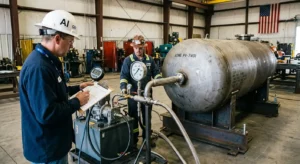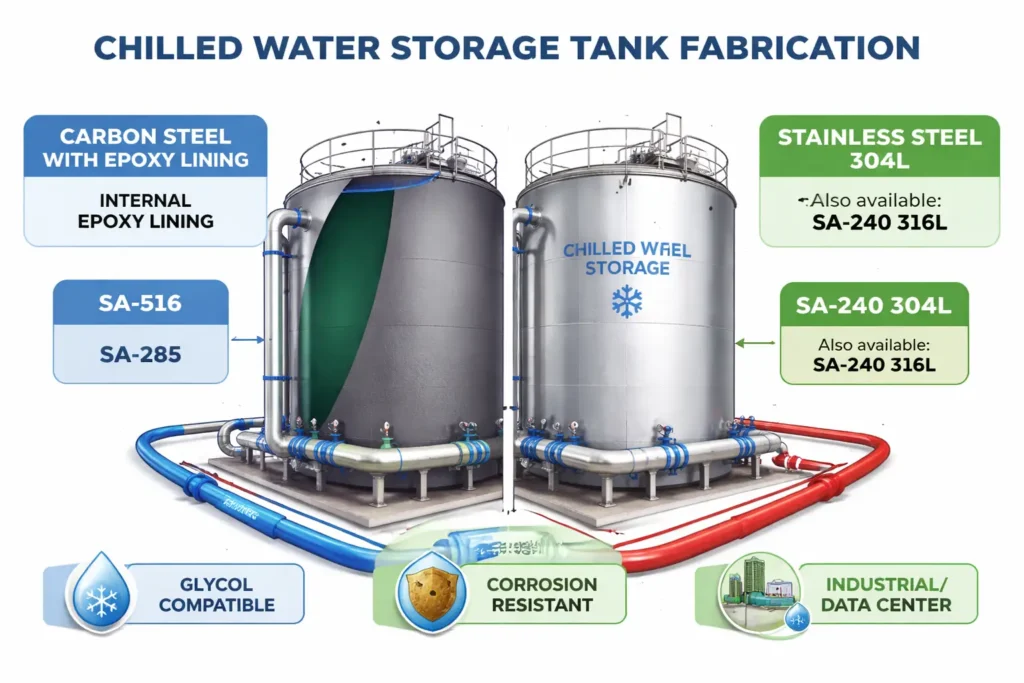
Selecting the wrong material for a chilled water storage tank or buffer tank leads to internal corrosion, water contamination, and premature structural failure eliminating the energy savings and operational benefits the system was designed to deliver. This guide is for mechanical engineers, procurement managers, and facility operators specifying tanks for chilled water applications. You’ll learn which materials suit chilled water service, how glycol concentration and water treatment chemistry affect that selection, and what ASME material requirements govern fabrication.
Why Material Selection Matters in Chilled Water Systems
Chilled water systems present a corrosion environment distinct from other water service applications, driven by dissolved oxygen, treatment chemicals, glycol additives, and continuous temperature cycling that accelerate material degradation. Internal corrosion contaminates loop water with iron oxides and particulates, fouling heat exchangers, clogging valves, and reducing chiller efficiency, thinning tank walls over time and compromising structural integrity; material selection must match system chemistry. For fabrication requirements under ASME standards, see ASME code stamped pressure vessels.
Carbon Steel The Standard Choice for Most Applications
Carbon steel is the most widely used material for chilled water storage tanks. ASME-approved grades SA-516 Grade 70 and SA-285 Grade C are standard for pressure vessel shells and heads in chilled water service. It performs well in closed-loop systems with controlled chemistry, pH 7.0–9.0, low dissolved oxygen, and proper inhibitors. The ASME Boiler and Pressure Vessel Code defines approved carbon steel grades and fabrication requirements for these applications systems.
The primary limitation of carbon steel in chilled water service is susceptibility to corrosion when water chemistry falls outside the acceptable range. Internal protective linings address this limitation by creating a barrier between the steel substrate and the water. Common lining options include:
- Epoxy coatings cost-effective for standard water chemistry, applied to the interior shell and heads before tank commissioning
- Coal tar epoxy higher chemical resistance for systems with more aggressive treatment chemistry
- Polyurethane linings flexible option where thermal cycling creates mechanical stress on rigid coatings
Lining selection depends on the water chemistry, operating temperature range, and expected service life. All lining systems require periodic inspection and reapplication as part of the tank’s maintenance program. For more on pressure vessel materials and grade selection, Red River’s engineering team evaluates specifications against operating conditions before fabrication begins.
Stainless Steel — When Corrosion Risk Is Elevated
Stainless steel becomes the correct specification when water chemistry, glycol concentration, or purity requirements create corrosion risk that carbon steel with lining cannot reliably manage.
Grade 304L is the standard stainless steel specification for most chilled water applications where corrosion resistance is the primary driver. It performs well in systems using ethylene or propylene glycol at concentrations up to 50%, and in systems where water purity requirements preclude the use of chemical corrosion inhibitors such as pharmaceutical process cooling or food-grade applications.
Grade 316L is specified when chloride exposure is a concern particularly in coastal facilities where ambient air contains elevated chloride levels, or in systems where process fluids occasionally contaminate the chilled water loop. The addition of molybdenum in 316L significantly improves pitting and crevice corrosion resistance in chloride environments.
The tradeoff with stainless steel is cost 304L and 316L typically cost 3–5 times more than carbon steel for equivalent tank size. This premium is justified when the alternative is accelerated corrosion, early tank replacement, or system contamination that damages downstream equipment. For pressure vessel fabrication in stainless steel, ASME-approved grades SA-240 304L and SA-240 316L are the standard specifications.
Glycol Compatibility and Its Effect on Material Selection
Glycol is added to chilled water systems for freeze protection and, in some systems, as a corrosion inhibitor. The concentration and type of glycol significantly affects material selection.
Ethylene glycol more common in industrial applications is compatible with both carbon steel and stainless steel when properly inhibited. Uninhibited ethylene glycol degrades over time and produces acidic byproducts that accelerate corrosion in carbon steel systems. Inhibitor maintenance is critical for tanks in ethylene glycol service.
Propylene glycol preferred in food, pharmaceutical, and potable water adjacent applications due to its lower toxicity is compatible with stainless steel and with carbon steel when properly inhibited and maintained.
At glycol concentrations above 40%, the corrosion inhibitor package becomes increasingly important. Systems that are not maintained at proper inhibitor concentrations create an acidic environment that attacks carbon steel linings and can compromise tank integrity. When inhibitor maintenance cannot be guaranteed, stainless steel eliminates the risk.
The ASHRAE HVAC Systems and Equipment handbook provides reference data on glycol concentration, freeze point, and material compatibility for chilled water system design.
ASME Material Requirements for Chilled Water Tanks
All materials used in ASME Section VIII pressure vessel construction must appear in the approved specifications listed in ASME Section II Part D, which documents allowable stress values for each approved material at specific operating temperatures. The values that govern required shell thickness in the design calculation.
For chilled water service, the most commonly specified ASME-approved materials are:
| Material | ASME Grade | Typical Application |
| Carbon steel plate | SA-516 Gr. 70 | Standard chilled water, properly treated |
| Carbon steel plate | SA-285 Gr. C | Lower pressure applications |
| Stainless steel plate | SA-240 304L | Glycol service, high-purity applications |
| Stainless steel plate | SA-240 316L | Chloride environments, aggressive chemistry |
Using non-ASME-approved materials in a pressure vessel disqualifies it from U-stamp certification and creates liability exposure for the specifying engineer and the facility operator. Learn more about Red River’s ASME U-stamp certification and quality standards. Red River sources all pressure-containing materials from certified suppliers with full material test reports and traceability documentation.
Need a Reliable Partner?
Red River evaluates material specifications against each project’s water chemistry, glycol concentration, operating pressure, and ASME requirements before fabrication begins. Every tank we build carries full material traceability, certified weld documentation, and hydrostatic test records. Contact our team to discuss material selection for your chilled water storage tank project.
Making the Right Material Decision
The decision between carbon steel with lining and stainless steel comes down to three questions what is the water chemistry, can inhibitor maintenance be guaranteed, and what is the consequence of early tank failure?
For most standard treated water systems with reliable inhibitor programs, carbon steel with epoxy lining is the cost-effective and technically sound choice. For systems with glycol above 40%, chloride exposure, high-purity requirements, or unreliable maintenance programs, stainless steel 304L or 316L eliminates the corrosion risk and justifies the cost premium over the tank’s service life.
Red River’s engineering team reviews these factors during the specification phase and recommends the material that balances performance, compliance, and long-term cost not the cheapest option that might require early replacement.
Frequently Asked Questions
1. What is the most common material for chilled water storage tanks?
Carbon steel grade SA-516-70 with an internal epoxy lining is the most common specification for standard chilled water service. It is cost-effective, ASME-approved, and performs well in properly treated closed-loop systems.
2. When should I specify stainless steel instead of carbon steel?
Specify stainless steel when glycol concentrations exceed 40%, when chloride exposure is present, when water purity requirements preclude chemical inhibitors, or when inhibitor maintenance cannot be reliably maintained throughout the tank’s service life.
3. What is the difference between 304L and 316L stainless steel for chilled water tanks?
Both grades offer strong corrosion resistance in most chilled water applications. 316L adds molybdenum, which significantly improves resistance to pitting and crevice corrosion in chloride environments. Specify 316L for coastal facilities or systems with known chloride exposure.
4. What is a Chilled Water Storage Tank?
A Chilled Water Storage Tank is a large container that stores chilled water for later use in cooling systems. It helps reduce peak load demands on chillers and improves energy efficiency.
5. How much volume is needed for chilled water storage?
A common starting point is 10 gallons per ton of installed chiller capacity for buffer tanks. Thermal storage tanks are sized based on desired discharge duration and the delta-T between supply and return
Key Takeaways
- Carbon steel grade SA-516-70 with internal epoxy lining is the standard material for most chilled water storage tanks cost-effective, ASME-approved, and reliable in properly treated closed-loop systems.
- Stainless steel 304L is specified when glycol concentrations exceed 40%, when water purity requirements preclude chemical inhibitors, or when inhibitor maintenance cannot be reliably sustained.
- Stainless steel 316L adds molybdenum for superior chloride resistance specify it for coastal facilities or systems with known chloride exposure in the water or ambient environment.
- All materials in ASME Section VIII pressure vessels must appear in ASME Section II Part D with documented allowable stress values non-approved materials disqualify the vessel from U-stamp certification.
- Red River sources all pressure-containing materials with full mill certifications and traceability documentation, and evaluates material specifications against each project’s water chemistry before fabrication begins.
Related Blog Post
Condensate Tanks: Types, Fabrication, and ASME Code
Which Tests Validate Deaeration in Pressure Systems?
Equalization Tanks: Design, Sizing, and Fabrication
What Are Thermal Storage Testing Standards for TES Vessels?