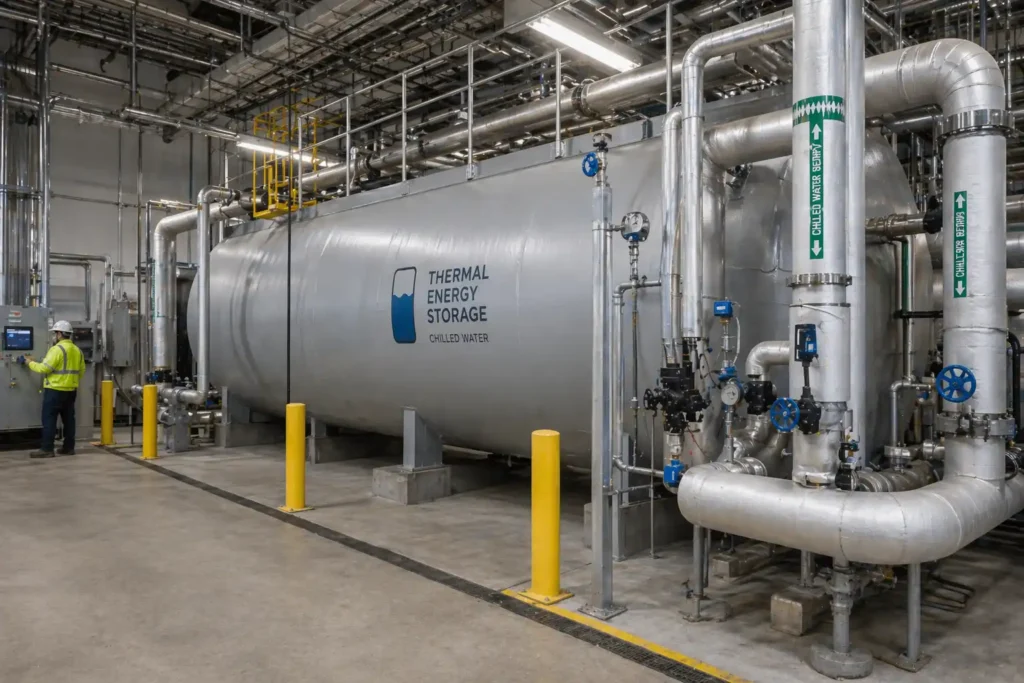
Understanding how do large-scale tanks balance peak demand is essential for facility operators and project engineers making TES system decisions. This guide covers the operating strategies, tank design requirements, and controls integration that determine whether a system delivers its projected demand charge savings.
The Core Mechanism: Separating Production from Consumption
A chiller runs whenever the building or process needs cooling. Without thermal storage, peak cooling demand and peak electricity demand coincide exactly, and the facility pays demand charges based on its highest interval of electricity consumption during the billing period.
A large-scale chilled water storage tank breaks that relationship. The chiller runs during off-peak hours overnight, charging the tank with cold water at supply temperatures between 40°F and 45°F. During on-peak hours, the tank discharges stored cooling capacity to meet facility demand while the chiller runs at reduced output or shuts down entirely. The electricity consumed during the peak demand window drops substantially, and with it the demand charge.
According to the U.S. Department of Energy, shifting thermal loads away from peak grid periods is one of the most cost-effective demand management strategies available for large facilities. For a foundational overview, see Red River’s coverage of chilled water storage tanks.
Operating Strategies and How They Affect Peak Demand Outcomes
The degree to which a large-scale tank reduces peak demand depends on which operating strategy the system is designed to execute. Three strategies are in common use.
Full storage
The chiller plant shuts down entirely during on-peak hours. The tank is charged to full capacity overnight and sized to handle 100 percent of the peak-period cooling load from storage alone. This strategy produces the maximum possible peak demand reduction because chiller electricity consumption during on-peak hours drops to zero. It requires the largest tank volume but is justified by the demand charge savings for facilities with severe peak charges or contractual demand limits.
Partial storage
The chiller runs continuously at constant reduced output, charging the tank during off-peak hours and supplementing facility cooling during peak hours. Less tank volume is required, but less peak demand reduction is captured. The most common approach for facilities where footprint or capital constraints prevent full storage sizing.
Demand limiting
The chiller plant output is capped at a predefined threshold during on-peak hours. When facility cooling demand exceeds that threshold, the tank discharges to cover the difference. Common in facilities with utility-imposed demand limits or constrained electrical service capacity. For more on how these strategies apply to data center applications, see how TES tanks support data center cooling.
How Do Large-Scale Tanks Balance Peak Demand: Design Requirements
A thermal storage tank that is correctly sized on paper but poorly designed or fabricated will not deliver peak demand reduction in operation. These design elements determine how do large-scale tanks balance peak demand in real operating conditions.
Thermal stratification and diffuser design
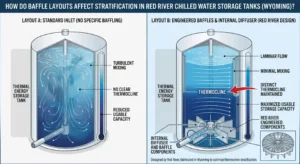
The usable capacity of a chilled water storage tank is not its nominal volume. It is the volume of cold water that can be charged and discharged without mixing with the warm return layer. That usable capacity is controlled by the internal diffuser systems at the top and bottom of the vessel. Poor diffuser design allows hydraulic momentum to mix the cold and warm layers, creating a thermocline zone that reduces effective usable capacity. On a large-scale tank, a poorly designed diffuser can reduce usable capacity by 15 to 20 percent relative to nominal volume, directly reducing peak demand coverage.
Volume sizing with efficiency factors
Tank volume is calculated from the ton-hours of required storage capacity, the supply-to-return temperature differential, and a system efficiency factor that accounts for stratification losses, heat gain through the insulation system, and mixing during charge and discharge. ASHRAE’s cool thermal energy storage guidance confirms that efficiency factors between 0.85 and 0.95 are appropriate for well-designed stratified chilled water systems. For conservative peak demand management, apply the lower end of that range.
ASME compliance and how do large-scale tanks balance peak demand safely
Any thermal storage vessel operating above 15 PSI requires compliance with ASME Section VIII. A vessel placed into service without the required ASME U Stamp creates legal liability and insurance exposure that can shut down the facility’s commissioning process. Red River holds active ASME U Stamp and NBBI R Stamp certifications. Every pressurized thermal storage vessel is built under third-party inspection by the Authorized Inspection Agency, with a complete documentation package including the ASME Form U-1, certified mill test reports, weld records, NDE reports, and hydrostatic test record.
Controls Integration: Where Peak Demand Reduction Is Won or Lost
A correctly fabricated tank with the right volume and diffuser design still fails to answer how do large-scale tanks balance peak demand if the control system does not execute the operating strategy accurately in real time.
The control system must monitor facility cooling load in real time, compare it against the remaining stored capacity in the tank, and make charge and discharge decisions that keep the facility below its peak demand target for the entire on-peak window. That requires accurate tank level sensing, reliable chiller plant status feedback, and control logic that accounts for load variability, weather, and time remaining in the on-peak window.
NREL’s research on thermal energy storage identifies controls integration and commissioning as among the most significant factors in whether a TES system delivers its projected demand savings. Systems with poorly tuned control logic routinely under-deliver even when the physical system is correctly designed.
Red River’s modular skid packages for pump stations, control valve assemblies, and instrumentation panels are pre-assembled and pre-tested before shipment, reducing field commissioning scope to connection and system-level verification.
Field Assembly and Fabrication Considerations
Large-scale tanks that exceed standard transport dimensions require field assembly. This is part of how do large-scale tanks balance peak demand reliably the same fabrication quality standards apply whether work happens in the shop or the field. Field welding requires the same ASME-qualified procedures, certified welders, and AIA inspection hold points as shop fabrication.
Fabricators with established field assembly experience plan inspection hold points into the field schedule from the start. Red River’s prefabrication services cover both shop-complete and field-assembled vessel scopes, with inspection hold points managed to schedule. Whether the project involves a single custom pressure vessel or a multi-vessel system, the same ASME-certified quality system governs every weld.
Ready to Start the Peak Demand Conversation?
Understanding how do large-scale tanks balance peak demand starts with the right fabricator involved before the tank is specified. Red River works through operating strategy, sizing requirements, and fabrication scope with clients before the RFQ goes out so the vessel is designed for the actual application, not adapted after the fact.
Request a quote or call 1-307-257-5332 to discuss your peak demand reduction project with Red River’s team.
Frequently Asked Questions
1. What site constraints affect large-scale tank design?
Four constraints drive the design from the start: available footprint, soil bearing capacity, transport access for oversized components, and height restrictions. Soil bearing capacity determines foundation depth and cost, and is frequently underestimated until a geotechnical report is in hand. Each constraint should be confirmed before vessel geometry is finalized, not after.
2. Can a phased capacity approach reduce capital cost?
Yes. A phased approach designs the foundation, piping headers, and structural infrastructure for the full intended system capacity, then installs only the first vessel or vessels in Phase 1. Additional tanks are added in later phases as load grows or capital becomes available. The upfront cost of oversizing the civil and piping infrastructure is almost always less than retrofitting it later.
3. What happens if the tank runs out of storage before the on-peak window closes?
The chiller plant picks up the cooling load when stored capacity is exhausted. In a demand-limiting strategy, the chiller ramps up to the demand limit and the facility stays below its peak demand target. In a full storage strategy, the chiller running during the on-peak window creates a demand event that reduces savings for that billing period. Proper sizing with conservative efficiency factors minimizes the frequency of this outcome.
4. Does Red River fabricate tanks for both atmospheric and pressurized TES applications?
Yes. Red River fabricates both atmospheric chilled water storage tanks and ASME-certified pressurized thermal storage vessels for data center, industrial, and utility applications. Each scope includes a complete documentation package delivered with the vessel.
5. What is the minimum tank volume for a meaningful impact on peak demand charges?
Systems below approximately 500 ton-hours of usable storage capacity rarely justify the capital cost in most commercial utility rate environments. The threshold shifts with the utility rate structure: facilities with very high demand charges can justify smaller systems. A sizing analysis using actual load data and utility rate schedules is the most reliable way to identify the minimum economically viable storage capacity for a specific facility.
Key Takeaways
- Large-scale tanks balance peak demand by charging overnight during off-peak hours and discharging stored cooling capacity during on-peak windows, reducing or eliminating chiller electricity consumption when demand charges are highest.
- Three operating strategies produce different demand outcomes: full storage eliminates on-peak chiller operation, partial storage runs the chiller at constant reduced output, and demand limiting caps chiller output at a predefined threshold.
- Thermal stratification performance determines usable tank capacity. Poor diffuser design can reduce usable capacity by 15 to 20 percent relative to nominal volume, directly reducing peak demand coverage.
- Controls integration determines whether the physical system delivers its design demand reduction. Poorly tuned control logic is among the most common causes of TES systems underperforming demand savings projections.
- Field assembly of large-diameter vessels requires ASME-qualified field welding with AIA inspection hold points planned into the construction schedule from the start.
Related Blog Post
Can Condensate Storage Improve Reliability?
Where Do Condensate Tanks Fit in a Steam System?
Which Nozzles Simplify Maintenance on Pressure Vessels?
How to Vent Condensate Tanks in Steam Systems
How Do Baffle Layouts Affect Stratification in TES Tanks?
About Author