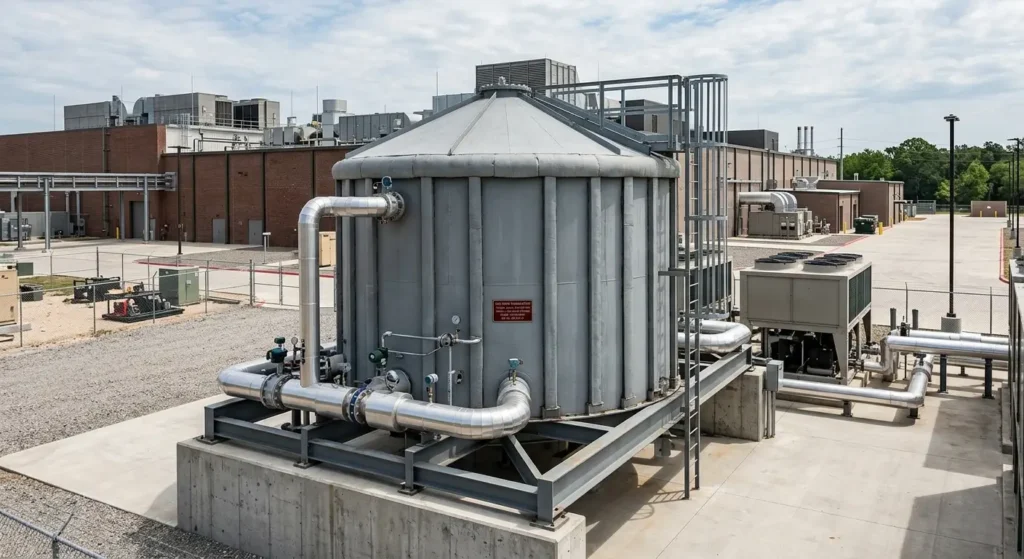
Thermal storage tanks for data centers are engineered vessels, not commodity storage, and a wrong specification creates cost and resilience problems that compound over the facility’s life. This guide covers what procurement managers and project engineers need to know before the RFQ goes out.
Why Thermal Storage Tanks for Data Centers Are Critical Infrastructure
A data center without thermal storage is entirely dependent on its chiller plant running at full capacity whenever cooling demand peaks. That creates two problems that compound each other over time.
The first is cost. Peak cooling demand in a data center typically coincides with peak utility demand charge windows. Running chillers at full load during those windows is the most expensive way to cool a facility. A correctly sized thermal storage tank shifts chiller operation to off-peak hours. It charges stored chilled water overnight and discharges it during peak periods when electricity costs are highest. This approach aligns with thermal management guidance in the ASHRAE TC 9.9 Datacom Series.
The second is resilience. Specifically, a chilled water storage tank provides a thermal buffer that gives the facility time to respond to a chiller fault without an immediate cooling emergency. For Tier III and Tier IV data centers where continuous availability is a contractual commitment, that buffer is not optional.
Undersized tanks fail to cover the full peak demand window. On the other hand, oversized tanks consume capital and footprint without delivering proportional benefit. Both outcomes trace back to the same root cause: procurement starting too late in the design process. For a deeper look at how TES systems support cooling operations, see how TES tanks support data center cooling.
Types of Thermal Storage Tanks Used in Data Centers
Thermal Storage Tanks for Data Centers: Atmospheric Chilled Water Tanks
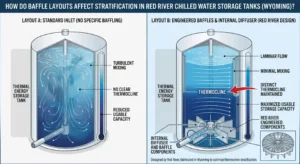
The most common configuration for large data center thermal energy storage is a large-diameter atmospheric chilled water tank operating at or near ambient pressure. These vessels store chilled water at supply temperatures, typically between 40°F and 45°F, and rely on thermal stratification to maintain separation between the cold supply layer at the bottom and the warmer return water at the top.
Internal diffuser systems at the top and bottom of the tank maintain stratification. Diffuser design is a fabrication specification item, not an afterthought. As a result, poor diffuser geometry allows cold and warm layers to mix during charge and discharge cycles, reducing the effective usable capacity of the tank below its nominal volume.
Atmospheric tanks in data center applications range from tens of thousands of gallons for smaller edge deployments to several million gallons for hyperscale facilities. The aspect ratio of a stratified chilled water tank has a direct effect on stratification performance. Taller tanks with higher height-to-diameter ratios maintain better thermal separation. When site footprint is constrained, address stratification performance in the fabrication specification. Specify diffuser design requirements and minimum height-to-diameter ratio criteria explicitly. For more on what chilled water storage tanks are and how they work, see what is a chilled water storage tank.
Pressurized Thermal Storage Vessels
Some data center cooling configurations require pressurized thermal storage. Hot water systems operating above 212°F, steam accumulator systems in combined heat and power applications, and closed-loop pressurized chilled water systems serving high-rise or complex mechanical configurations all fall into this category.
Any thermal storage vessel operating above 15 PSI internal pressure requires compliance with ASME Section VIII of the Boiler and Pressure Vessel Code. An ASME U Stamp certified fabricator must design, fabricate, and stamp the vessel before it enters legal service. This is a legal requirement in most jurisdictions, not a recommendation. For details on how ASME Section VIII applies specifically to TES tanks, see what ASME Section VIII applies to TES tanks.
Red River holds an active ASME U Stamp certification and an NBBI R Stamp for repair and alteration work. As a result, every pressurized thermal storage vessel is built under active third-party inspection by the Authorized Inspection Agency (AIA).
Ice Storage Tanks and Phase Change Systems
Ice storage systems achieve significantly higher energy density than chilled water systems, storing thermal energy as latent heat during the phase change from liquid to solid water. For data centers where footprint is severely constrained, ice storage reduces the physical volume required for equivalent storage capacity. However, ice storage is one configuration of thermal storage tanks for data centers that trades higher chiller energy cost for reduced physical footprint.
The fabrication requirements for ice storage tanks differ from chilled water vessels in material selection, internal coil configuration, and operating temperature range. Designers must account for the thermal cycling stresses of repeated freeze-thaw cycles. As a result, material selection and weld quality are both critical to long service life in ice storage applications.
Ice storage systems carry higher chiller energy cost because the evaporator must operate at lower temperatures to produce ice rather than chilled water. The fabrication specification for ice storage tanks must address coil material compatibility, freeze-thaw cycle fatigue, and insulation system requirements for tanks cycling below the freezing point of water. Red River’s fabrication capabilities cover ice storage tank construction, including coil configuration and insulation system coordination.
ASME Fabrication Requirements for Data Center Thermal Storage
For any pressurized thermal storage vessel, ASME Section VIII sets the design, material, fabrication, inspection, and testing requirements. The Authorized Inspection Agency verifies compliance. Their inspector witnesses critical fabrication milestones and countersigns the manufacturer’s data report.
Every compliant vessel ships with a complete documentation package. This includes the ASME Form U-1 manufacturer’s data report, certified mill test reports (CMTRs) for all major materials, and weld procedure specifications (WPS). It also includes weld records identifying the certified welders and procedures used on each joint, NDE reports for all required nondestructive examination, and the pressure test record confirming hydrostatic test completion at or above 1.3 times the maximum allowable working pressure (MAWP).
For atmospheric tanks that do not require ASME pressure vessel certification, fabrication quality still matters. Weld quality, material traceability, and coating system performance directly affect service life and maintenance costs. Therefore, specifying a fabricator with an active quality management system, even for atmospheric vessels, produces a better long-term outcome than treating the tank as a commodity purchase. This applies equally to thermal storage tanks for data centers whether they are pressurized or atmospheric configurations.
Data center owners and their engineers should confirm the applicable code requirements with the project mechanical engineer before the fabrication RFQ is issued. Applying ASME Section VIII to an atmospheric tank that does not require it adds unnecessary cost. Failing to apply it to a pressurized vessel that does require it creates a legal and insurance liability that can ground a project at the commissioning stage. For a breakdown of what TES tanks can save on energy costs, see can TES tanks reduce energy costs.
Material Selection for Thermal Storage Tanks
Carbon steel with internal lining
The standard specification for atmospheric chilled water storage in most data center applications. The lining system provides the corrosion barrier that protects the base metal from stored water. Lining application requires surface preparation to SSPC-SP10 near-white blast standard before coating is applied. Specifying a holiday detection test and a minimum dry film thickness requirement in the fabrication scope protects against lining quality shortfalls. For a full breakdown of which materials suit chilled water service, see which materials suit chilled water service.
Stainless steel
Eliminates the lining requirement and is specified where water chemistry control is difficult, where the facility has a low tolerance for lining maintenance, or where the operating temperature range creates thermal cycling challenges for coating adhesion. The higher material cost is often justified by reduced lifecycle maintenance expense.
Specialty alloys
Required for applications involving aggressive chemical environments, unusually high or low operating temperatures, or specific compatibility requirements with the process fluid. Ice storage applications with glycol-based secondary fluids require material compatibility verification before specification is finalized.
Red River’s pressure vessel fabrication capability covers the full range of carbon steel, stainless steel, and specialty alloy vessel construction, with material traceability documentation for every project.
Integration Requirements: How the Tank Connects to the Chilled Water Plant
Nozzle configuration and piping connections
The size, location, orientation, and rating of every nozzle on a thermal storage tank must be specified before fabrication begins. Nozzle configuration drives the piping design, and changes after fabrication are expensive. Position supply and return connections, overflow and drain connections, instrumentation nozzles, and manway access relative to the tank geometry and the site piping layout.
ASME Section VIII nozzle reinforcement requirements add wall thickness or reinforcing pads around each penetration. In addition, for large-diameter atmospheric tanks, nozzle reinforcement is still a design item even when the tank itself is not pressure-rated. Inadequate nozzle reinforcement in large tanks creates stress concentration points that initiate fatigue cracks over years of thermal cycling. Confirm every nozzle location, size, flange rating, and orientation in the vessel drawing before fabrication begins. Relocating a nozzle on a completed vessel is not a straightforward modification.
Structural steel and support systems
Large thermal storage tanks require engineered support structures. The structural design must account for the full operating load and seismic requirements at the installation site. It must also address wind loading for outdoor installations and differential thermal expansion between the tank and its support structure. For tanks in high seismic zones, the structural engineering for the support system can be as complex as the vessel design itself.
Insulation and vapor barrier systems
Chilled water storage tanks operating below ambient temperature require external insulation and vapor barrier systems to prevent condensation and heat gain. Vapor barrier continuity is the critical performance requirement. Any breach allows warm, moist ambient air to reach the cold tank surface, creating condensation that saturates the insulation and dramatically reduces thermal performance.
Red River fabricates complete modular skid packages that integrate the storage vessel with structural steel, connecting piping, and instrumentation in a single pre-tested assembly. For thermal storage tanks for data centers, this pre-tested skid format is one of the most reliable ways to compress field installation time. For data center applications where field installation time is constrained, a pre-tested skid arriving ready to connect is a significant schedule advantage over field-assembled components.
Commissioning and Operational Considerations
A fabricated and installed thermal storage tank does not deliver its design performance automatically. Several variables determined during fabrication must be verified in the field. Commissioning is where fabrication quality is either confirmed or exposed. A structured commissioning plan tied directly to the vessel specification is the most reliable way to close that loop. This is especially true for thermal storage tanks for data centers, where performance gaps discovered after installation are expensive to resolve.
Fill water quality
Chilled water systems filled with untreated or poorly conditioned water introduce dissolved solids, biological growth potential, and corrosion byproducts from day one. Establish water treatment specifications before filling the tank. Do not wait until the first corrosion inspection reveals a problem.
Stratification verification
Run temperature profiling at multiple elevations during the first charge-discharge cycle. This establishes a baseline for ongoing stratification monitoring. A tank that shows poor stratification at commissioning has a diffuser problem that will not resolve itself in operation.
Control system integration
The charge and discharge setpoints require field verification. So does the switching logic between chiller operation and tank discharge, as well as the demand response integration. Control logic that passes simulation testing often requires tuning against actual facility load variability.
Red River’s prefabrication services include pre-commissioning of integrated skid assemblies before shipment. This reduces the field commissioning scope and compresses the time between installation and first operational use.
What to Require from a Thermal Storage Tank Fabricator
Active ASME U Stamp certification
Verify the certificate number independently through the National Board before issuing a purchase order. An active certification means the shop is currently audited, not just historically certified.
A documented quality management system
Covers material receiving, fabrication process controls, weld procedure qualification, and inspection hold points. Ask for the quality manual index and relevant sections covering NDE and pressure testing.
Application experience in data center or critical cooling environments
A fabricator who has built thermal storage vessels for data center applications understands the documentation requirements, integration coordination requirements, and schedule sensitivity that general industrial fabricators may not.
A complete sample documentation package
Review the Form U-1, a sample CMTR, and a sample weld record before award to confirm the fabricator’s documentation capability matches your project requirements.
Schedule transparency at the RFQ stage
Ask for a milestone schedule that identifies drawing approval hold points, material procurement lead times, inspection hold points, and the planned hydrostatic test date.
Ready to Start Your Thermal Storage Tank Project?
Every thermal storage tank project starts with a conversation about operating conditions, site constraints, and documentation requirements. Red River’s capabilities include an active ASME U Stamp, NBBI R Stamp, AWS membership, and an established AIA relationship that keeps inspection hold points on schedule across every project.
Red River’s team works through the fabrication scope before the RFQ goes out. Whether you are specifying a chilled water atmospheric tank, a pressurized hot water vessel, or an ice storage system, the process starts before the purchase order is issued. Thermal storage tanks for data centers require a fabricator who understands the documentation requirements, commissioning expectations, and system integration demands of this application. That means confirming the applicable code and reviewing operating conditions. It also means discussing stratification diffuser design, coordinating nozzle placement, and identifying material and insulation options that match your water chemistry and maintenance expectations.
Request a quote or call 1-307-257-5332 to talk through your thermal storage tank specification before the RFQ goes out.
Frequently Asked Questions
1. How do large-scale tanks balance peak demand?
Large-scale thermal storage tanks charge during off-peak hours when chiller energy costs are lowest, then discharge stored chilled water during peak demand windows. Chillers run overnight to fill the tank, then the tank handles daytime cooling demand at reduced or zero chiller load. This flattens the facility’s demand curve without reducing cooling capacity.
2. How does storage shift cooling load?
The chiller plant runs overnight to fill the tank, then the tank handles daytime cooling demand in place of the chiller. Load moves from on-peak to off-peak hours, reducing demand charges without adding chiller capacity or compromising cooling performance during peak windows.
3. Where should industrial tanks be located?
As close to the chilled water plant as the site allows. Shorter piping runs reduce thermal losses, pressure drop, and pumping energy. Outdoor installations require insulation and vapor barrier systems. Indoor installations require structural floor loading verification before placement.
4. What delta-T drives volume?
Every degree Fahrenheit of additional temperature differential between supply and return reduces required tank volume proportionally. At a 16°F delta-T the formula is: volume (gallons) = (ton-hours x 12,000) / (500 x 16). Pushing delta-T from 16°F to 20°F on the same load cuts required volume by 20 percent.
5. What hydrostatic tests are required?
ASME Section VIII requires hydrostatic testing at 1.3 times the vessel’s maximum allowable working pressure (MAWP). The test is witnessed by the Authorized Inspection Agency inspector and documented in the pressure test record that ships with the vessel.
6. How are QC steps documented?
Each fabrication milestone generates a written record: material receiving inspection, fit-up inspection before welding, in-process weld inspection, NDE results, and the final hydrostatic test record. These are compiled into the project documentation package delivered with the vessel.
Key Takeaways
- Thermal storage tanks for data centers operating above 15 PSI require ASME Section VIII compliance. Verify active U Stamp certification independently through the ASME manufacturer database before issuing a purchase order.
- Atmospheric chilled water tanks rely on thermal stratification maintained by internal diffuser systems. Diffuser design must be specified in the fabrication scope as it directly determines usable storage capacity.
- Material selection drives long-term maintenance costs as much as initial capital cost. Match carbon steel with lining, stainless steel, or specialty alloy to the actual operating environment before the RFQ goes out.
- Integration requirements including nozzle configuration, structural support design, and insulation vapor barrier coordination must be resolved before fabrication begins. Changes after fabrication are expensive and delay commissioning.
- Require ASME certification, a documented QMS, application experience in critical cooling environments, a sample documentation package, and a milestone schedule from any fabricator at the RFQ stage, not after award.
Related Blog Post
Can Condensate Storage Improve Reliability?
Where Do Condensate Tanks Fit in a Steam System?
Which Nozzles Simplify Maintenance on Pressure Vessels?
How to Vent Condensate Tanks in Steam Systems
How Do Baffle Layouts Affect Stratification in TES Tanks?
- Industrial Cooling Energy Storage: Systems and Fabrication
- What Are Pressurized Storage Vessels?
- Thermal Storage Tanks for Data Centers
- Energy Storage Tank Fabrication Services: A Buyer’s Guide
- Understanding Tensile Failure in Industrial Materials
- GTaw Welding Certification: A Path to Better Job Opportunities
About Author