
Industrial buyers sourcing energy storage tank fabrication face real compliance and quality risks when choosing the wrong vendor. This guide is for procurement managers, engineers, and project managers evaluating fabricators for pressure-rated storage applications. You will find a full breakdown of what fabrication involves, which certifications to require, how to qualify a vendor, and what your documentation package should include.
Sourcing energy storage tank fabrication services is one of the highest-stakes vendor decisions an industrial procurement team makes. The wrong fabricator creates compliance exposure, project delays, and equipment failures that follow a project for its entire service life. This guide covers everything a buyer, engineer, or project manager needs to know: what fabrication actually involves, how to evaluate vendors, which certifications matter and why, what industries rely on these services, and what questions to ask before committing to a shop.
What Energy Storage Tank Fabrication Services Actually Cover
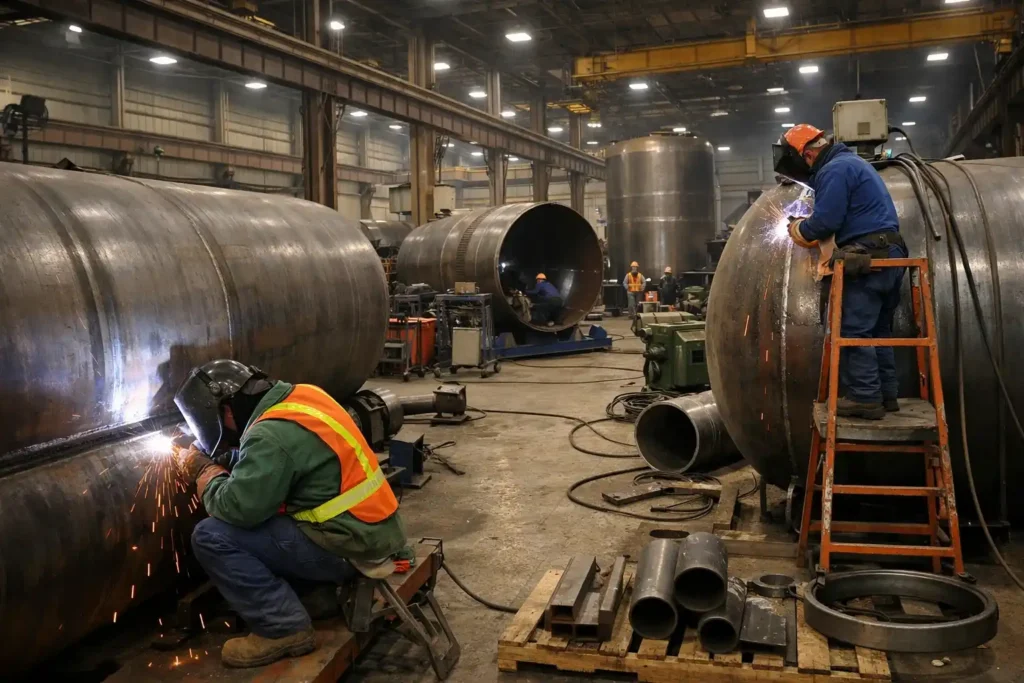
Energy storage tank fabrication is not a single task. It is a disciplined sequence of engineering, material selection, forming, welding, inspection, and testing processes, each of which must meet applicable code requirements before the next step begins.
The scope of what falls under this category is broader than many buyers initially expect. At its core, energy storage tank fabrication covers vessels designed to hold gases, liquids, or mixed-phase media under controlled pressure and temperature conditions. This includes pressure vessels, storage tanks, separator vessels, fuel gas conditioning vessels, produced water tanks, and process tanks used across oil and gas, power generation, bio gas, and industrial applications.
What separates a fabrication shop capable of this work from a general metalworking operation is the combination of engineering competency, certified welding processes, quality management systems, and regulatory compliance infrastructure. A shop without those elements cannot legally or safely produce a pressure-rated energy storage tank for commercial or industrial use in most jurisdictions.
Red River has been providing ASME-certified pressure vessel fabrication and custom industrial fabrication since 2003. Every energy storage tank we build carries the documentation, certifications, and third-party inspection records that procurement teams and project engineers require.
Why ASME Certification Is the Non-Negotiable Starting Point
The American Society of Mechanical Engineers (ASME) publishes the Boiler and Pressure Vessel Code (BPVC), which is the governing standard for pressure vessel and storage tank fabrication across the United States and in many international markets. Most state jurisdictions require ASME compliance for any vessel operating above 15 PSI internal pressure. Many project specifications require it as a contractual condition of purchase, independent of local law.
The ASME U Stamp is the specific certification a fabrication shop must hold to manufacture pressure vessels under Section VIII of the BPVC. It is not a self-certification. It requires an Authorized Inspection Agency (AIA) to audit the shop’s quality system, review its documented procedures, and provide a commissioned inspector on-site during fabrication. The U Stamp on a vessel is a statement that the design, materials, construction, and inspection all met the code’s requirements under active third-party oversight.
For buyers, this matters for two reasons. First, a tank without a valid U Stamp cannot be legally placed into service in most regulated industrial environments. Second, a U Stamp creates a documented audit trail that protects both the buyer and the operator over the tank’s full service life. When a vessel is inspected, repaired, or decommissioned years later, that documentation is the baseline record.
Red River holds an active ASME U Stamp certification and an NBBI R Stamp certification for repair and alteration work. Our welders operate under ASME-qualified weld procedures, and our shop is an American Welding Society (AWS) member. These credentials are actively maintained through regular audits, not historical certifications gathering dust.
The ASME website at asme.org maintains a searchable database of certified manufacturers where buyers can independently verify any shop’s active certification status before issuing a purchase order.
The Fabrication Process from Engineering Review to Delivery
Understanding how a properly managed fabrication process works helps buyers ask better questions and identify shops that are cutting corners. Here is how a well-run energy storage tank fabrication project progresses from initial inquiry to delivery.
Engineering Review and Design Confirmation
Every project starts with a review of operating conditions: design pressure, design temperature, fluid or gas composition, corrosion allowance requirements, applicable code (typically ASME Section VIII Division 1 or Division 2), and any client-specific supplementary requirements. If a customer provides a design, the fabricator reviews it for code compliance. If not, the fabricator develops the design from the operating parameters.
Material Selection and Procurement
Material selection is driven by the operating environment. Carbon steel is common for standard applications. Stainless steel, chrome-moly alloys, and specialty materials are required for high-temperature, corrosive, or high-pressure environments. Every material plate and fitting must come with certified mill test reports (CMTRs) that confirm chemistry and mechanical properties. Shops that cannot produce CMTRs for a vessel’s components have a traceability gap.
Plate Forming and Shell Fabrication
Plate forming involves rolling or pressing steel plate to the required shell geometry. Tolerances are tight. Weld joint fit-up must meet code requirements before welding begins.
Welding
All welding on ASME code vessels must be performed by certified welders using qualified weld procedures under an approved Welding Procedure Specification (WPS). Every weld is subject to visual inspection, and many require additional nondestructive examination (NDE) methods depending on the vessel’s design pressure, material, and joint efficiency classification.
Nondestructive Examination
Depending on the vessel design, welds may require radiographic testing (RT), ultrasonic testing (UT), magnetic particle testing (MT), or liquid penetrant testing (PT). These methods identify subsurface or surface weld discontinuities that visual inspection alone cannot detect.
Hydrostatic or Pneumatic Pressure Testing
Before a vessel is released for delivery, it is hydrostatically tested at 1.3 times the maximum allowable working pressure (MAWP) to confirm structural integrity under pressure. The test is witnessed and documented.
Final Inspection and Documentation Package
The completed vessel leaves the shop with a full documentation package: the manufacturer’s data report (ASME Form U-1), CMTRs, weld records, NDE reports, pressure test records, and the nameplate data. This package is the vessel’s permanent record. Red River manages this full sequence in-house, from our pipe fabrication and structural steel fabrication capabilities through to final documentation and delivery logistics.
Industries That Depend on Energy Storage Tank Fabrication
The range of industries that require energy storage tank fabrication services is broader than most people outside the sector realize. Each vertical has distinct design requirements, regulatory overlays, and procurement expectations.
Oil and Gas
This is the highest-volume application sector for energy storage tanks. Produced water storage, crude oil storage, natural gas separator vessels, fuel gas conditioning packages, and emulsion treater vessels are all common. Operators in this sector typically have rigorous vendor qualification processes. ASME U Stamp certification is often a hard requirement in purchase specifications. Our oil and gas fabrication work spans upstream, midstream, and downstream applications.
Power Generation
Thermal power plants, combined-cycle facilities, and renewable energy installations all use pressure vessels and storage tanks in feedwater systems, steam drums, fuel storage, and cooling systems. Operating pressures and temperatures in this sector push materials and welding to demanding limits. Reliability is paramount since unplanned downtime in power generation carries enormous financial consequences.
Bio Gas
Biogas production from anaerobic digestion and landfill gas recovery requires storage vessels designed for pressurized biogas service. Biogas is corrosive, and many biogas streams carry hydrogen sulfide (H2S) and moisture that accelerate internal corrosion. Material selection and internal coating systems are critical design elements. Our bio gas pressure vessel fabrication capability is specifically configured for these corrosive service requirements.
Minerals and Mining
Hydrometallurgical processing, acid leaching circuits, and chemical storage in mining operations all require custom fabricated vessels built for aggressive chemical environments. Material selection for corrosion resistance is a primary design driver.
Government and Commercial Projects
Municipal water systems, government infrastructure projects, and commercial industrial facilities all require ASME-compliant pressure vessels and storage tanks. Procurement processes in these sectors are typically formal, with vendor prequalification, certified documentation packages, and inspection requirements built into the contract.
How to Evaluate and Qualify a Fabrication Vendor
Every buyer’s first question should be about certification, but certification alone is not sufficient to qualify a fabricator for a critical project. Here is a structured evaluation approach.
Step 1: Verify Active ASME U Stamp Certification
Check the ASME manufacturer database directly. An active certification confirms the shop is currently audited and compliant, not just formerly certified. Verify the certificate number matches the shop you are dealing with.
Step 2: Review the Quality Management System
A compliant fabrication shop operates under a documented quality management system that covers everything from material receiving to final inspection. Ask to see the quality manual or the relevant sections covering welding, NDE, and pressure testing procedures.
Step 3: Confirm Welder Qualifications
All welders working on code vessels must hold current qualification certifications for the weld processes and positions they use. Ask for welder qualification records (WQRs) relevant to your project’s weld requirements.
Step 4: Evaluate Application Experience
Ask for references or project examples in your specific application area. A fabricator experienced in oil and gas separator vessels understands operating environments, inspection access requirements, and project coordination expectations that a general fabricator does not.
Step 5: Assess Documentation Capability
The documentation package that ships with your vessel is as important as the vessel itself. A fabricator who is vague or disorganized about documentation is a risk. Ask for a sample manufacturer’s data report and material traceability documentation from a completed project.
Step 6: Assess Communication and Project Management
Complex fabrication projects have long lead times, involve multiple inspection hold points, and require active coordination between the fabricator, the AIA inspector, and the client’s engineering team. Ask how the shop handles project communication, change management, and schedule reporting.
Red River has managed all of these elements across hundreds of projects since 2003. Our clients range from first-time industrial operators to international publicly held energy companies. Both get the same documented quality system and the same transparency throughout fabrication.
Modular Skid Packages and Integrated Storage Systems
Increasingly, energy storage is not just a tank. It is a complete integrated system delivered pre-assembled and pre-tested, ready for field connection. This is the domain of modular skid packages, and it changes the economics and logistics of project execution significantly.
A modular skid package combines a fabricated vessel or multiple vessels with their associated structural steel skid, process piping, instrumentation connections, safety relief systems, and secondary containment, all assembled and tested in the fabrication facility before shipping.
The operational advantages are substantial. Field installation time drops because the skid arrives as a tested unit rather than a collection of components requiring field assembly and commissioning. Quality control is tighter because the entire system is assembled and inspected in a controlled shop environment rather than on a construction site. For remote or challenging installation locations, this is often the difference between a manageable project and a logistical problem.
Red River fabricates complete skid-mounted energy storage systems, combining our pressure vessel fabrication, pipe fabrication, and structural steel capabilities under one quality system and one project team. Our prefabrication services cover the full scope from design coordination through pressure testing and pre-commissioning, delivered to your site schedule.
Common Energy Storage Tank Types and Their Applications
Not all energy storage tanks are alike. The design configuration, pressure rating, and material requirements vary significantly by application. Here is a reference overview of the most common types buyers encounter.
Horizontal Pressure Vessels
Horizontal orientation is common for two-phase and three-phase separator vessels in oil and gas applications, where gravity separation of liquid phases is required. They are also used for buffer storage in fuel gas systems.
Vertical Pressure Vessels
Vertical vessels are used where floor space is limited or where liquid level measurement is a primary operating concern. They are common in process industries for chemical storage, surge vessels, and reactor feed systems.
Fuel Gas Conditioning Packages
These are specialized systems that filter, heat, regulate pressure, and meter natural gas for combustion turbine or reciprocating engine applications. The vessels and piping in a fuel gas conditioning package must be designed and fabricated to ASME standards and often to additional power generation owner specifications.
Produced Water Storage Tanks
In oil and gas production, produced water is separated from crude and must be stored before disposal, injection, or treatment. These tanks vary widely in pressure rating depending on the producing formation and process design.
Custom Process Vessels
Many industrial applications require vessels that do not fit a standard category. Custom geometry, unusual nozzle configurations, internal components, and specialty liners or coatings all fall into this category. This is where fabrication experience and engineering competence matter most.
Documentation, Inspection, and Quality Control Standards
Documentation is not paperwork. For an energy storage tank, documentation is the legal and technical record that establishes the vessel’s fitness for service, its rated operating limits, and its compliance history. Gaps in documentation create liability for the operator and can result in a vessel being pulled from service during a regulatory inspection.
The core documentation package for an ASME-coded vessel includes:
- Manufacturer’s Data Report (ASME Form U-1): the primary legal document identifying the vessel, its design parameters, the applicable code, and the authorized inspector who witnessed fabrication and testing.
- Certified Mill Test Reports (CMTRs): material traceability for every major component, confirming the steel used meets mechanical and chemical requirements specified in the design.
- Weld Records: documentation of the welders, weld procedures, and filler materials used on each weld joint, confirming qualified welders used qualified procedures throughout fabrication.
- NDE Reports: results of all nondestructive examination performed on the vessel’s welds and base materials, including disposition of any indications found.
- Pressure Test Records: confirmation that the vessel was successfully tested at or above the required test pressure with no leaks or structural issues.
Red River delivers a complete documentation package with every vessel. Our clients receive organized, reviewer-ready records that satisfy third-party inspection requirements, insurance documentation requests, and regulatory audits.
Wyoming and Rocky Mountain Fabrication: Regional Considerations
Sourcing fabrication from a shop located in the Rocky Mountain region carries practical advantages for operators in Wyoming, Colorado, Montana, and adjacent states that are often underweighted in vendor selection decisions.
Shipping distance and cost are real factors for large pressure vessels and heavy skid assemblies. Oversized load permitting, route surveys, and pilot car requirements add cost and lead time to every long-haul delivery. A regional fabricator reduces those costs and frequently offers more flexibility on delivery scheduling and last-mile coordination.
Regional familiarity with oil and gas, power generation, and mining operating environments also matters. Fabricators who have worked with operators in the Powder River Basin, the Pinedale Anticline, and other Rocky Mountain producing areas understand the field conditions their equipment will operate in. That understanding informs better design decisions.
Red River is based in Gillette, Wyoming, in the heart of the Powder River Basin. We serve operators across Wyoming and the broader Rocky Mountain region, with national and international project capability for clients whose operations extend beyond the region. Our location is not a limitation. For clients in the region, it is a logistical and operational advantage.
Get Your Energy Storage Tank Built to Code
Every pressure vessel and energy storage tank Red River builds starts with a conversation about your specs, your timeline, and your compliance requirements. If you are sourcing a fabricator for your next project, contact our team or call 307.257.5332 and let’s talk through what you need.
Frequently Asked Questions
1.What is the difference between an energy storage tank and a pressure vessel?
The terms overlap but are not identical. A pressure vessel is any closed container designed to hold fluids or gases at pressures significantly above or below ambient. An energy storage tank may or may not be a pressure vessel depending on its operating pressure. When a storage tank operates above approximately 15 PSI internal pressure, ASME Section VIII requirements typically apply, and it is classified and fabricated as a pressure vessel. Your fabricator should confirm the applicable code based on your specific operating conditions before design begins.
2.Does Red River ship energy storage tanks and skid packages outside of Wyoming?
Yes. Red River serves clients across the United States and internationally. Shipping and logistics for oversized pressure vessels and skid packages can be coordinated as part of the project scope. We work regularly with operators in Colorado, Montana, North Dakota, and other states, as well as international clients.
3.How long does custom energy storage tank fabrication take?
Lead times depend on tank size, design complexity, material availability, and current shop loading. A straightforward single-compartment vessel may be completed in 8 to 14 weeks from drawing approval. Complex vessels with specialty materials, extensive internal components, or integrated skid packages will require longer schedules. Contact us with your specifications and required delivery date for an accurate timeline assessment.
4.What certifications should I require from an energy storage tank fabrication vendor?
At a minimum, require an active ASME U Stamp for any pressure-rated vessel. For repair and alteration work on existing vessels, the NBBI R Stamp is the relevant credential. AWS membership and certified welders working under qualified weld procedures are also baseline requirements. For government contracts or regulated industries, additional certifications or prequalification documentation may apply.
5.Can Red River handle fabrication for confidential or proprietary process designs?
Yes. A significant portion of our project work involves proprietary process equipment, novel technology, and client-confidential applications. We operate with full discretion and have a long record of protecting intellectual property for clients who bring early-stage or proprietary designs through fabrication. Nondisclosure agreements are a standard part of our project initiation process for sensitive work.
6.What is the NBBI R Stamp and when is it required?
The National Board of Boiler and Pressure Vessel Inspectors (NBBI) R Stamp authorizes a fabrication shop to perform repairs and alterations on pressure vessels and boilers that were originally constructed under an ASME code stamp. If your operation requires in-service repair or modification of an existing coded vessel rather than a new vessel build, an R Stamp-certified fabricator is required. Red River holds both the ASME U Stamp and NBBI R Stamp certifications, covering new construction and repair work under one quality system.
Key Takeaways
- ASME U Stamp certification is a legal requirement for pressure-rated energy storage tanks in most commercial and industrial applications. Verify it independently before awarding a purchase order.
- The documentation package, including the Form U-1, CMTRs, weld records, NDE reports, and pressure test records, is as important as the physical vessel. Gaps in documentation create long-term liability.
- Application experience matters as much as general fabrication capability. Oil and gas, power generation, bio gas, and mining each have distinct design requirements and operating environments.
- Modular skid packages reduce field installation time, improve quality control, and simplify project coordination by consolidating vessel, piping, and structural fabrication under a single quality system.
- Regional fabrication reduces shipping costs and lead time for operators in Wyoming and the Rocky Mountain region. For oversized vessels and skid packages, proximity to the installation site has real economic value.
- Evaluating a fabricator on certification, quality system, welder qualifications, application experience, documentation capability, and project communication gives a complete picture that certification alone does not.
Related Blog Post
Can Condensate Storage Improve Reliability?
Where Do Condensate Tanks Fit in a Steam System?
Which Nozzles Simplify Maintenance on Pressure Vessels?
How to Vent Condensate Tanks in Steam Systems
How Do Baffle Layouts Affect Stratification in TES Tanks?
About Author



