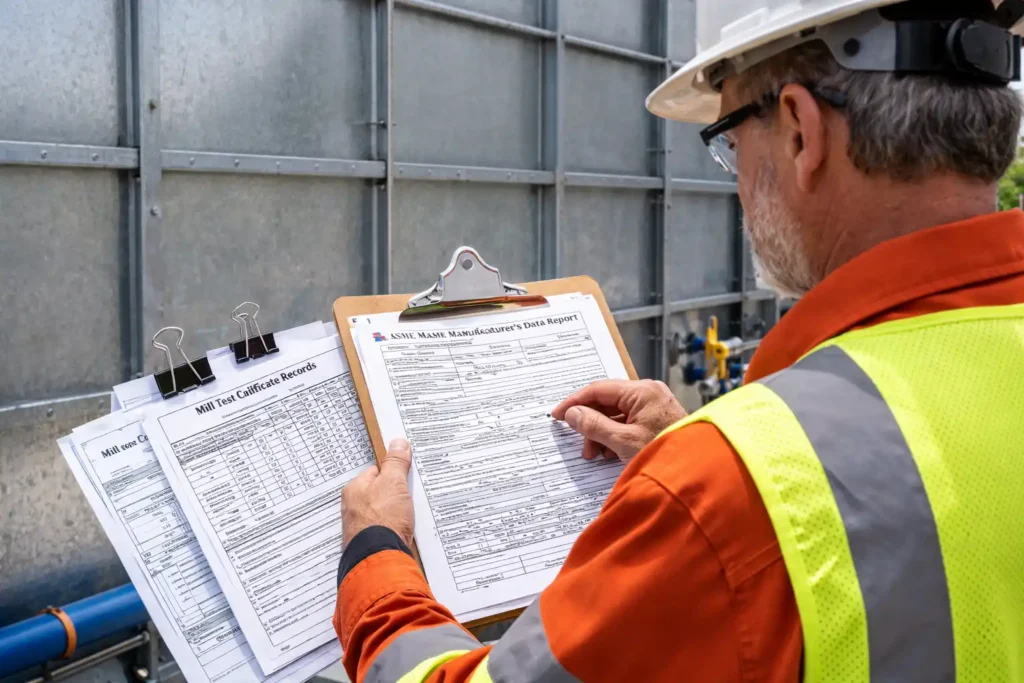
Modular tank approvals stall on paperwork gaps, not fabrication defects. This guide is written for engineers, procurement leads, and project managers who need a tank inspected, registered, and cleared on the first visit. It covers the six core documents every inspector expects, four supporting records that prevent follow-up visits, and how to organize the full package so review is verification rather than discovery
Modular tank approvals stall on missing paperwork, not design problems. This guide is for engineers, procurement leads, and project managers who need a tank inspected, registered, and cleared fast. It covers exactly which documents to ship with the vessel, why each one matters to the authority having jurisdiction, and how to organize the package so inspectors can move on the first visit. Every practice in this section comes back to the same question: what documentation speeds modular tank approval from a scheduled visit into a same-day sign-off.
Why Documentation Drives Approval Speed
A modular tank can be fabricated perfectly, welded to code, and still sit uninspected for weeks because the paperwork is incomplete. Inspectors do not have time to chase missing mill certs or reconstruct weld procedures after delivery. If the package is not ready when they arrive, they leave and you wait for the next scheduled visit.
That delay costs real money. Piping crews, electrical contractors, and startup engineers were mobilized for a specific date. A paperwork gap pushes all of them. Most project budgets do not account for a second inspector mobilization. The fabricator’s documentation discipline should be a selection criterion, not an afterthought.
Red River Co has shipped thousands of pressure vessels and modular tanks from Gillette since 2003, and every unit leaves with the full documentation package organized and indexed. That front-loaded paperwork discipline is the single biggest reason our clients rarely see approval delays.
The Core Documentation Package Every Inspector Expects
Six documents handle the overwhelming majority of inspector questions on a new modular tank. Miss any one of them and the approval timeline extends.
1. Mill Test Certificates (MTCs)
Every plate, pipe, and structural section in the tank ships with a mill certificate that traces the material back to its heat number, chemistry, and mechanical properties. Inspectors use these to confirm the material matches the design spec.
MTCs should be organized by component and indexed to the drawing, not dumped in a folder. When an inspector asks about the material grade on a specific nozzle, you want the answer in under a minute.
2. Weld Procedure Specifications (WPS) and PQRs
Every weld on a pressure-rated tank follows a documented weld procedure specification, backed by a procedure qualification record (PQR) that proves the procedure produces sound welds. These are standard ASME Section IX requirements.
The package should include the WPS for every weld type used on the tank, the supporting PQR for each, and the revision history if any procedure was updated during fabrication.
3. Welder Qualification Records
Each welder who touched the tank must be certified to the applicable WPS, and that qualification must be current. Inspectors check welder IDs against the qualification records on file.
The documentation should list every welder who worked on the tank, their qualification scope, the date of their most recent continuity record, and the welds they performed. No gaps, no expired certifications.
4. Hydrostatic Test Records
Hydrotest proves the vessel holds its design pressure without leaking or deforming. The test record documents the fill water source, test pressure, hold time, ambient temperature, and inspector sign-off.
For modular tanks assembled in the field, hydrotest typically happens on-site after final assembly. The shop-side hydrotest of individual sections is documented separately and both records should be available.
5. Manufacturer’s Data Report (U-1 Form for ASME Builds)
The Manufacturer’s Data Report is the single most important document in the approval package. For ASME-stamped tanks, this is the U-1 form, and it captures design pressure, design temperature, material specifications, weld details, inspection results, and the authorized inspector’s sign-off.
The U-1 is what the National Board registers, and it is the document every future inspector will reference throughout the tank’s service life. Get it wrong and the problem follows the tank for decades.
6. National Board Registration
Any ASME-stamped pressure vessel intended for service in most US jurisdictions must be registered with the National Board of Boiler and Pressure Vessel Inspectors. Registration assigns a permanent tracking number that ties the vessel to its U-1 form and inspection history.
Need a modular tank with documentation ready from day one? Request a quote from Red River or call 1-307-257-5332 to walk through the full documentation package for your project.
Supporting Documents That Speed Review
Beyond the core six, four additional documents resolve the most common inspector follow-up questions and prevent second visits.
Coating and Lining Certifications
For potable water service, NSF/ANSI 61 certification on the interior coating is mandatory. For produced water, chemical-resistant coating specs with compatibility data resolve any questions about service life. The certification should include application thickness, cure conditions, and batch traceability.
Nondestructive Examination (NDE) Reports
Radiographic testing on critical welds, dye penetrant testing on fillet welds, and ultrasonic testing on thick sections all generate reports that validate weld integrity beyond visual inspection. For high-pressure or high-cyclic applications, NDE records are not optional.
Design Calculation Package
For tanks in seismic-active zones or non-standard service conditions, the design calc package shows how the vessel handles lateral loads, cyclic pressure, and thermal expansion. An engineer of record signature on the cover page carries weight with local inspectors.
Foundation and Anchor Documentation
The tank fabricator provides the foundation load data, but the civil contractor’s as-built ringwall drawings and anchor pull test records close the loop. Inspectors want to see that the foundation matches the design spec the tank was engineered for.
How to Organize the Package for Fast Inspection
Documentation that exists but cannot be found might as well not exist. Three practices separate a fast inspection from a slow one.
Index everything to the drawing. Every document in the package should reference the drawing number it supports. An inspector asking about the nozzle on the north side of the tank should find mill cert, weld record, and NDE report in one pull.
Digital and hard copy both. Inspectors work in the field where WiFi is unreliable. A three-ring binder with tabbed sections travels well, and a USB drive with the same content as searchable PDFs covers the digital request.
Deliver the package before the inspector arrives. Email the full package 48 hours ahead of the inspection visit. If the inspector can pre-review, the on-site inspection is verification rather than discovery, which cuts review time by more than half.
What Happens When Documentation Is Incomplete
The inspection is postponed, not waived
A second mobilization fee is triggered
Schedule delays run 2-6 weeks depending on inspector availability in the jurisdiction
Some jurisdictions require re-application if the initial inspection visit is inconclusive
The fabricator’s documentation discipline (not the inspector’s schedule) is the controllable variable. If you are specifying a modular tank and need the documentation package ready on day one, talk to the fabrication team that builds it into every order. Request a quote from Red River or call 1-307-257-5332.
Ready to Get Your Tank Approved Without Delays?
If you are specifying a modular tank and want the documentation ready on day one, the smartest next step is a fabrication review with engineers who handle the full paperwork discipline on every build. Request a quote from Red River or call 1-307-257-5332 to talk through your project, code requirements, and approval timeline.
Frequently Asked Questions
1. When are modular tanks better than single tanks?
Modular wins on restricted sites, when transport permits get costly, or when capacity needs to scale in phases. Single tanks stay better for open sites with static capacity.
2. How do seismic limits affect modular tanks?
Seismic category drives anchor sizing, panel thickness, and foundation loads. Higher-seismic sites (ASCE 7 categories D, E, F) need heavier anchors and reinforced ringwalls, which we spec during design review.
3. Who signs off on the Manufacturer’s Data Report?
The fabricator’s authorized representative and the Authorized Inspector (AI) both sign. The AI is a third-party inspector certified by the National Board, and without that signature the U-1 is not valid.
4. Do atmospheric tanks need the same documentation as pressure-rated tanks?
No. Atmospheric tanks built to API 650 or AWWA D103 do not require ASME U Stamp documentation, but mill certs, weld records, welder qualifications, and hydrotest records still apply. The code determines the specific paperwork set.
5. What happens if documentation is missing during inspection?
The inspection is typically postponed until the missing documents are produced. For field inspections, that means a second mobilization fee and a schedule delay that can run weeks depending on inspector availability.
Key Takeaways
- Ship every modular tank with the core six documents: MTCs, WPS/PQRs, welder qualifications, hydrotest records, Manufacturer’s Data Report, and National Board registration
- Add coating certifications, NDE reports, design calcs, and foundation records as supporting documents for faster approval
- Index every document to the drawing number so inspectors can answer questions in seconds, not minutes
- Deliver the full documentation package 48 hours before the inspection to turn on-site review into verification
- Confirm your fabricator carries the ASME U Stamp and registers tanks with the National Board, because missing code compliance cannot be fixed with paperwork aloneseismic
Related Blog Post
Can Condensate Storage Improve Reliability?
Where Do Condensate Tanks Fit in a Steam System?
Which Nozzles Simplify Maintenance on Pressure Vessels?
How to Vent Condensate Tanks in Steam Systems
How Do Baffle Layouts Affect Stratification in TES Tanks?
About Author