
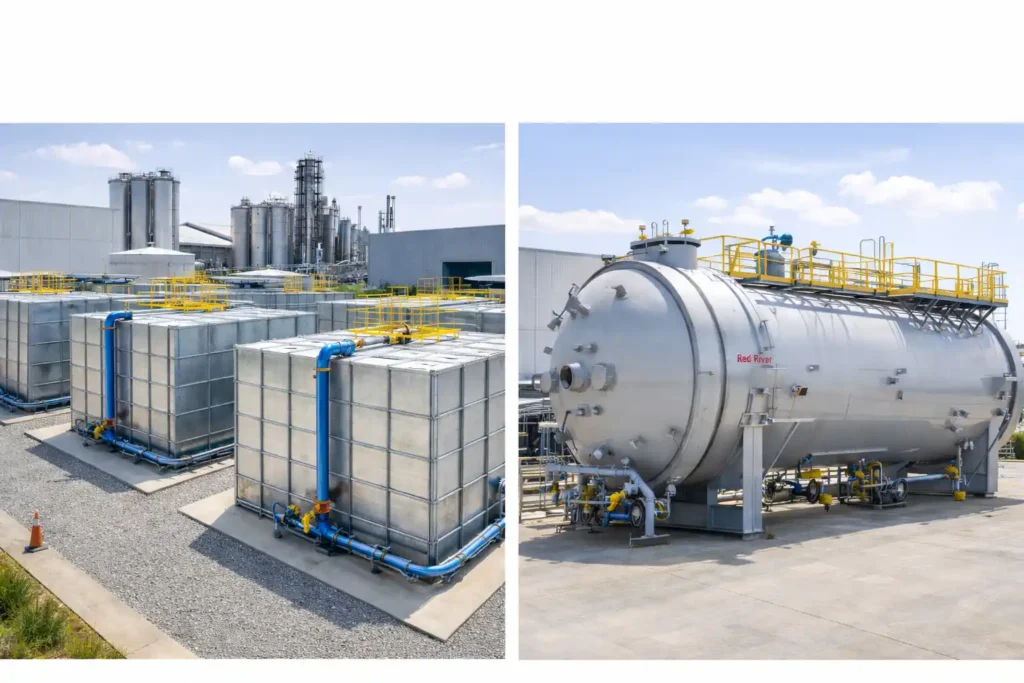
When are modular tanks better than single tanks? The answer comes down to site access, transport logistics, and whether your capacity needs are fixed or phased. This guide is for engineers, procurement managers, and project leads evaluating both options. You will walk away knowing exactly which configuration fits your project and why.
The Real Question Behind the Decision
Most teams do not start with “modular or single.” They start with a capacity number, a site footprint, and a deadline. The tank type question shows up once those constraints collide with reality: a road weight limit, a concrete pad that will not fit a 60-foot vessel, or a phased budget that cannot fund one large pressure vessel up front.
That is where modular tanks earn their place. A modular approach splits capacity across two or more smaller vessels, often shipped as skid-mounted units and tied together on site. Single tanks still win for many applications, but there are clear cases where going modular is the stronger engineering and business call. Knowing when modular tanks are better than single tanks is rarely obvious from the spec sheet alone. The real answer surfaces on-site, not in the office.
When Modular Tanks Win
1. The Site Has Access or Space Restrictions
Remote pads in the Powder River Basin, refinery yards with live piping overhead, and elevated platforms all share the same problem: you cannot always crane in a 120,000-gallon single vessel. Modular tanks solve that constraint.
Smaller individual units clear tight gates, fit under pipe racks, and can be positioned by standard rigging crews instead of specialized heavy-lift contractors. For a lot of oil and gas operators, that alone justifies the modular route.
2. Transport Logistics Push Costs Past the Tipping Point
Once a vessel crosses roughly 12 feet in diameter, you are usually looking at permitted loads, pilot vehicles, and route surveys. Cross two states with those requirements, and the logistics bill starts rivaling the fabrication cost.
Modular pressure vessels stay within standard shipping envelopes. You trade one expensive superload for several routine flatbed runs, and your project schedule no longer hinges on a single permit approval. For international jobs, modular units drop cleanly into standard shipping containers, which is a meaningful advantage when your equipment has to clear customs.
3. You Need Phased Capacity, Not Day-One Capacity
Single tanks force a full capital commitment on day one. Modular configurations let you install 50 percent of the storage now and add the rest in year two or year three as production ramps.
Bio gas operators and mineral processing startups lean on this approach often. It matches tank capacity to actual throughput, keeps early capex lower, and avoids the waste of oversized equipment sitting half-empty during the commissioning years.
Talking through a phased capacity project? Request a fabrication consultation, and we will walk you through the trade-offs for your specific site and volume curve.
4. Redundancy and Uptime Matter More Than Simplicity
Single tanks are elegant until one needs an internal inspection, a hydrotest, or an NBBI R Stamp repair. When that tank goes offline, the whole process goes offline with it. Modular pressure vessel fabrication builds natural redundancy right into the system.
You can rotate vessels through inspection cycles without shutting down production, isolate a unit for a weld repair while the rest of the train keeps running, and meet ASME inspection intervals without scheduling expensive full-plant turnarounds. For power generation and gas processing facilities where downtime costs are measured in thousands per hour, the math favors modular.
5. Process Flexibility Is a Requirement
Some operations run different fluids, different temperatures, or different pressures across a single storage system. Utilizing skid-mounted storage tanks lets you vary materials and ratings across the skid. One vessel might be carbon steel for feedstock, another stainless for finished product, a third rated for higher pressure cycling.
A single tank forces you to design to the most demanding spec across every condition, which usually means overbuilding and overpaying.
When Single Tanks Still Make Sense
Knowing when modular tanks are better than single tanks also means recognizing when they are not. Single tanks are the right call when your site has generous access, road clearance is unrestricted, and your capacity requirements are locked in from day one. A single ASME-stamped vessel uses less total steel per gallon of storage, has fewer connection points (which means fewer potential leak paths), and keeps instrumentation straightforward: one level transmitter, one pressure gauge, one set of controls.
For bulk liquid or gas storage at a fixed volume, a single vessel is typically lower cost per gallon on fabrication alone and simpler to maintain over its service life. If your process runs a single fluid at a consistent temperature and pressure, there is no engineering reason to split that into multiple vessels and add the tie-in piping that comes with them.
Single tanks also make sense when the timeline is tight and the permitting environment is predictable. A single large vessel can be engineered, stamped, and shipped as one unit without the coordination overhead of scheduling multiple vessels through inspection and delivery in sequence
For straightforward bulk storage at fixed volumes, a single ASME-stamped pressure vessel is usually cheaper per gallon and simpler to maintain.
Cost Comparison: How the Numbers Actually Shake Out
When evaluating when modular tanks are better than single tanks, total installed cost tells a different story than fabrication cost alone.
| Factor | Single Tank | Modular Tanks |
| Fabrication cost per gallon | Lower | 10 to 25 percent higher |
| Transport cost | Higher (permits, superloads) | Standard freight rates |
| Installation complexity | Simple foundation, one set | More piping and tie-ins |
| Phased investment | Full capex day one | Capex spread across phases |
| Redundancy for maintenance | None without a spare | Built in |
| Customization per vessel | Single spec only | Mix materials and ratings |
The headline cost favors single tanks on fabrication alone. The total installed cost, including transport, site prep, downtime risk, and future expansion, often tips the scales back toward modular on complex sites.
Working With a Fabricator Who Builds Both
Understanding when modular tanks are better than single tanks comes down to four variables: site access, transport cost, capacity phasing, and uptime requirements. If you are weighing modular against single for an upcoming project, the smartest next step is a fabrication review with engineers who build both every day. Request a quote from Red River or call 1-307-257-5332 to talk through your site, capacity, and schedule.
The cleanest way to avoid a bad configuration decision is to work with a fabricator who has built both modular and single-vessel systems at scale, and who will tell you which one actually fits your project rather than which one is easier to quote.
Red River has experience optimizing ASME pressure vessel configuration design across both types for oil and gas operators, biogas facilities, and power generation clients since 2003. Our engineering team reviews site footprint, transport route, capacity curve, and inspection requirements before recommending a configuration. If a single tank is the right answer, we will say so.
That kind of straight answer is what you should expect from any fabricator you put on your shortlist.
How Certifications Apply to Both
Whether you go modular or single, the code requirements do not change. Every pressure vessel built for oil and gas, power generation, or biogas service in the United States must carry the ASME U Stamp, meet ASME Boiler and Pressure Vessel Code Section VIII requirements, and be registered with the National Board where applicable.
The difference with modular setups is that each vessel gets its own nameplate, its own inspection record, and its own serial number. That paperwork volume is higher, but for large facilities, it actually helps with maintenance tracking and audit readiness.
Ready to Spec the Right Configuration?
If you are weighing modular against single for an upcoming project, the smartest next step is a fabrication review with engineers who build both every day. Request a quote from Red River or call 1-307-257-5332 to talk through your site, capacity, and schedule.
Frequently Asked Questions
1. How do seismic limits affect modular tanks?
Seismic category drives anchor sizing, panel thickness, and foundation loads. Higher-seismic sites (ASCE 7 categories D, E, F) need heavier anchors and reinforced ringwalls, which we spec during design review.
2. What documentation speeds modular tank approval?
Mill certs, weld procedures, welder qualifications, hydrotest records, and a manufacturer’s data report cover most inspector questions. For ASME builds, add the U-1 form and National Board registration.
3. Can modular tanks handle the same pressures as a single vessel?
Yes. Modular vessels are designed to the same MAWP, temperature, and cyclic loading requirements as any single tank. The fabricator sizes wall thickness, material grade, and weld procedures to match the service conditions of each unit.
4. How long does a modular tank project typically take to fabricate?
Lead times vary with size and material, but modular builds often ship faster than comparable single vessels because smaller units can run in parallel on the shop floor. Expect 12 to 20 weeks for most standard modular configurations.
5. What industries use modular tanks most often?
Oil and gas, bio gas, power generation, mining and minerals, and government facilities all use modular configurations regularly. Any industry with phased builds, tight sites, or high uptime requirements leans modular.
Key Takeaways
- When modular tanks are better than single tanks comes down to this: choose modular when site access, transport weight limits, or permit costs make a single large vessel impractical to deliver and install
- Go modular when your project needs phased capacity that matches production ramp-up, not full volume on day one
- Default to single tanks for simple bulk storage with static capacity and good site access: the per-gallon fabrication cost is lower
- Factor redundancy into the decision for any facility where unplanned downtime costs more than the premium of a modular build
- Confirm every vessel carries the ASME U Stamp and required NBBI registration, regardless of which configuration you pick
Related Blog Post
Can Condensate Storage Improve Reliability?
Where Do Condensate Tanks Fit in a Steam System?
Which Nozzles Simplify Maintenance on Pressure Vessels?
How to Vent Condensate Tanks in Steam Systems
How Do Baffle Layouts Affect Stratification in TES Tanks?
About Author



