
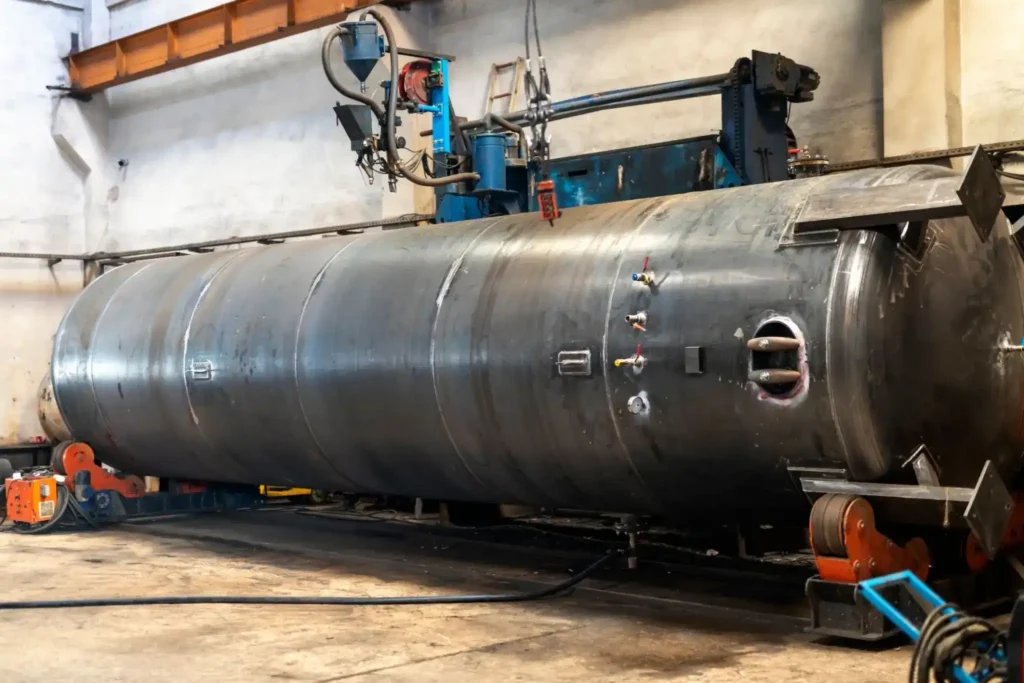
Deaeration is validated through three distinct test types: dissolved oxygen measurement confirms the deaerator achieves the 0.005 cc/liter performance threshold, hydrostatic pressure testing confirms the storage vessel holds pressure to ASME code, and weld NDE confirms the fabrication integrity of every pressure-retaining joint. All three must pass before a deaerator system is considered ready for service.
Key Takeaways
- Deaeration testing standards require validation through dissolved oxygen performance testing, hydrostatic pressure testing of the storage vessel, and weld nondestructive examination during fabrication.
- HEI Standards for Deaerators require dissolved oxygen in deaerated feedwater to be 0.005 cc/liter (approximately 7 ppb) or below at design operating conditions.
- ASME BPVC Section VIII requires hydrostatic testing of the deaerator storage vessel at a minimum of 1.3 times the MAWP before the vessel leaves the fabrication facility.
- NDE weld examination pressure vessel requirements include radiographic, ultrasonic, magnetic particle, and liquid penetrant testing, applied based on joint category and design requirements.
- Every ASME vessel requires a Manufacturer’s Data Report (Form U-1), hydrostatic test record, NDE reports, and MTRs as permanent documentation, forming the deaerator performance acceptance test record.
- Red River coordinates hydrostatic pressure testing and NDE examination through an ASME Authorized Inspector on every deaerator storage vessel, with full documentation delivered with each vessel.
Why Deaeration Testing Matters
A deaerator not performing to specification puts the entire boiler system at risk. Dissolved oxygen left in feedwater corrodes boiler tubes, heat exchanger surfaces, and feedwater piping from the inside, leading to tube failures and unplanned shutdowns. Performance validation confirms dissolved gases are removed to within the specified threshold. Vessel integrity validation confirms the pressure vessel meets ASME code requirements. Both must pass before the system enters service.
What Is the Primary Test for Deaeration Performance?
The primary test for deaeration performance is dissolved oxygen testing at the boiler feedwater outlet. Deaeration testing standards set by the Heat Exchange Institute (HEI) require dissolved oxygen to be 0.005 cc/liter (approximately 7 ppb) or less at design operating conditions. The dissolved oxygen testing boiler feedwater standard is measured after the deaerator reaches thermal equilibrium at rated steam flow and feedwater temperature.
Required Test Conditions
Testing must be conducted at 100 percent of rated feedwater flow, with steam supply at rated operating pressure, with inlet feedwater at the design temperature, and after a stabilization period of 15 to 30 minutes at steady state. A deaerator that cannot consistently achieve this threshold fails the deaerator performance acceptance test and requires adjustment or replacement of internal components. See Red River’s pressure vessel fabrication for how deaerator storage vessels are fabricated to support commissioning performance testing.
What Is a Hydrostatic Pressure Test and When Is It Required?
A hydrostatic pressure test deaerator requirement applies to every ASME pressure vessel before it leaves the fabrication facility. Under ASME BPVC Section VIII, Division 1, the test is performed at a minimum of 1.3 times the MAWP. For a deaerator storage vessel rated at 15 psig MAWP, the minimum test pressure is 19.5 psig, held for a defined duration while inspected for leaks or distortion.
The test uses water because it is incompressible. A failure during hydrostatic testing produces a controlled pressure drop rather than an explosive rupture. An ASME Authorized Inspector witnesses and documents the test before issuing the ASME Data Report. Red River coordinates hydrostatic pressure testing on every deaerator storage vessel as a standard fabrication step. See Red River’s capabilities for how pressure testing is managed across vessel scopes.
When Is Pneumatic Testing Used Instead?
ASME BPVC Section VIII permits pneumatic testing only when water testing is impractical. Pneumatic tests are conducted at approximately 1.1 times the MAWP. Because gas is compressible and stores more energy than water at equivalent pressure, pneumatic testing carries higher risk and requires additional safety precautions. For most deaerator storage vessels, the hydrostatic pressure test is the required method.
What NDE Weld Examination Applies to Deaerators?
NDE weld examination pressure vessel requirements under ASME BPVC Section VIII are based on the joint efficiency assumed in the vessel design. The four primary methods applied to deaerator vessels are radiographic testing (RT) for internal defects, ultrasonic testing (UT) for flaws and wall thickness, magnetic particle testing (MT) for surface discontinuities on ferromagnetic welds, and liquid penetrant testing (PT) for surface-breaking defects on stainless steel components. Red River coordinates all required NDE weld examination through qualified inspection personnel. See Red River’s prefabrication services for how NDE documentation is managed across modular feedwater system scopes.
What Documentation Is Produced by Deaeration Testing?
Each test produces a permanent vessel record required for ASME registration with the National Board and retained by the owner for the life of the vessel. The standard documentation package includes the ASME Manufacturer’s Data Report (Form U-1), hydrostatic test record, NDE examination reports, dissolved oxygen test record, and material test reports. Red River delivers a complete documentation package with every vessel. See Red River’s modular skid packages for how integrated documentation is managed across complete feedwater system assemblies.
What This Means When Specifying a Deaerator Vessel
Which tests validate deaeration determines what documentation and performance records must be produced before a deaerator system enters service. The three-layer validation, dissolved oxygen measurement, hydrostatic testing, and NDE weld examination, each addresses a failure mode the others cannot detect. Skipping any one leaves a gap that surfaces as a maintenance problem, an insurance issue, or a regulatory finding later in the vessel’s service life.
Source Your Deaerator Vessel From Red River
Red River fabricates ASME-certified deaerator storage vessels for boiler feedwater and process applications across oil and gas, power generation, and industrial sectors from Gillette, Wyoming, since 2003. Red River holds active ASME U Stamp and NBBI R Stamp certifications and is an American Welding Society (AWS) member. Every vessel ships with full hydrostatic test documentation, NDE records, MTRs, and an ASME Authorized Inspector sign-off. Request a quote or call 1-307-257-5332 to discuss your deaerator vessel requirements.
Frequently Asked Questions
1. What Dissolved Oxygen Level Confirms Deaeration Is Working?
Deaeration is confirmed when dissolved oxygen testing at the boiler feedwater outlet measures 0.005 cc/liter (approximately 7 ppb) or below. This is the acceptance threshold defined by HEI deaeration testing standards, measured at design flow and operating conditions after the system reaches thermal equilibrium.
2. Is a Hydrostatic Test Required for Every Deaerator Vessel?
Yes. ASME BPVC Section VIII requires a hydrostatic pressure test for every pressure vessel, including deaerator storage tanks, before the vessel is placed in service. The test is conducted at a minimum of 1.3 times the MAWP, witnessed by an ASME Authorized Inspector.
3. What Is the Difference Between Hydrostatic and Pneumatic Testing?
Hydrostatic testing uses water and is the standard ASME method. Pneumatic testing uses compressed gas and is permitted only when water testing is impractical. Pneumatic testing carries higher risk due to the compressibility of gas and requires additional safety precautions.
4. Who Witnesses the Hydrostatic Test on an ASME Pressure Vessel?
An ASME Authorized Inspector employed by a third-party inspection organization accredited by ASME witnesses and documents the hydrostatic test and signs the Manufacturer’s Data Report confirming the test was completed to code requirements.
5. Does Red River Provide Test Documentation With Deaerator Vessels?
Yes. Every deaerator storage vessel Red River fabricates ships with the ASME Manufacturer’s Data Report (Form U-1), hydrostatic test record, NDE examination reports, and material test records. Request a quote or call 1-307-257-5332 to discuss your project requirements.
Related Blog Post
Can Condensate Storage Improve Reliability?
Where Do Condensate Tanks Fit in a Steam System?
Which Nozzles Simplify Maintenance on Pressure Vessels?
How to Vent Condensate Tanks in Steam Systems
How Do Baffle Layouts Affect Stratification in TES Tanks?
About Author



