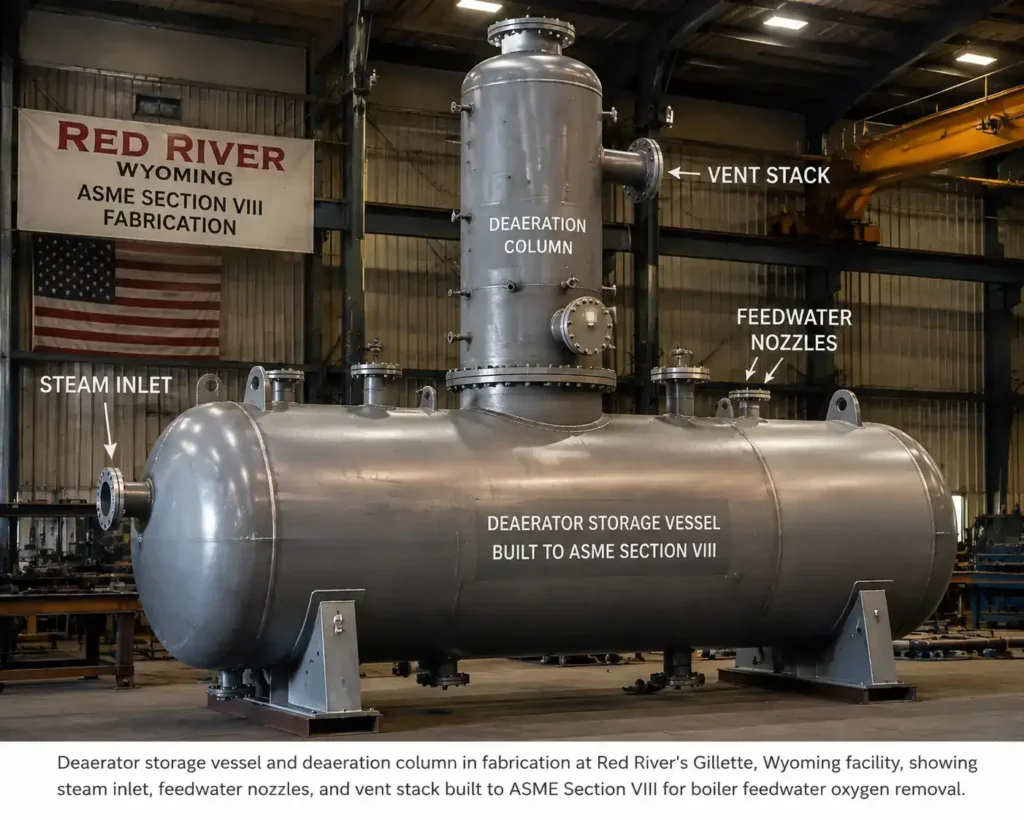
Deaerator tanks cut oxygen by heating boiler feedwater to its saturation temperature and mechanically agitating it so dissolved gases leave solution and vent continuously to the atmosphere, reducing dissolved oxygen to below 0.005 cc per liter. At that level, oxygen pitting corrosion in carbon steel boiler tubes and condensate return lines becomes negligible.
Key Takeaways
- Deaerator oxygen removal works by exploiting the relationship between water temperature and gas solubility. As feedwater temperature rises to saturation, the solubility of dissolved oxygen and carbon dioxide drops to near zero.
- Mechanical agitation through tray cascades or spray nozzles increases the water surface area exposed to the steam atmosphere, accelerating gas release and improving the feedwater deaeration process.
- A properly operating deaerator reduces boiler feedwater dissolved oxygen to below 0.005 cc per liter, approximately seven parts per billion by weight, the threshold below which oxygen corrosion in boiler components becomes negligible.
- The vent on every deaerator tank continuously exhausts the released gases. A partially closed vent restricts gas removal and allows dissolved oxygen to remain in the treated feedwater.
- Every deaerator storage vessel operating above 15 psig requires ASME U Stamp certification under Section VIII, Division 1.
Why Does Dissolved Oxygen Destroy Boiler Systems?
Dissolved oxygen in boiler feedwater attacks carbon steel through oxygen pitting. Oxygen molecules react with iron in the vessel walls, tubes, and piping to form iron oxide, which flakes away and exposes fresh metal. Each cycle creates a smaller, deeper pit.
Why Oxygen Corrosion in Boiler Systems Is Particularly Damaging
Oxygen corrosion in boiler systems is localized and fast, which is the same oxygen corrosion boiler operators encounter under the name oxygen pitting. A tube that shows no external sign of damage can develop a through-wall pit within months at elevated dissolved oxygen levels. The failure mode is sudden and the consequences in a pressurized steam system are serious.
Why Mechanical Deaeration Is the Primary Removal Method
The U.S. Department of Energy identifies dissolved oxygen as the most damaging contaminant in boiler feedwater and confirms that mechanical deaeration is the most reliable removal method at industrial scale. Chemical oxygen scavengers such as sodium sulfite or hydrazine address residual dissolved oxygen after deaeration but are not a substitute for a properly operating deaerator.
What Is the Physics Behind Deaerator Oxygen Removal?
Deaerator tank operation is governed by Henry’s Law: gas solubility in water is proportional to the partial pressure of that gas above the liquid surface. As feedwater temperature rises to saturation, vapor pressure increases and the partial pressure of oxygen drops, driving dissolved gases out of solution almost completely.
Stage 1: Heating the Feedwater to Saturation
Incoming feedwater is brought rapidly to saturation temperature by direct contact with steam. The closer feedwater temperature reaches saturation, the more dissolved gas leaves solution. Inadequate steam supply or undersized steam connections limit deaerator oxygen removal efficiency.
Stage 2: Separation and Venting
Once dissolved gases come out of solution, they must be separated from the water and removed before they can dissolve back in. Mechanical agitation through tray cascades or spray nozzles keeps fresh water surfaces exposed to the steam atmosphere. The steam flow carries released gases to the vent, which must remain open and correctly sized.
What Are the Main Deaerator Tank Design Types?
Two primary designs accomplish the feedwater deaeration process through different internal mechanical arrangements. Both achieve deaerator oxygen removal to below 0.005 cc per liter when correctly sized and operated.
Tray-Type Deaerators
In a tray deaerator, feedwater cascades over stainless steel trays inside the deaeration column. Steam flows countercurrently upward through the falling water, creating high surface area contact. Tray deaerators perform well across a wide operating range and are the preferred choice for large power generation facilities and continuous high-flow industrial steam systems.
Spray-Type Deaerators
In a spray deaerator, feedwater passes through atomizing nozzles that break it into fine droplets dispersed into the steam space. Spray designs are mechanically simpler and standard in packaged boiler installations and smaller industrial systems. Performance is more sensitive to changes in inlet water temperature and steam pressure than tray designs.
Combined Tray and Spray Designs
Most modern industrial deaerators use both mechanisms: spray nozzles for initial heating and partial oxygen removal, followed by a tray section for final polishing. Red River’s pressure vessel fabrication scope covers deaerator storage vessels for all three design types. See Red River’s capabilities for how deaerator vessels are fabricated for power generation, oil and gas, and biogas steam systems.
Why Does the Deaerator Vent Matter?
The vent is a critical component of how a deaerator tank cuts oxygen. Released gases must be continuously exhausted to atmosphere. A correctly sized vent releases approximately one to three percent of total steam supply, with a visible continuous plume under normal load conditions. Operators who throttle the vent sacrifice oxygen removal efficiency. The steam saved typically costs far more in boiler tube maintenance than the energy saving justifies.
What ASME Requirements Apply to Deaerator Vessels?
Every deaerator storage vessel operating above 15 psig must carry the ASME U Stamp under ASME Section VIII, Division 1. ASME code governs material selection, weld quality, nozzle reinforcement, and hydrostatic testing at 1.3 times the MAWP. The National Board maintains permanent registration records for all stamped vessels.
Red River holds active ASME U Stamp and NBBI R Stamp certifications. Every coded deaerator vessel ships with the ASME Form U-1, certified mill test reports, weld procedure qualification records, NDE examination reports coordinated through qualified inspection personnel, and the hydrostatic test record. See Red River’s modular skid packages for how deaerator vessels are integrated into complete steam generation skid assemblies.
What This Means When Specifying a Deaerator Vessel
Deaerator tank operation at the correct design pressure, vent sizing, and internal configuration determines whether the boiler feedwater dissolved oxygen target of 0.005 cc per liter is actually achieved in service. A correctly sized vessel that is poorly vented or operating with inadequate steam supply provides only partial deaeration, and the oxygen corrosion in boiler tubes accumulates silently until a failure occurs. The specification decisions belong in the design phase, confirmed before fabrication begins.
Discuss Your Deaerator Tank Requirements With Red River
Red River fabricates ASME-certified deaerator storage vessels for power generation, oil and gas, biogas, and industrial process steam applications from Gillette, Wyoming, since 2003. Red River holds active ASME U Stamp and NBBI R Stamp certifications and is an American Welding Society (AWS) member. Request a quote or call 1-307-257-5332 to discuss your deaerator vessel design pressure, internal configuration, and fabrication scope.
Frequently Asked Questions
1. How Do Deaerator Tanks Cut Oxygen Without Chemicals?
Deaerator tanks cut oxygen through a physical feedwater deaeration process based on Henry’s Law: as feedwater temperature rises to saturation, the solubility of dissolved oxygen drops to near zero. Mechanical agitation through tray cascades or spray nozzles maximizes water surface area exposed to the steam atmosphere, accelerating gas release. Chemical oxygen scavengers address residual dissolved oxygen after mechanical deaeration and are not a substitute for a properly operating deaerator.
2. What Boiler Feedwater Dissolved Oxygen Level Does a Deaerator Achieve?
A properly operating deaerator reduces boiler feedwater dissolved oxygen to below 0.005 cc per liter, approximately seven parts per billion by weight. This is the threshold below which oxygen pitting corrosion becomes negligible in carbon steel boiler tubes and condensate return piping. Actual performance depends on operating pressure, inlet water temperature, steam flow rate, and the condition of internal components.
3. Why Does the Deaerator Vent Need to Stay Open?
The vent exhausts dissolved gases driven out of solution by the deaeration process. If throttled or blocked, released gases accumulate in the steam space and raise their partial pressure above the water surface, reducing the driving force for further gas release. A continuously venting deaerator is operating correctly. One with no visible vent plume requires investigation.
4. Can a Deaerator Cut Oxygen Without Adequate Steam Supply?
No. Steam supplies the heat needed to raise feedwater temperature to saturation and carries released gases to the vent. A deaerator operating without adequate steam will not reach saturation temperature and will not provide the scrubbing flow needed to remove released gases. Systems with undersized steam connections consistently show elevated dissolved oxygen in treated feedwater.
5. Does a Deaerator Need to Be ASME-Certified to Operate Legally?
Yes. Any deaerator storage vessel or deaeration column operating above 15 psig must carry the ASME U Stamp under Section VIII, Division 1. Operating a non-coded pressure vessel in this service is a code violation that affects insurance coverage, jurisdictional registration, and plant safety compliance. Verify the fabricator’s U Stamp certification is active before awarding a contract.
Related Blog Post
Can Condensate Storage Improve Reliability?
Where Do Condensate Tanks Fit in a Steam System?
Which Nozzles Simplify Maintenance on Pressure Vessels?
How to Vent Condensate Tanks in Steam Systems
How Do Baffle Layouts Affect Stratification in TES Tanks?
About Author