
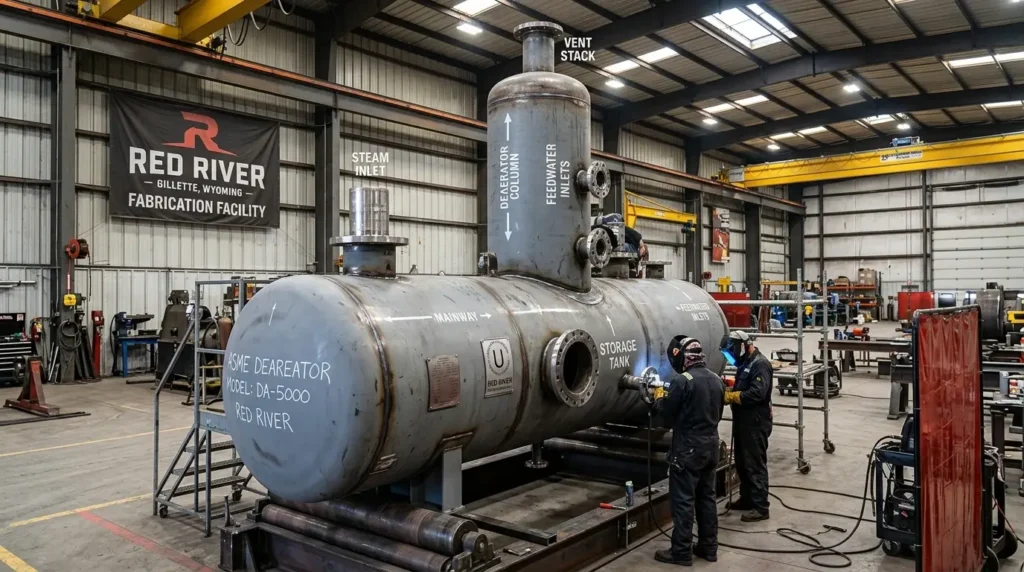
Deaerators are required in steam boiler systems and hot-water heating applications when dissolved oxygen and carbon dioxide must be removed from feedwater to prevent corrosion, pitting, and premature equipment failure. They are mandated by system design standards, boiler codes, and plant operating requirements, and the deaerator pressure vessel must be built to ASME Section VIII when operating above defined pressure thresholds.
Key Takeaways
- Deaerators are required in high-pressure steam systems, continuous makeup water applications, power generation plants, and process facilities where dissolved oxygen corrosion risk is significant.
- ASME BPVC Section VIII governs deaerator pressure vessel fabrication. Fabricators must hold the ASME U Stamp to manufacture code-compliant vessels.
- HEI standards deaerator performance specifications cover oxygen removal efficiency and venting capacity for spray and tray-type designs.
- Signs a system needs a deaerator include persistent corrosion, high feedwater oxygen readings above 7 parts per billion, and significant makeup water volume added continuously.
- Deaerators are sized based on boiler feedwater flow rate, condensate return percentage, and steam load requirements.
- An ASME U Stamp and NBBI R Stamp certified fabricator ensures the deaerator pressure vessel is code-compliant and documented for National Board registration.
What Is a Deaerator and What Does It Do?
A deaerator is a pressure vessel designed to remove dissolved gases, primarily oxygen and carbon dioxide, from boiler feedwater deaeration systems before water enters the boiler. Dissolved oxygen is the leading cause of corrosion and pitting in boiler tubes, feedwater lines, and heat exchangers. Carbon dioxide forms carbonic acid in condensate return systems, accelerating pipe degradation.
Deaerators heat feedwater to the saturation temperature of the steam being injected, driving dissolved gases out of solution. The gases are then vented continuously to atmosphere, reducing dissolved oxygen to below seven parts per billion, the industry standard threshold for corrosion control. See Red River’s pressure vessel fabrication scope for how deaerator storage vessels are fabricated across spray and tray-type designs.
When Are Deaerators Legally or Operationally Required?
Deaerators are not mandated by a single federal law, but become required under a combination of technical necessity, code compliance, and engineering specification in several defined scenarios.
High-Pressure Steam Boiler Systems
ASME BPVC Section I governs power boilers, and most engineering standards for systems operating above 15 psig treat deaeration as a design requirement. At these pressures, dissolved oxygen causes accelerated corrosion not manageable through chemical treatment alone.
Continuous Feedwater Supply Systems
Any boiler system with continuous makeup water requirements requires boiler feedwater deaeration. Fresh water carries significantly more dissolved oxygen than recirculated condensate. Without a deaerator, chemical oxygen scavengers become inadequate as the sole corrosion control method at scale.
Utility and Combined Heat and Power Applications
Power generation facilities and combined heat and power (CHP) plants always include deaerators in system design. ASME and the Heat Exchange Institute (HEI) publish standards that guide deaerator sizing and performance. These function as design mandates in facilities with licensed boiler operators and formal inspection regimes.
Process Plants and OEM Mandates
In oil and gas and refining applications, feedwater must meet strict dissolved gas specifications. Many boiler manufacturers void warranties if a deaerator is not installed. Industrial insurance providers may require deaeration as a loss-prevention measure in high-pressure steam applications. Red River’s prefabrication services cover deaerator storage vessels built to stamped engineering drawings for integration into existing feedwater systems.
What Standards Govern Deaerator Design?
ASME BPVC Section VIII and HEI Standards
ASME BPVC Section VIII, Division 1 governs the ASME deaerator storage vessel. HEI standards for deaerators cover venting capacity, oxygen removal efficiency, and materials for spray and tray-type designs, defining the performance specifications a code-compliant deaerator must meet in industrial service.
Fabricators producing deaerator pressure vessels for systems above 15 psig and above six inches in diameter must hold the ASME U Stamp. Red River holds active ASME U Stamp (U4) and NBBI R Stamp certifications, both verifiable with the issuing bodies. Every deaerator vessel ships with full MTR documentation and ASME Authorized Inspector approval. See Red River’s capabilities for how certification and documentation are managed across deaerator vessel scopes.
What Are the Signs a System Needs a Deaerator?
Common operational indicators include recurring pitting or corrosion in boiler tubes and heat exchangers despite chemical treatment, oxygen readings above 7 ppb in feedwater testing, elevated iron or copper content indicating corrosion product carryover, and significant continuous makeup water volume. Chemical oxygen scavenging can supplement deaeration but cannot replace it in systems where corrosion risk is significant and continuous.
How Does Deaerator Sizing Work?
Deaerators are sized based on maximum feedwater flow rate, with storage capacity typically providing five to ten minutes of feedwater at full load. Key inputs include boiler horsepower, condensate return percentage, feedwater temperature, required discharge pressure, and makeup water quality. Red River’s modular skid packages integrate deaerator vessels into complete feedwater system assemblies. See Red River’s about us page for fabrication history and certifications.
What This Means When Specifying a Deaerator
Deaerators are required by a combination of code, OEM mandates, and operational necessity. The conditions that trigger the requirement, including operating pressure, makeup water volume, and dissolved oxygen targets, determine both the deaerator design and the fabrication standard the storage vessel must meet. Getting the specification right at the design stage avoids the corrosion damage, warranty voidance, and regulatory complications that follow from a system without adequate boiler feedwater deaeration.
Discuss Your Deaerator Vessel Requirements With Red River
Red River fabricates ASME-certified deaerator storage vessels for boiler feedwater and process applications across oil and gas, power generation, and industrial sectors from Gillette, Wyoming, since 2003. Red River holds active ASME U Stamp and NBBI R Stamp certifications and is an American Welding Society (AWS) member. Request a quote or call 1-307-257-5332 to discuss your deaerator vessel design pressure, storage sizing, and fabrication scope.
Frequently Asked Questions
1. What Dissolved Oxygen Level Requires a Deaerator?
Industry standards require dissolved oxygen in boiler feedwater to be reduced to seven parts per billion or below. In most high-pressure steam systems, this level can only be reliably achieved through mechanical deaeration, as chemical treatment alone is insufficient at scale.
2. Do Low-Pressure Steam Systems Require a Deaerator?
Low-pressure systems below 15 psig may not require a deaerator by code, but may still benefit from one. Systems with high makeup water volume, persistent corrosion issues, or manufacturer requirements should be evaluated by a mechanical engineer regardless of operating pressure.
3. Does a Deaerator Need to Be ASME-Certified?
The deaerator storage vessel must be fabricated to ASME BPVC Section VIII by a U Stamp certified fabricator when operating above the code exemption thresholds. Vessels produced without the stamp cannot be registered with the NBBI.
4. How Long Do Deaerators Last?
A properly fabricated and maintained deaerator storage vessel can operate for 30 years or more. Service life depends on water quality, operating pressure and temperature cycles, and the quality of the original fabrication.
5. Can Red River Fabricate Deaerator Storage Vessels?
Yes. Red River fabricates ASME Section VIII deaerator pressure vessels for boiler feedwater systems under active U Stamp certification, inspected by an ASME Authorized Inspector and delivered with full MTR and quality control documentation. Request a quote or call 1-307-257-5332 to discuss your project.
Related Blog Post
Can Condensate Storage Improve Reliability?
Where Do Condensate Tanks Fit in a Steam System?
Which Nozzles Simplify Maintenance on Pressure Vessels?
How to Vent Condensate Tanks in Steam Systems
How Do Baffle Layouts Affect Stratification in TES Tanks?
No related articles found.
About Author



