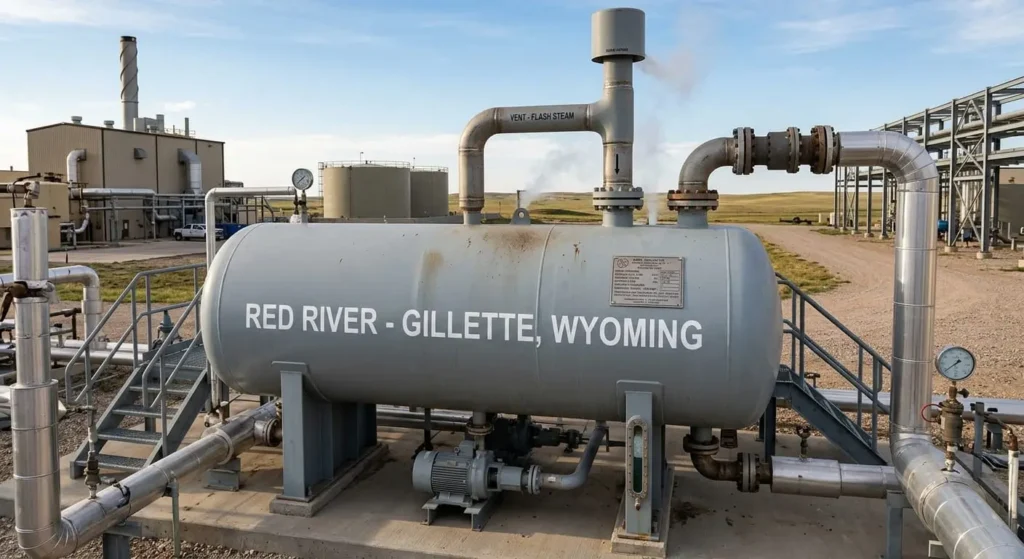
Condensate tanks are vented through an open atmospheric vent pipe sized for the maximum flash steam flow on unpressurized vessels, or through an ASME-specified safety relief valve on pressurized condensate receivers. The condensate tank venting method depends on whether the tank operates at atmospheric or elevated pressure, and the vent must be correctly sized and located or backpressure will block condensate return and dissolved gases will remain in the tank to corrode the vessel internally.
Key Takeaways
- Atmospheric condensate tank venting uses an open vent sized to handle the maximum flash steam flow without creating backpressure that blocks condensate return.
- Pressurized condensate tanks use a pressure relief device rather than an atmospheric vent condensate tank opening, sized and set in accordance with ASME BPVC Section VIII requirements.
- Flash steam forms when high-pressure condensate enters a lower-pressure tank and a portion of the liquid vaporizes. The flash steam vent must be sized to pass this flash fraction without restricting flow.
- Dissolved oxygen and carbon dioxide exit through the vent along with flash steam. Proper condensate tank venting is a corrosion control measure as much as a pressure control measure.
- Vent piping must rise continuously to a safe discharge point and must not be capped, plugged, or restricted. Sealing an atmospheric tank vent converts it into an unregistered pressure vessel.
- Red River designs boiler condensate vent connections to client-specified operating conditions, with every pressurized vessel built under ASME U Stamp certification.
Why Do Condensate Tanks Need to Be Vented?
Condensate arriving at the tank from a high-pressure steam distribution system carries significant energy. When hot, high-pressure condensate drops to the lower pressure inside the tank, a portion of it flashes to steam. That flash steam vent path must remain open or pressure builds, backs up against the condensate return lines, and eventually stops condensate flow from the steam traps in the system.
Condensate Tank Venting as a Corrosion Control Measure
Condensate tank venting also controls corrosion. Dissolved oxygen and carbon dioxide are released as gases when condensate enters the tank and pressure drops. If they cannot escape, they remain at elevated concentrations and accelerate corrosion of the tank shell, heads, and nozzles. An open, unrestricted vent allows these gases to exit continuously during normal boiler condensate vent operation.
Why the Vent Is Not a Minor Accessory
The vent connection is an active part of both the pressure management and corrosion protection systems for the condensate tank and the feedwater circuit. Treating condensate tank vent sizing as a field afterthought rather than a fabrication-scope design input produces backpressure problems and corrosion failures that could have been prevented at the specification stage. See Red River’s pressure vessel fabrication scope for how vent nozzles are designed into condensate vessels from the start.
What Is the Difference Between Atmospheric and Pressurized Venting?
The condensate tank venting approach depends entirely on whether the vessel is designed as an atmospheric or a pressurized vessel.
Atmospheric Vent Condensate Tank
An atmospheric vent condensate tank uses an open vent, typically a plain pipe or gooseneck fitting, that allows steam and gases to discharge freely to the atmosphere. The vent carries no set pressure and is not a relief device. It is an unrestricted opening sized to pass the maximum flash steam flow without creating meaningful backpressure, routed to a safe discharge location away from personnel areas.
Pressurized Condensate Receivers
Pressurized condensate tanks operate above atmospheric pressure and use a safety relief valve sized in accordance with ASME BPVC Section VIII rather than an open vent. The valve discharges to a safe location when vessel pressure exceeds the MAWP but does not vent continuously during normal operation.
Red River fabricates both types. Every pressurized vessel is built under ASME U Stamp certification and registered with the National Board of Boiler and Pressure Vessel Inspectors, with the relief device specification confirmed before fabrication begins. See Red River’s capabilities for how vent and relief device specifications are managed across the vessel fabrication scope.
How Is Condensate Tank Vent Sizing Calculated?
For atmospheric tanks, condensate tank vent sizing is based on the maximum flash steam flow entering from the condensate return system.
Calculating the Flash Fraction
The flash fraction is the portion of incoming condensate that converts to steam when pressure drops from the condensate return line pressure to the tank operating pressure. It is calculated from steam tables using the inlet temperature and the tank pressure. Higher inlet temperatures and lower tank pressures produce higher flash fractions and require larger flash steam vent connections.
Vent Pipe Sizing Targets
The vent pipe must pass the flash steam flow without generating backpressure above the design point. Common practice targets vent velocity below 20 to 30 feet per second, with pipe diameter selected from the calculated volumetric flow rate at tank pressure and the target velocity.
Key Condensate Tank Vent Sizing Inputs
The five inputs a mechanical engineer uses for condensate tank vent sizing are:
- Condensate inlet temperature and pressure
- Tank operating pressure
- Total condensate flow at maximum system load
- Flash fraction calculated from steam tables
- Vent pipe length and fittings resistance
The fabricator builds the tank with a vent nozzle sized to match, with nozzle reinforcement and flange rating confirmed for the service conditions. See Red River’s process tanks for related vessel types requiring the same condensate tank vent sizing discipline.
Where Should the Vent Connection Be Located?
Vent connection location directly affects condensate tank venting performance and safety.
Top-of-Vessel Placement
The vent connection on a condensate tank is always located at the top of the vessel to ensure only vapor exits. Placing the vent at any other location risks liquid carryover into the vent piping, causing water hammer, pipe erosion, and potential hot liquid discharge at the vent outlet.
Horizontal vs. Vertical Tank Placement
On horizontal tanks, the vent nozzle sits on the top centerline near the condensate inlet end, where flash steam naturally accumulates. On vertical tanks, the vent is on the top head. In both cases, the vent piping must rise continuously to the discharge point without low points where condensate can collect and block the opening.
Consequences of Blocking the Vent
A blocked vent on an atmospheric condensate tank removes the only pressure relief path. The tank pressurizes as flash steam accumulates, which violates ASME code for unregistered vessels and creates a serious failure and safety risk. Vent piping must be inspected periodically to confirm it remains unobstructed.
What Are the Common Venting Problems in Condensate Systems?
Three recurring condensate tank venting conditions reduce system performance and increase corrosion risk.
Undersized Vents
Undersized flash steam vent connections create backpressure when flash steam cannot exit fast enough. That backpressure backs up condensate return and causes steam traps to malfunction, reducing heat transfer efficiency across the distribution system.
Capped or Plugged Vents
Capped or plugged vents are the most dangerous condition. They eliminate the only boiler condensate vent relief path from an atmospheric vessel and must be corrected immediately before returning the tank to service. This condition is sometimes created inadvertently during maintenance when a temporary cap is installed and not removed.
Vent Piping With Low Points
Vent piping with low points allows condensate to collect and block the vent, producing the same effect as a capped vent and restricting flash steam from exiting the vessel. All vent piping must rise continuously from the nozzle to the discharge point. Red River’s modular skid packages integrate condensate tanks with flash steam recovery connections pre-piped before delivery, with vent routing confirmed in the assembly drawings.
What This Means When Specifying a Condensate Tank Vent
How to vent condensate tanks correctly comes down to three decisions made before fabrication: whether the vessel is atmospheric or pressurized, what flash steam vent flow rate must pass through the opening at maximum load, and where the nozzle must be positioned for safe, unrestricted vapor discharge. All three decisions belong in the specification, not in the field after the vessel is installed.
Vent connection design is part of every condensate tank Red River fabricates, not deferred to the piping contractor. Red River sizes the vent nozzle from client-supplied process conditions before fabrication begins, with nozzle location, size, and flange rating on the fabrication drawing and reviewed by an ASME Authorized Inspector before production starts.
Discuss Your Condensate Tank Vent Design With Red River
Red River has fabricated ASME-certified condensate tanks for oil and gas, power generation, biogas, and industrial applications from Gillette, Wyoming, since 2003. Red River holds active ASME U Stamp and NBBI R Stamp certifications and is an American Welding Society (AWS) member. Every vessel ships with full MTR documentation, hydrostatic test records, and an ASME Authorized Inspector sign-off. Learn more at Red River’s about us page, or request a quote and call 1-307-257-5332 to discuss your condensate tank venting scope.
Frequently Asked Questions
1. Does Every Condensate Tank Need a Vent?
Yes. Every condensate tank requires a means of pressure relief or gas venting. Atmospheric condensate tank venting uses an open vent pipe sized for the maximum flash steam flow. Pressurized tanks use an ASME-specified safety relief valve. Sealing either without a proper alternative creates an unsafe unrelieved pressure condition.
2. Can Flash Steam From the Vent Be Recovered?
Yes. Flash steam vented from an atmospheric condensate tank contains usable heat energy and can be captured by a flash steam vent recovery system for low-pressure heating. Recovery systems must be sized to avoid imposing backpressure on the condensate tank vent during peak flow conditions.
3. What Size Vent Pipe Does a Condensate Tank Need?
Vent pipe size depends on the flash steam flow rate calculated from condensate inlet temperature, pressure, and maximum system load. The pipe is sized to keep vent velocity below roughly 20 to 30 feet per second to limit backpressure and noise. A mechanical engineer performs this condensate tank vent sizing calculation for each specific system.
4. What Happens If the Condensate Tank Vent Is Blocked?
A blocked atmospheric vent removes the only pressure relief path. The tank pressurizes as flash steam accumulates, which can cause a sudden pressure release, vessel damage, or injury. A capped or obstructed vent must be cleared immediately and the cause of the blockage identified before returning the tank to service.
5. Does Red River Include Vent Nozzles in the Condensate Tank Fabrication Scope?
Yes. Red River sizes and positions the vent nozzle from client-supplied process conditions as part of the standard boiler condensate vent design scope, with nozzle size, location, and flange rating on the fabrication drawing. Request a quote or call 1-307-257-5332 to discuss your project requirements.
Related Blog Post
How Do Baffle Layouts Affect Stratification in TES Tanks?
What Delta T Drives Volume in Thermal Storage Tanks?
Industrial Cooling Energy Storage: Systems and Fabrication
Carbon Steel Tanks: The Complete Fabrication Guide
Can Condensate Storage Improve Reliability?
About Author