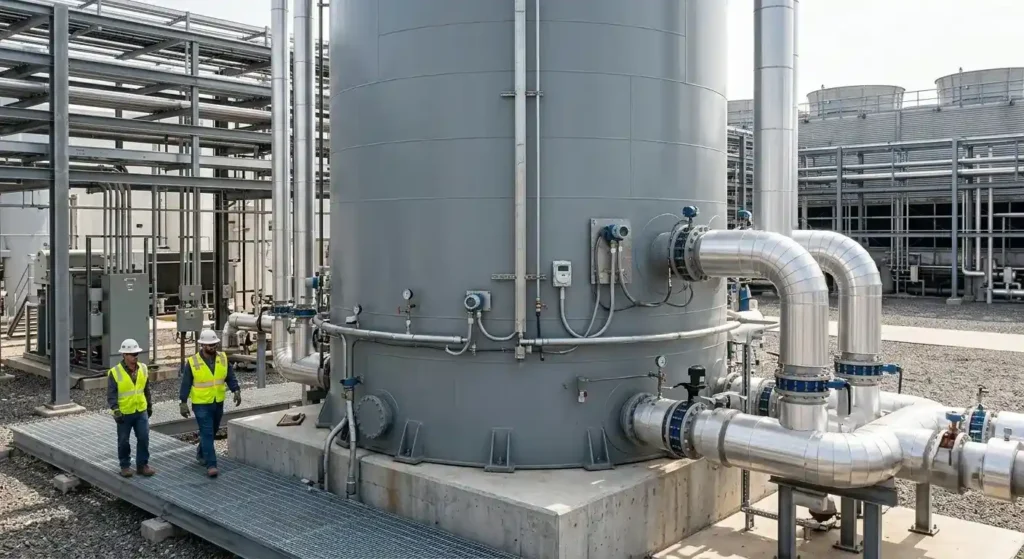
Delta T, the temperature difference between cold supply water leaving the tank and warm return water entering it, determines how much thermal energy each gallon of tank volume stores. The relationship is direct and linear: double the delta T and you halve the required tank volume for the same stored energy capacity.
Key Takeaways
- Every degree of delta T added reduces required tank volume by the same proportion. Moving from 10 to 20 degrees Fahrenheit halves the tank volume needed for the same stored cooling energy.
- The standard volume formula divides peak load times discharge duration by the product of delta T and stratification efficiency. Both variables reduce usable capacity when they fall below design values in operation.
- Modern chilled water designs target 16 to 20 degrees Fahrenheit delta T through hot aisle containment, optimized airflow, and high-efficiency cooling coil selection.
- Stratification efficiency depends on diffuser design, tank geometry, and flow control. Poor diffuser design drops usable capacity to 60 to 70 percent of nominal volume regardless of the delta T achieved in the chilled water loop.
- Higher delta T systems with lower supply temperatures require more insulation, better vapor barrier design, and attention to thermal bridging at support attachments and nozzle penetrations.
What Is the Engineering Relationship Between Delta T and Tank Volume?
Sizing a thermal storage tank starts with a direct equation: the higher the delta T, the more energy each gallon stores, and the smaller the tank required to meet a given storage target. Delta T thermal storage tank sizing is the most direct lever available before a single pound of steel is ordered.
The Standard Volume Formula
The standard volume formula for chilled water thermal storage is:
Tank Volume (gallons) = (Cooling Load in tons x Discharge Duration in minutes x 24) / (Delta T x Stratification Efficiency)
For a 1,000-ton cooling load with 15-minute ride-through, 12-degree delta T, and 0.90 stratification efficiency:
(1,000 x 15 x 24) / (12 x 0.90) = 33,333 gallons
The same load at 20-degree delta T:
(1,000 x 15 x 24) / (20 x 0.90) = 20,000 gallons
How Delta T Reduces Tank Size and Cost
Moving from 12 to 20 degrees delta T reduces tank volume by 40 percent. The chilled water temperature differential volume relationship is that direct: every degree of delta T added reduces vessel size and its associated material, insulation, and installation cost. Red River’s pressure vessel fabrication process includes working through delta T inputs and volume calculations during the engineering review phase before fabrication scope is finalized.
What Controls Delta T in a Chilled Water System?
Delta T is controlled by the chiller supply temperature on the cold side, the return water temperature on the warm side, and the system design that prevents the two from mixing.
How Chiller Supply Temperature Sets the Cold Side
The cold side of the delta T is set by the chiller supply temperature. Most conventional chilled water systems supply water at 44 to 46 degrees Fahrenheit. High-efficiency designs targeting higher delta T push chiller supply temperatures down to 38 to 42 degrees Fahrenheit. Lowering supply temperature increases the cold side contribution to delta T but may reduce chiller efficiency and increase compressor lift.
How Return Water Temperature Sets the Warm Side
The warm side of the delta T is set by the return water temperature from the cooling loads. Traditional designs return water at 54 to 56 degrees Fahrenheit. High-density cooling designs with optimized airflow push return temperatures to 60 degrees Fahrenheit and above, increasing delta T without changing supply temperature.
How System Design Collapses Realized Delta T
Bypassing or mixing warm and cold water streams, undersized cooling coils, and poorly controlled variable flow pumping collapse the realized delta T below the design value. A TES tank delta T design that assumes 18 degrees but delivers 10 degrees in operation runs out of usable capacity before the design ride-through duration is reached. Red River’s thermal energy storage services account for realistic operating delta T, not theoretical maximum values, when sizing thermal storage volume.
How Does Stratification Efficiency Interact With Delta T?
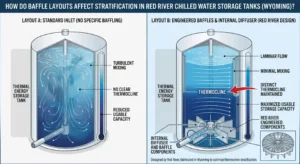
Stratification efficiency is the fraction of nominal tank volume that delivers usable storage, and reducing it has the same effect on capacity as reducing delta T. Diffuser design is the primary control variable.
Why Stratification Efficiency Matters to the Volume Calculation
A perfectly stratified tank would deliver 100 percent of its volume as usable storage. In practice, mixing at the thermocline between the warm and cold water layers reduces usable capacity to 85 to 95 percent for well-designed tanks and as low as 60 to 70 percent for poorly designed ones. Reducing stratification efficiency has the same effect as reducing delta T: both reduce energy stored per unit of volume. A tank designed for 18-degree delta T with 85 percent stratification efficiency delivers the same usable capacity as a tank designed for 15.3-degree delta T with 100 percent efficiency.
How Diffuser Design Controls the Thermocline
The diffuser system at the supply and return nozzles controls velocity and flow distribution of water entering and leaving the tank. A well-designed diffuser maintains a sharp thermocline by introducing flow at low velocity across a large area. A poorly designed diffuser introduces high-velocity jets that mix warm and cold water and destroy the thermocline. Red River’s fabrication capabilities include coordinating diffuser design with vessel geometry during the engineering review phase so the fabricated tank achieves the stratification efficiency the volume calculation assumed. See Red River’s modular skid packages for how diffuser and nozzle design is managed across complete integrated TES skid scopes.
How Does Delta T Affect Material Selection for the Storage Vessel?
Higher delta T systems operating at lower supply temperatures require more attention to insulation and vapor barrier design. A tank supplying 38-degree water in a mechanical room at 75 degrees ambient faces a 37-degree temperature differential at the vessel surface, driving condensation risk and thermal loss that a higher supply temperature system does not encounter to the same degree.
Insulation and Vapor Barrier Requirements at Low Supply Temperatures
ASME-coded thermal storage vessels operating at low supply temperatures require vapor barrier continuity around all penetrations, insulation thickness calculated for the actual surface temperature at minimum supply temperature, and support ring design that avoids thermal bridges through the insulation layer. ASHRAE thermal performance standards govern minimum insulation and vapor barrier requirements for occupied mechanical rooms and outdoor installations.
Material Selection for Low-Temperature Chilled Water Service
For chilled water service material selection, supply temperature and water chemistry together determine whether carbon steel with epoxy lining, stainless steel, or a lined vessel is the right specification. See Red River’s process tanks and thermal energy storage fabrication scope for related material selection applications.
What Are Practical Delta T Ranges by Application?
Data center chilled water applications typically target 12 to 20 degrees Fahrenheit, while industrial and power generation applications run wider depending on the storage medium and service temperature.
Data Center Chilled Water Storage Delta T Targets
Legacy facilities with traditional cooling coil designs typically achieve 10 to 12 degrees Fahrenheit delta T in operation. Modern high-density deployments with hot aisle containment and optimized airflow target 16 to 20 degrees Fahrenheit. Higher delta T chilled water design is widely recognized as a primary lever for reducing data center capital cost and tank volume requirements. See Red River’s prefabrication services for how TES vessels are fabricated for chilled water and industrial applications.
Industrial and Power Generation Delta T Ranges
Industrial process cooling and power generation heat recovery applications see wider delta T ranges depending on the storage medium and service temperature. Hot water storage systems may operate at delta T of 30 to 100 degrees Fahrenheit or more. Process cooling applications vary based on process fluid properties and the approach temperatures achievable with the available heat exchange equipment. Red River fabricates thermal storage vessels across the full range of industrial delta T and temperature conditions.
Delta T and Tank Sizing Red River Confirms Before Fabrication Begins
What delta T drives volume on any project depends on chiller supply temperature, return water temperature, and achievable stratification efficiency. Red River works through the delta T inputs, volume calculation, and tank geometry before fabrication scope is finalized, so the vessel is sized for actual operating conditions rather than theoretical design values. Red River holds active ASME U Stamp and NBBI R Stamp certifications and has fabricated chilled water and thermal storage vessels for power generation, oil and gas, and biogas clients from Gillette, Wyoming, since 2003. The National Board maintains registration records for all ASME-stamped vessels Red River delivers.
Ready to Size Your Thermal Storage Tank Against Your Actual Delta T?
Request a quote or call 1-307-257-5332 to discuss your delta T targets and thermal storage tank sizing with Red River’s fabrication team. The earlier the delta T and volume review starts, the more options remain available for tank geometry, material selection, and schedule.
Frequently Asked Questions
1. What Delta T Drives Volume Most Significantly in Chilled Water TES Systems?
Delta T is the most powerful single variable in chilled water TES sizing. Every degree of additional delta T reduces required tank volume proportionally. Moving from 10 to 20 degrees halves the tank volume needed for the same storage capacity. In practical terms, the delta T decision often determines whether a project requires one large tank or two smaller ones.
2. What Is a Realistic Delta T for a Chilled Water Thermal Storage System?
Modern designs with hot aisle containment and optimized airflow target 16 to 20 degrees Fahrenheit delta T. Legacy facilities with traditional cooling coil designs typically achieve 10 to 12 degrees in operation. The realized delta T in the field is often lower than the design delta T due to bypass mixing, undersized coils, and poor flow control.
3. How Does Stratification Efficiency Affect the Volume Calculation?
Stratification efficiency determines the fraction of nominal tank volume that delivers usable storage. A tank with 85 percent stratification efficiency effectively operates at 85 percent of its nominal delta T for sizing purposes. Poor diffuser design can drop stratification efficiency to 60 to 70 percent, requiring a significantly larger tank than the volume calculation based on nominal delta T would suggest.
4. Does a Higher Delta T Affect Material Selection for the Storage Vessel?
Yes. Higher delta T systems with lower supply temperatures face greater condensation risk and thermal loss at the vessel surface. Insulation thickness calculations, vapor barrier design, and support ring geometry all need to account for the actual minimum supply temperature. For very low supply temperatures, stainless steel or lined carbon steel may be required depending on water chemistry.
5. What Happens When Realized Delta T in Operation Is Lower Than Design Delta T?
The usable storage capacity delivered by the tank is proportionally lower than designed. A tank sized for 18-degree delta T that operates at 12 degrees delivers only two-thirds of the design storage capacity. This is one of the most common reasons thermal storage systems underperform against their design ride-through duration in actual operation.
Related Blog Post
How to Vent Condensate Tanks in Steam Systems
How Do Baffle Layouts Affect Stratification in TES Tanks?
Industrial Cooling Energy Storage: Systems and Fabrication
Carbon Steel Tanks: The Complete Fabrication Guide
Can Condensate Storage Improve Reliability?
About Author