
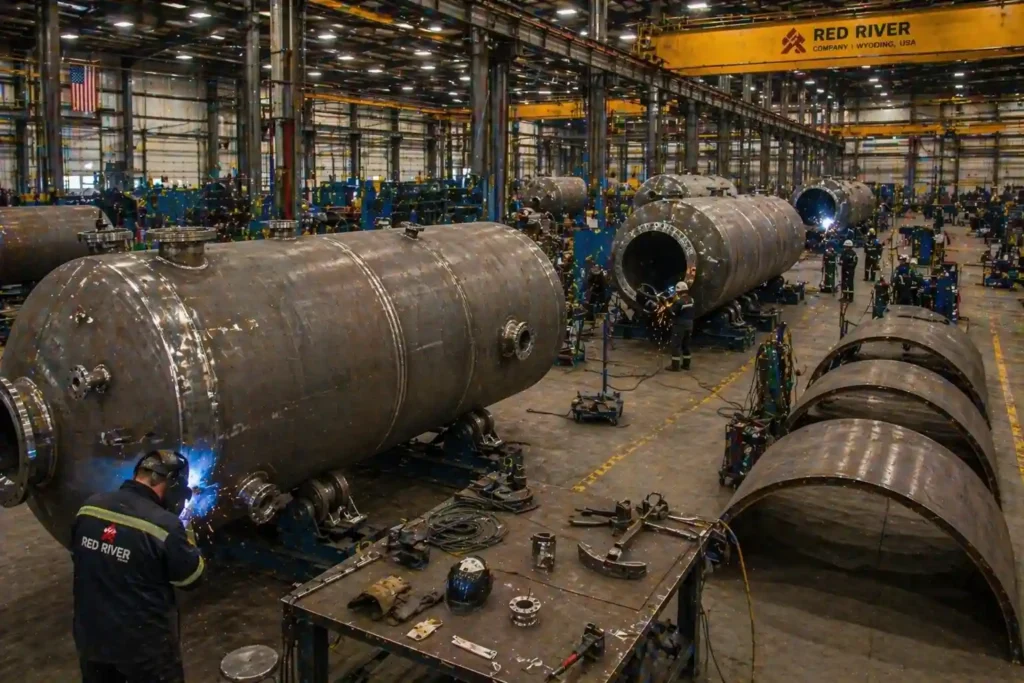
Carbon steel tanks are the most widely specified vessels in industrial applications, but carbon steel is not a single material and not a single product. This guide covers material grades, fabrication sequence, ASME requirements, coating systems, and how to qualify a fabricator before issuing a purchase order.
Key Takeaways
- Carbon steel tanks are the most widely specified vessel type in industrial applications because they deliver structural performance and weldability at a lower cost than specialty alloys.
- SA-516 Grade 70 is the standard material for ASME pressure vessel fabrication in most industrial service conditions. Grade selection should always be confirmed against design pressure, temperature, and service environment.
- ASME U Stamp certification is a legal requirement for any carbon steel pressure vessel operating above approximately 15 PSI in commercial or industrial service. Verify it independently before awarding a purchase order.
- The coating or lining system is as important as the base material. Internal lining selection must be compatible with the process fluid, operating temperature, and maintenance requirements.
- A complete tank specification covering design conditions, material grade, NDE requirements, coating system, nozzle schedule, and documentation requirements eliminates scope ambiguity and reduces change order risk.
What Carbon Steel Tanks Are and Where They Are Used
A carbon steel tank is a pressure vessel or storage container fabricated from steel in which carbon is the primary alloying element. Carbon content, typically ranging from 0.05% to 0.30% for grades most commonly used in industrial fabrication, controls strength, hardness, and weldability. Most fabrication-grade carbon steels are optimized to balance these properties for structural performance and ease of welding under code-controlled conditions.
Carbon steel tanks appear across virtually every industrial sector. In oil and gas, they are used for produced water storage, crude oil storage, natural gas separator vessels, and fuel gas conditioning packages. In power generation, they serve as feedwater storage, fuel storage, and condensate vessels. In biogas and chemical processing, they provide pressurized storage for gases and liquids that do not require corrosion-resistant alloys.
The common thread is that carbon steel delivers structural performance at a material and fabrication cost significantly lower than stainless steel or specialty alloy alternatives. When the process fluid is compatible and a coating or lining system can address internal corrosion requirements, carbon steel is almost always the right choice. Red River fabricates carbon steel pressure vessels across this full range of applications, from standard storage tanks to complex multi-nozzle process vessels and modular skid-mounted systems.
Carbon Steel Grades Used in Tank Fabrication
SA-516 Grade 70: The workhorse of ASME pressure vessel fabrication. A pressure vessel quality carbon steel plate with a minimum tensile strength of 70,000 PSI and excellent notch toughness at low temperatures. Welds cleanly under standard procedures and is readily available in a wide range of plate thicknesses. For oil and gas separator vessels, produced water tanks, fuel gas conditioning packages, and general industrial storage vessels, SA-516-70 is the starting point unless service conditions require something different.
SA-285 Grade C: A lower-strength carbon steel used for unfired pressure vessels and storage tanks where high strength is not required and service temperatures are moderate. Less commonly specified than SA-516-70 for new construction but still appears in some atmospheric storage and low-pressure applications.
SA-36 and A572 Structural Grades: For non-pressure-rated components including support structures, skid frames, and platforms. Not used for pressure-containing components but integral to the overall tank system design.
Low-temperature grades: For cryogenic or low-temperature service, SA-516-70 normalized or SA-537 Class 1 are common choices. Charpy impact testing at the minimum design temperature is required under ASME code, and material must be certified to meet impact toughness requirements.
How Carbon Steel Tanks Are Fabricated
Material receipt and verification: Every plate, fitting, and structural component arrives with a certified mill test report (CMTR) confirming chemical composition and mechanical properties. Material that cannot be traced to a valid CMTR does not go into a code vessel.
Plate forming and shell rolling: Carbon steel plate is rolled or pressed to the shell geometry required by the vessel design. Tolerances on roundness, straightness, and weld joint fit-up are governed by ASME code. Proper fit-up before welding is critical.
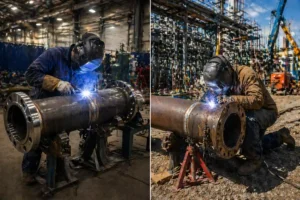
Welding under qualified procedures: All welding on ASME code vessels is performed under a qualified Welding Procedure Specification (WPS) by welders with current qualification records for the applicable weld process and position. Red River’s welders operate under ASME-qualified procedures, and the shop maintains active AWS membership.
Nondestructive examination: Depending on design pressure, joint efficiency classification, and material, welds may require radiographic testing (RT), ultrasonic testing (UT), magnetic particle testing (MT), or liquid penetrant testing (PT). Red River’s fabrication capabilities include full NDE coordination as part of the standard fabrication process.
Hydrostatic pressure testing: Before any vessel leaves the shop, it is hydrostatically tested at 1.3 times the maximum allowable working pressure (MAWP). The test is witnessed by the Authorized Inspector and documented. A vessel that fails hydrostatic testing does not ship.
Documentation and final release: The completed tank ships with a full documentation package: ASME Form U-1 Manufacturer’s Data Report, CMTRs for all pressure-containing materials, weld records, NDE reports, and pressure test records.
ASME Certification and Code Compliance
Any pressure vessel operating above approximately 15 PSI in a commercial or industrial application must be fabricated under ASME Section VIII of the Boiler and Pressure Vessel Code. Fabricating and selling a pressure vessel without ASME U Stamp certification is illegal in most U.S. jurisdictions and creates significant liability for the operator.
Compliance is verified by an Authorized Inspection Agency whose commissioned inspector witnesses key fabrication hold points and signs off on the completed vessel. Red River holds an active ASME U Stamp certification and an NBBI R Stamp for repair and alteration work on existing coded vessels. Both are actively maintained through regular third-party audits.
Coating and Corrosion Protection Systems
External coating systems: Typically start with abrasive blast cleaning to SSPC-SP10 Near-White Metal or SSPC-SP6 Commercial Blast standard, followed by a zinc-rich primer, an epoxy intermediate coat, and a polyurethane topcoat. The specific system depends on exposure environment, temperature range, and owner specification.
Internal lining systems: For tanks handling corrosive process fluids, produced water with high chloride content, or chemical solutions incompatible with bare carbon steel. Common options include glass-flake epoxy linings, novolac epoxy systems for chemical resistance, and rubber or fiberglass linings for highly aggressive environments. Lining selection must be compatible with the process fluid, operating temperature, and maintenance procedures.
Cathodic protection: For buried or submerged carbon steel tanks, cathodic protection systems, either impressed current or sacrificial anode, are typically required to control external corrosion. Design should be coordinated with the tank design, not added after installation. Red River’s prefabrication capabilities include abrasive blasting and coating application as part of the shop fabrication scope.
How to Specify a Carbon Steel Tank Correctly
A complete specification eliminates ambiguity during fabrication, reduces change order risk, and ensures the delivered tank meets the intended service requirements. A complete specification addresses:
Design pressure and temperature: Including any vacuum or external pressure conditions.
Material grade: Including any supplementary requirements such as impact testing or normalized plate.
Nozzle schedule: Including size, rating, orientation, facing, joint efficiency, and NDE requirements.
Coating and lining systems: With surface preparation standard and dry film thickness requirements for both internal and external systems.
Support configuration: Including saddle dimensions for horizontal vessels or leg or skirt design for vertical vessels.
Documentation requirements: Including ASME Form U-1, CMTRs, weld records, NDE reports, and pressure test records.
What to Look for in a Carbon Steel Tank Fabricator
Active ASME U Stamp certification: Verify independently in the ASME manufacturer database before issuing a purchase order. An active certification means the shop is currently audited.
Material traceability: Every plate and fitting in a code vessel must be traceable to a valid CMTR. Ask how the shop manages traceability from receipt through final documentation.
In-house NDE capability: Shops that coordinate NDE in-house manage inspection hold points more predictably and produce cleaner documentation packages.
Coating capability: A fabricator who handles abrasive blasting and coating application in-house delivers tanks with inspected, shop-applied coating systems. Red River has been fabricating carbon steel tanks and pressure vessels since 2003, serving clients from startup operators placing their first vessel order to international energy companies with rigorous vendor qualification processes.
Ready to Specify Your Carbon Steel Tank Project?
Request a quote or call 1-307-257-5332 to discuss your carbon steel tank requirements with Red River’s fabrication team.
Frequently Asked Questions
1. What is the difference between a carbon steel tank and a stainless steel tank?
The primary difference is corrosion resistance. Stainless steel contains chromium, which forms a passive oxide layer that resists corrosion without a coating or lining. Carbon steel does not have this property and requires a coating, lining, or cathodic protection system in corrosive environments. Carbon steel is significantly less expensive and is the correct choice for most industrial applications where the process fluid is compatible or where a lining system is feasible and economical.
2. What ASME code applies to carbon steel pressure vessels?
Most carbon steel pressure vessels used in industrial applications are fabricated under ASME Section VIII Division 1, which covers unfired pressure vessels. Division 2 applies to vessels with more demanding design requirements and higher allowable stress values. The applicable division is determined by design pressure, service conditions, and owner specifications.
3. How long do carbon steel tanks last?
Service life depends heavily on the operating environment, coating or lining system integrity, inspection and maintenance practices, and corrosion rate of the process fluid. Well-designed carbon steel tanks with properly applied and maintained coating systems routinely achieve 20 to 40-year service lives in appropriate applications. Regular inspection under the applicable in-service inspection standard is the primary tool for managing service life.
4. Can carbon steel tanks be repaired if they are damaged or corroded?
Yes. Repair of ASME-coded carbon steel pressure vessels must be performed by a shop holding the NBBI R Stamp, which authorizes repair and alteration work on vessels originally constructed under an ASME code stamp. Red River holds both the ASME U Stamp for new construction and the NBBI R Stamp for repair and alteration work.
5. What wall thickness is typical for a carbon steel pressure vessel?
Wall thickness is calculated based on design pressure, vessel diameter, material allowable stress at design temperature, and any corrosion allowance specified by the owner. A small-diameter vessel at moderate pressure may have a wall as thin as 3/16 inch. A large-diameter high-pressure vessel may require wall thicknesses of two inches or more.
6. Does Red River fabricate custom carbon steel tanks for non-standard configurations?
Yes. Custom geometry, unusual nozzle configurations, internal baffles and weirs, agitator connections, heating or cooling coils, and specialty liners or coatings are all part of the standard fabrication scope. Red River has fabricated custom carbon steel vessels for applications ranging from straightforward produced water storage to complex proprietary process equipment.
Related Blog Post
What Delta T Drives Volume in Thermal Storage Tanks?
Industrial Cooling Energy Storage: Systems and Fabrication
Can Condensate Storage Improve Reliability?
How Are Shop vs Field Welds Chosen for Fabrication
Energy Storage Tank Construction: A Complete Guide
About Author



