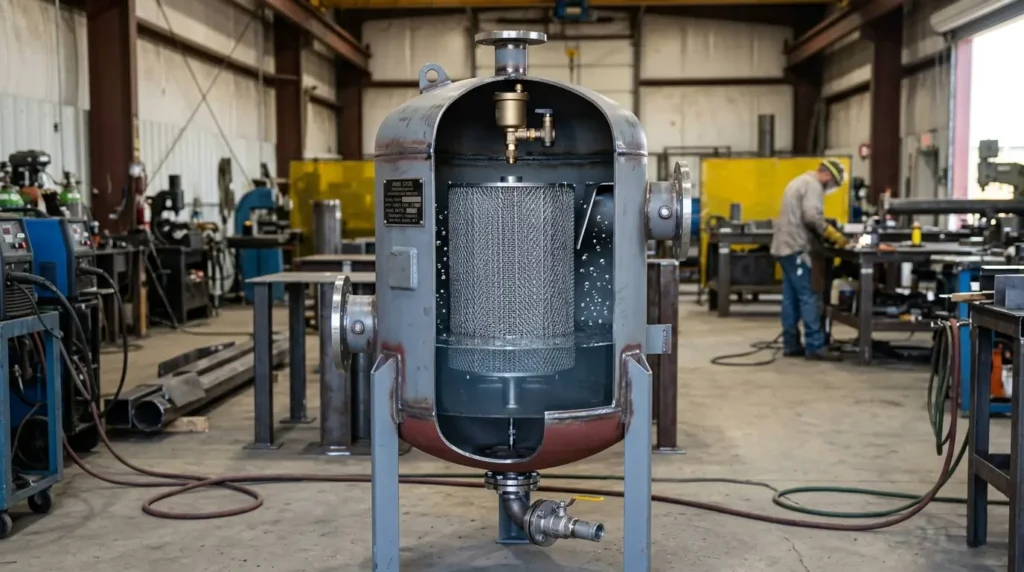
Air separator tanks work by slowing circulating fluid inside a wider vessel, which releases trapped air from the liquid so it can rise to the top and vent automatically. The result is a loop kept full of fluid rather than a mix of fluid and entrained gas, protecting pumps, heat exchangers, and piping from the corrosion, noise, and heat transfer losses that air pockets cause.
Key Takeaways
- Air separator tanks work by creating a low-velocity zone where entrained air leaves the fluid and rises to the top of the vessel.
- An automatic air vent at the top continuously discharges collected air without manual bleeding or loop interruption.
- Coalescing media inside many units merges microbubbles too small to rise on their own into larger bubbles that can vent, capturing the fine entrained air a plain chamber misses.
- Tangential and straight-through designs reach the same goal by different internal flow paths, with the right choice depending on the flow rate, space, and air load the system carries.
- Placement matters. Air leaves fluid most readily where the fluid is hottest and at lowest pressure, which is where the separator captures the most air per pass.
How Do Air Separator Tanks Work in a Hydronic Loop?
Air separator tanks operate on one principle: slow the fluid down and give the air somewhere to go. Fast-moving fluid holds entrained air in suspension, but when it enters the wider body of the separator, the velocity drops and the air is free to rise.
Why Entrained Air Is a Problem
A hydronic or process loop is designed to circulate liquid, not a mix of liquid and gas. Entrained air creates noise and vibration through pumps and valves, reduces heat transfer efficiency in heat exchangers, and promotes corrosion at air-water interfaces inside piping and vessels. A separator that removes air continuously keeps the loop performing as designed.
Why the Separator Is a Coded Pressure Vessel
Because the air separator holds system pressure in a pressurized loop, it is built to ASME Section VIII. Red River’s pressure vessel fabrication covers air separator vessels across hydronic and process loop applications. Every coded vessel is registered with the National Board.
What Happens Inside an Air Separator Tank?
The separation process follows a clear sequence from fluid entry to clean fluid exit.
Step 1: Fluid Enters and Velocity Drops
Fluid enters through the inlet and immediately encounters a vessel cross-section significantly larger than the supply pipe. The sudden increase in area drops fluid velocity sharply. Slower fluid cannot hold entrained bubbles in suspension as effectively, releasing them to rise under their own buoyancy.
Step 2: Air Rises and Collects in the Dome
Released bubbles rise through the slow-moving fluid and collect in the dome at the top of the tank. Larger bubbles rise fastest. The smallest microbubbles need the coalescing media to rise within the time available inside the vessel.
Step 3: The Automatic Air Vent Discharges the Air
At the top of the vessel, a float-operated automatic air vent releases collected air to atmosphere as the dome fills, then reseals when fluid returns. This continuous discharge makes the separator self-maintaining: no manual bleeding, no loop shutdown.
Step 4: Dirt Settles in Combination Units
In combination air and dirt separator vessels, particles heavier than the fluid settle to the bottom simultaneously. A blowdown valve allows periodic flushing of sediment without draining or stopping the loop. See Red River’s process tanks for how combination vessels are configured for specific loop conditions.
How Does Coalescing Media Capture Microbubbles?
Coalescing media solves the core limitation of a plain separation chamber: bubbles below a certain size cannot rise fast enough to vent before the fluid exits the vessel.
How the Media Works
Coalescing media is an internal mesh or array of surfaces through which the fluid must pass. The smallest microbubbles contact the surfaces, cling to them, and merge by surface tension into larger bubbles. Once the merged bubble reaches sufficient size, buoyancy carries it upward to the dome and vent. ASHRAE guidance on hydronic system design informs both the media specification and vessel sizing for air separator applications.
Why Media Matters
Without coalescing media, fine entrained air passes through and continues circulating, degrading heat transfer and accelerating corrosion across the full loop.
How Do Tangential and Straight-Through Designs Differ?
Tangential and straight-through separators reach the same goal by different mechanisms.
Tangential Design
A tangential inlet introduces fluid off-center so it enters the vessel in a circular swirling path. Centrifugal force throws the denser liquid outward while the lighter air concentrates in the calm low-pressure core at the center, rising directly to the vent. Tangential designs are effective on high-flow loops with moderate to heavy air entrainment.
Straight-Through Design
A straight-through design relies on velocity reduction and coalescing media rather than swirl. Fluid enters one side, slows in the enlarged vessel body, passes through the media, and exits the other side. Both designs are fabricated as ASME-coded pressure vessels and are often delivered as part of modular skid packages where air control integrates with the rest of the loop equipment. Red River’s fabrication capabilities cover both configurations.
Why Does Placement Affect Air Separator Performance?
Placement directly determines how much air a separator can capture per pass.
The Physics of Air Solubility
Air dissolves in water at a solubility that decreases as temperature rises and as pressure drops. A loop location that is hot and at low pressure holds the least dissolved air, meaning the most air is already out of solution and available to be captured. Placing the separator there intercepts the maximum air content per pass.
Optimal Placement in Common Loop Types
In a heating loop, the optimal location is just downstream of the boiler on the pump suction side, where fluid is hottest and pressure is lowest. For chilled water or thermal energy storage loops, identify the minimum air solubility point and install the separator there. Nozzle layout is confirmed during the engineering review.
What This Means When Specifying an Air Separator
Air separator performance is the product of correct sizing, coalescing media matched to the expected air load, and placement at the right loop point. A high-quality separator in the wrong location underperforms. These decisions belong in the design phase, confirmed before the vessel is ordered.
Discuss Your Air Separator Requirements With Red River
Red River fabricates ASME-certified air separators and combination air and dirt separator vessels for hydronic and process loop applications from Gillette, Wyoming, since 2003, holding active ASME U Stamp and NBBI R Stamp certifications.
Ready to Size Your Air Separator?
Request a quote or call 1-307-257-5332 to discuss your air separator sizing, media configuration, and installation requirements with Red River’s team.
Frequently Asked Questions
1. What Is the Basic Principle Behind an Air Separator Tank?
The basic principle is velocity reduction. Fast-moving fluid holds air in suspension, but when it enters the wider body of the separator, it slows and the air rises to the dome and vents through the automatic air vent while de-aerated fluid continues through the loop.
2. How Does the Automatic Air Vent Work?
The automatic air vent is a float-operated valve at the top of the separator dome. As air collects and fills the dome, the float drops and opens the valve to release air. When fluid returns, the float rises and reseals the valve. This is continuous and requires no manual intervention.
3. What Does Coalescing Media Do Inside the Tank?
Coalescing media is an internal mesh through which fluid passes. The smallest microbubbles cling to the media surfaces, merge into larger bubbles with enough buoyancy to rise to the dome and vent. The media captures fine entrained air that a plain low-velocity chamber cannot separate on its own.
4. Does an Air Separator Work Continuously or Does It Need Bleeding?
It works continuously. The automatic air vent discharges collected air without stopping the loop. In a combination unit, particulates also settle continuously and are periodically flushed through a bottom blowdown valve without interrupting loop operation.
5. Does Placement Matter for Air Separator Performance?
Yes, significantly. An air separator performs best where fluid is at its highest temperature and lowest pressure in the loop. This is typically on the pump suction side downstream of the heat source. A separator in a cold, high-pressure section captures far less air. Placement is confirmed during loop design.
Related Blog Post
Which Materials Suit Make-Up Water Service?
How Big Should Make-Up Water Tanks Be?
Make-Up Water Tanks: Design, Sizing, and Fabrication
When to Spec Equalization Tanks for Industrial Systems
How Do Equalization Tanks Balance Flow?
About Author