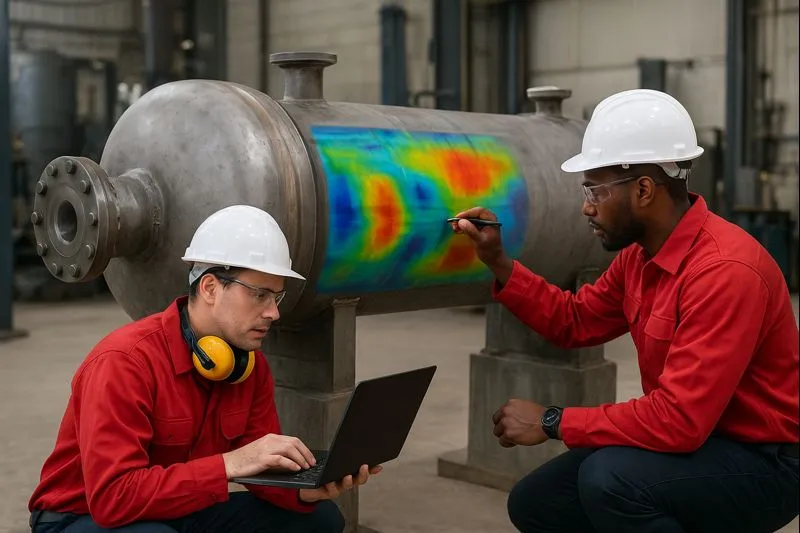
Stress analysis determines how pressure, temperature, and external forces impact a pressure vessel’s structural integrity and performance. It helps engineers identify weak points, prevent failures, and ensure long-term safety. In this blog, RedRiver LLC breaks down the essential methods and principles behind effective pressure vessel stress analysis.
Exploring How Do You Perform Stress Analysis on a Pressure Vessel
How do you perform stress analysis on a pressure vessel is a question that lies at the heart of engineering design and safety. Stress analysis is the process of determining how a vessel reacts under various pressure loads, temperatures, and external forces, ensuring full ASME BPVC compliance throughout the design and evaluation stages. This ensures that every vessel maintains its structural integrity, even under extreme operational conditions.
Pressure vessels store fluids or gases under pressure levels different from ambient conditions, which makes them vulnerable to mechanical failure if not properly designed. The aim of pressure vessel stress analysis and calculations is to identify stress distributions, measure their magnitude, and ensure ASME BPVC compliance by verifying that the material and geometry can withstand those stresses without failure.
At RedRiver LLC, engineers use advanced analytical techniques, simulation tools, and material testing to ensure every pressure vessel is built with precision and safety in mind.
The Fundamentals of What Is Pressure Vessel Stress Analysis
To understand how do you perform stress analysis on a pressure vessel, it’s essential to first know what is pressure vessel stress analysis. It involves applying physics, mathematics, and materials science to assess the structural strength of pressure vessels under internal and external loads.
This includes analyzing:
- Internal pressure acting on the vessel walls.
- External forces like wind or seismic activity.
- Thermal expansion due to temperature fluctuations.
- Residual stresses from welding and fabrication.
By performing this analysis, engineers ensure that the vessel meets design standards such as the ASME Boiler and Pressure Vessel Code (BPVC). RedRiver LLC’s specialists perform every calculation with precision, ensuring compliance and long-term performance.
The Process of Pressure Vessel Stress Analysis and Calculations
When discussing pressure vessel stress analysis and calculations, engineers typically follow a series of structured steps that ensure every aspect of the vessel is accounted for.
The process involves:
- Defining the load cases: Determining internal pressures, external loads, and environmental conditions. (Learn more)
- Modeling the vessel: Creating detailed 3D models to visualize how pressure and heat will affect the vessel.
- Applying stress formulas: Using thin-wall or thick-wall equations to calculate hoop, longitudinal, and radial stresses. (Hoop and radial stress guide)
- Using simulation tools: Implementing Finite Element Analysis (FEA) software to detect stress concentrations and deformation zones.
- Validating results: Comparing calculations against material properties and safety standards to ensure compliance. (Pressure vessel inspection)
Through this process, RedRiver LLC ensures that each vessel’s design meets structural integrity requirements before fabrication begins.
What Are the Types of Stresses in Pressure Vessels
To properly perform stress analysis, engineers must understand what are the types of stresses in pressure vessels. Each type of stress acts differently, and all must be accounted for to ensure stability.
The main stresses include:
- Hoop Stress: The circumferential stress caused by internal pressure attempting to expand the vessel’s walls.
- Longitudinal Stress: Acts along the vessel’s axis, primarily due to pressure on the end caps.
- Radial Stress: Occurs across the vessel’s wall thickness, decreasing from inner to outer surface.
- Thermal Stress: Created by uneven temperature distribution within the vessel material.
- Residual Stress: Stresses left in the vessel after welding or manufacturing processes. (Post-weld treatment guide)
During pressure vessel stress analysis and calculations, all of these stresses are combined to create a complete picture of how the vessel will perform in operation.
Welding in Pressure Vessel Engineering
An often-overlooked aspect of how do you perform stress analysis on a pressure vessel is understanding the impact of welding. Welding introduces heat, which affects the material’s microstructure and introduces residual stresses that must be managed through post-weld heat treatment and inspection.
What Is Welding in Pressure Vessel Engineering
Welding in pressure vessel engineering refers to the precise process of joining metals to form a sealed and pressure-resistant structure. Proper welding ensures the vessel remains leak-proof and capable of withstanding operational stress.
How Is Welding Used in Pressure Vessel Fabrication
How is welding used in pressure vessel fabrication involves techniques that maintain uniform stress distribution across the structure. Welding in pressure vessel construction joins components such as cylindrical shells, heads, and nozzles while preserving material strength.
Engineers at RedRiver LLC use advanced methods to ensure welding integrity aligns with stress analysis results. Their approach minimizes defects and maximizes safety.
What Are the Common Welding Methods for Pressure Vessels
The common welding methods for pressure vessels include:
- Gas Tungsten Arc Welding (GTAW or TIG): Precise and clean welds for stainless steel and thin materials. (TIG welding)
- Submerged Arc Welding (SAW): Provides deep penetration and consistency in thicker components.
- Gas Metal Arc Welding (GMAW or MIG): Offers efficiency for large-scale fabrication.
- Shielded Metal Arc Welding (SMAW): Used for field or maintenance work due to its flexibility.
Each method affects stress distribution differently, which is why welding is carefully planned during stress analysis..
The Role of Materials in Stress Analysis
Material selection affects how do you perform stress analysis on a pressure vessel, requiring strength, elasticity, corrosion resistance, and compatibility with Welding in pressure vessel construction to ensure long-term structural reliability and performance.
Common materials include:
- Carbon Steel: Cost-effective, suitable for moderate pressures. (Material guide)
- Stainless Steel: Offers superior corrosion resistance and high-temperature tolerance.
- Nickel Alloys: Excellent for extreme heat and chemical environments.
- Duplex Stainless Steels: Combine strength and resistance to stress corrosion cracking.
- Titanium: Lightweight and ideal for corrosive or high-performance applications.
Each material is analyzed to ensure that it meets the required strength-to-stress ratios. RedRiver LLC selects materials based on engineering data, ensuring each vessel is built for both durability and efficiency.
Ensuring Safety Through Pressure Vessel Stress Analysis and Calculations
The ultimate goal of stress analysis is safety. A pressure vessel failure can result in catastrophic consequences. By combining analytical design, computational modeling, and rigorous testing, engineers confirm that:
By combining analytical design, computational modeling, and rigorous testing, engineers confirm that:
- The vessel’s thickness and geometry meet safety limits. (Custom tank solutions)
- The welding and joints are strong and defect-free.
- The material will not deform under pressure or temperature changes.
This proactive approach reflects RedRiver LLC’s commitment to engineering excellence and safety-first fabrication.
How Do You Perform Stress Analysis on a Pressure Vessel
In conclusion, how do you perform stress analysis on a pressure vessel requires a balance of theoretical knowledge, computational modeling, and practical engineering expertise. The process ensures that every vessel can handle internal pressure, external loads, and thermal effects safely over its lifetime.
With a strong focus on pressure vessel stress analysis and calculations, material science, and precision welding, RedRiver LLC continues to set the standard for safety and quality in the pressure vessel industry.
Partner with RedRiver LLC
When you need reliable, expertly engineered pressure vessels, trust RedRiver LLC. Their commitment to accuracy, innovation, and safety ensures each project meets the highest standards of performance.
Visit RedRiver LLC to learn how their expertise in pressure vessel fabrication and manufacturing can help bring your project to life with unmatched precision and compliance.
Frequently Asked Questions
1. How do you perform stress analysis on a pressure vessel?
Engineers analyze load conditions, perform analytical calculations, and use simulation tools like Finite Element Analysis (FEA) to predict stress behavior.
2. What is pressure vessel stress analysis?
It is the process of evaluating stresses in a vessel under internal and external pressures to ensure structural integrity and safety.
3. What are the types of stresses in pressure vessels?
The main types include hoop, longitudinal, radial, thermal, and residual stresses, all of which affect vessel performance.
4. What is welding in pressure vessel engineering?
Welding in pressure vessel engineering joins components into a strong, leak-proof structure capable of handling pressure and heat.
5. How is welding used in pressure vessel fabrication?
Welding connects vessel shells, heads, and nozzles while ensuring consistent strength and proper stress distribution.
6. What are the common welding methods for pressure vessels?
TIG, MIG, SAW, and SMAW are commonly used, each offering specific advantages depending on material and thickness.
7. Why is stress analysis important in pressure vessel fabrication?
It ensures that the design can withstand operational pressures and temperatures without risk of deformation or failure.
Key Takeaways
- How do you perform stress analysis on a pressure vessel involves assessing how forces and pressure affect vessel performance.
- Stress analysis prevents failure by ensuring the vessel can handle internal and external loads.
- Welding plays a critical role in maintaining structural integrity and must align with stress design.
- Material choice determines the vessel’s ability to resist stress, corrosion, and fatigue.
- RedRiver LLC delivers expert engineering solutions with a commitment to safety and excellence.
Related Blog Post
Pressure Vessel Design & Engineering: Concept to Launch
What is Pressure Vessel Design and Engineering: Code-Ready Guide
What are the Key Factors in Pressure Vessel Engineering
How Do You Design a Pressure Vessel: A Step-By-Step Guide
What is Pressure Vessel Fabrication and Manufacturing
About Author