
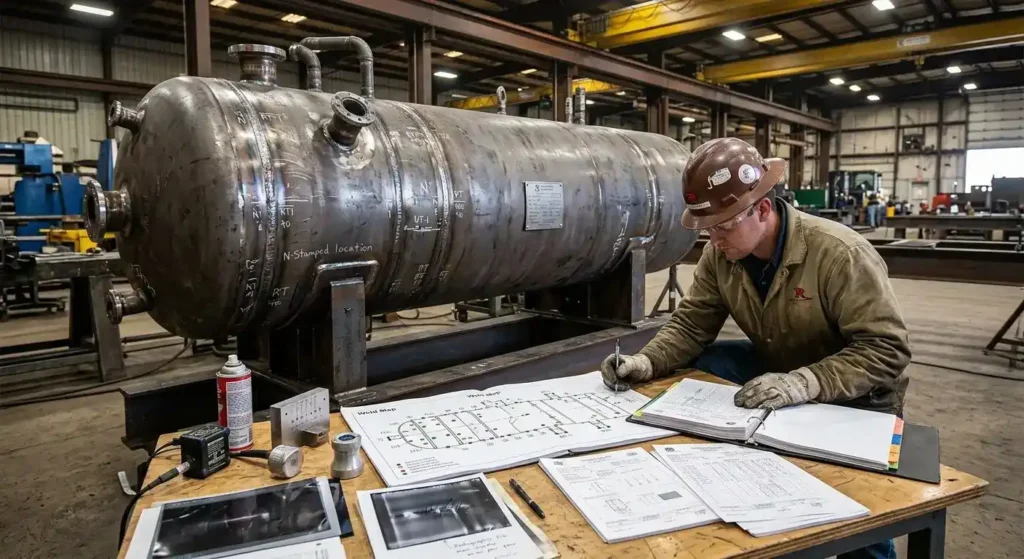
Documenting NDE results correctly comes down to recording six elements for every examination: the weld identity tied to the weld map, the written procedure and revision used, the examiner and their certification level, the raw result and disposition against named acceptance criteria, the formal handling of any reject and re-test, and a dated signature. A single missing element makes the entire record unverifiable, regardless of how sound the weld is.
Key Takeaways
- Tie every NDE record to a unique weld number on the weld map. Without that link, the record cannot be traced to the joint it certifies.
- Name the acceptance standard and procedure revision on every report, not just the pass or reject result. ASME BPVC Section V governs how each examination is documented.
- Log the examiner’s name, method, and certification level on every examination. Interpretations must be signed by personnel qualified under SNT-TC-1A or CP-189.
- Document repairs and re-tests as separate entries and never overwrite an original result. The full history is part of the code record.
- Build NDE documentation requirements into the build schedule from day one. NDE records roll up into the ASME Form U-1 data report, so front-loaded discipline turns closeout into collation, not reconstruction.
What Does NDE Documentation Actually Prove?
NDE documentation proves an examination happened, a qualified person performed it, and the part met the acceptance criteria written into the code. Non-Destructive Examination checks welds without damaging them, but the paperwork is what an inspector, owner, or insurer actually reviews.
Why Clean Records Matter Regardless of Weld Quality
Without complete records, a sound weld is unverifiable. A vessel can pass every test on the shop floor and still be rejected at sign-off because the technician referenced the wrong procedure revision or left the acceptance standard blank. Good documentation answers four questions: what was examined, how it was examined, who examined it, and whether it passed. Red River coordinates NDE through qualified inspection personnel, with every record built to match the NDE documentation requirements of each method. See Red River’s pressure vessel fabrication and capabilities scope.
What Records Does Each NDE Method Require?
Each NDE method produces its own record type, but all weld inspection records must link back to a specific weld, a specific procedure, and a specific qualified examiner.
Visual Testing
Visual testing (VT) is the baseline method. Its report notes the examiner, the lighting and viewing distance, the surface condition, and the result against the named acceptance standard.
Liquid Penetrant and Magnetic Particle Testing
Liquid penetrant testing (PT) and magnetic particle testing (MT) records list the materials used, dwell times, technique, and indications found, with sketches or photographs where relevant.
Radiographic Testing
Radiographic testing (RT) produces a film or digital image plus a reader sheet. The record ties each shot to a weld map location, names the technique, and logs the interpreter’s accept or reject call.
Ultrasonic Testing
Ultrasonic testing (UT) requires calibration records, equipment and probe details, scan coverage documentation, and the disposition of every indication above the reporting threshold.
The method changes across these five types, but the documentation discipline does not. Applicable standards: ASME BPVC Section V and ASNT SNT-TC-1A/CP-189 for examiner qualification.
How Do You Document NDE Results Step by Step?
NDE results are documented in a fixed sequence so the record is built as the work happens, not reconstructed at the end.
Step 1: Log Against the Weld Map
Log the examination request against the weld map before any testing starts. Each weld carries a unique number so the record has a defined location.
Step 2: Capture the Procedure and Technique
Record the procedure number, the revision, and the acceptance standard. This is where most documentation disputes are settled or lost.
Step 3: Record the Examiner and Qualifications
List the name, certification level, and method. An RT interpretation signed by an uncertified reader cannot support the ASME stamp.
Step 4: Record the Raw Result and Disposition
State what was found and the accept or reject call against the named criteria. “No relevant indications” is acceptable; “Looks fine” is not.
Step 5: Handle Rejects Formally
Document the repair and re-test as a separate entry. Never overwrite the original. The full history is part of the code record.
Step 6: Sign and Date
An unsigned report is a draft. The examiner’s signature and date close the entry. Red River’s modular skid packages and prefabrication services apply this same sequence across complete vessel and piping scopes.
What Do ASME Section V and Section VIII Require?
ASME Section V governs how each NDE method is performed and what the procedure must contain. Section VIII, Division 1 defines which welds require examination and the acceptance level. Records must satisfy both simultaneously, and ASME Section V reporting requirements govern the content of each record at every link in the chain. An Authorized Inspector must be able to trace from the data report to the weld map to the NDE record and confirm it meets the code edition on the nameplate. When that chain breaks, the vessel cannot be stamped.
What Documentation Mistakes Cause an Inspection to Fail?
Most inspection failures trace back to three errors, and all are avoidable.
Mismatched Procedure Revisions
The shop runs to revision four while the report cites revision two. The record contradicts itself and cannot be accepted.
Missing Acceptance Criteria and Untraceable Welds
A report that records “pass” without naming the acceptance standard gives the Authorized Inspector nothing to verify. If the weld number on the report does not match the weld map, the record cannot be linked to the joint it certifies and is not usable. Red River has fabricated coded vessels from Gillette, Wyoming, since 2003, maintaining documentation practices that support clean inspections on every project.
How Do NDE Records Feed the Manufacturer’s Data Report?
Every NDE record feeds into the documentation package that supports the ASME Form U-1 or U-1A filed for a coded vessel. The data report summarizes the build, and the weld inspection records are the evidence that supports it.
For repairs and alterations, the record carries the National Board R Stamp and its R-1 form. Every coded vessel Red River fabricates ships with the ASME Form U-1, certified mill test reports, weld procedure qualification records, NDE examination reports, and the hydrostatic test record. Red River holds active ASME U Stamp and NBBI R Stamp certifications.
What This Means for Your Next Vessel Project
Knowing how to document NDE results is about building traceable, code-ready records as the work happens. The fabricators who treat documentation as part of the build clear inspection without delays. Red River holds active ASME U Stamp and NBBI R Stamp certifications and has fabricated coded pressure vessels from Gillette, Wyoming, since 2003.
Ready to Discuss Your NDE Documentation Requirements?
Request a quote or call 1-307-257-5332 to discuss your NDE documentation requirements and fabrication scope with Red River’s team.
Frequently Asked Questions
1. What Does NDE Stand For in Pressure Vessel Fabrication?
NDE stands for Non-Destructive Examination. It covers methods including radiographic, ultrasonic, magnetic particle, liquid penetrant, and visual testing that check welds and materials without cutting or damaging them. In coded work, the examination confirms a part meets ASME acceptance criteria.
2. How Long Should NDE Records Be Retained?
Retention requirements depend on the code edition, the owner’s contract, and jurisdictional rules. When unclear, retain the full documentation package. The National Board registration record provides a permanent external reference.
3. Who Is Qualified to Sign Off on NDE Results?
Only personnel certified under a written practice aligned with SNT-TC-1A or CP-189 can interpret and sign NDE results. A Level I examiner cannot perform interpretations reserved for Level II. Name, certification level, and signature all belong on the record.
4. What Is the Difference Between ASME Section V and Section VIII for NDE?
ASME Section V defines how each NDE method is performed and what the procedure must contain. Section VIII defines which joints require examination and at what acceptance level. Records must satisfy both, and the Authorized Inspector traces the chain from the data report to each examination record.
5. Can Digital Records Replace Film and Paper for NDE Documentation?
Yes. Digital radiography and electronic record systems are widely accepted when they preserve image quality, traceability, and all required data fields. The format can change, but the required content cannot: the weld, the procedure, the qualified examiner, and the disposition of every indication.
Related Blog Post
Can Condensate Storage Improve Reliability?
Where Do Condensate Tanks Fit in a Steam System?
Which Nozzles Simplify Maintenance on Pressure Vessels?

How to Vent Condensate Tanks in Steam Systems
How Do Baffle Layouts Affect Stratification in TES Tanks?
About Author



