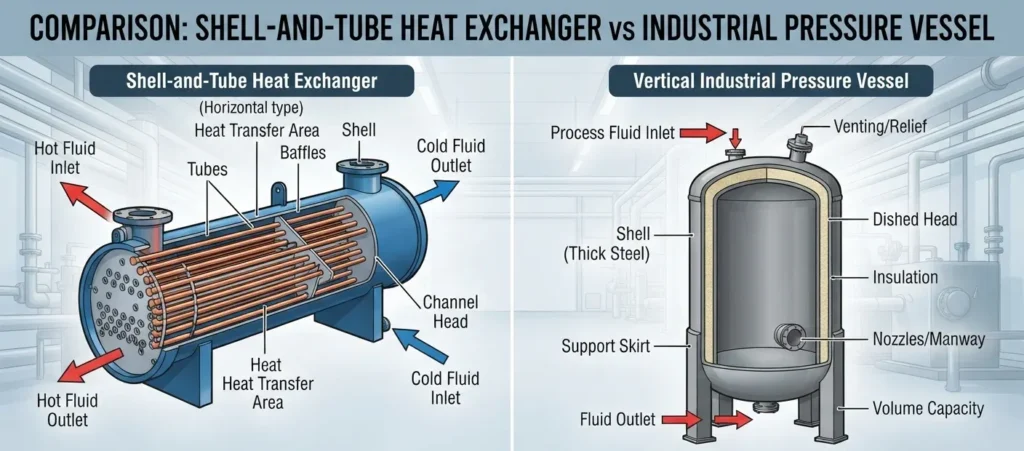
Understanding the difference between heat exchangers and pressure vessels used in industrial operations and engineering systems choose the right equipment for safe and efficient industrial operations. While both are used across industries like oil and gas, chemical processing, manufacturing, and power generation, heat exchangers transfer heat, whereas pressure vessels safely contain pressurized fluids. This article covers their key differences, similarities, applications, and when a heat exchanger qualifies as a pressure vessel.
Difference Between Heat Exchangers and Pressure Vessels at a Glance
| Feature | Heat Exchanger | Pressure Vessel |
| Primary Function | Transfers heat between fluids | Contains fluids under pressure |
| Design Priority | Thermal efficiency | Pressure containment |
| Operates Under Pressure | Sometimes | Yes |
| Typical Industries | HVAC, food processing, petrochemical | Oil & gas, chemical, manufacturing |
What Is a Heat Exchanger?
A heat exchanger transfers heat between two or more fluids without allowing them to mix. By recovering and redistributing thermal energy, these systems improve efficiency while reducing operating costs.
Heat exchangers are commonly used in:
- Petrochemical plants
- Refineries
- Food and beverage processing
- Pharmaceutical manufacturing
- HVAC systems
- Power generation
Several heat exchanger designs are available, each suited to different operating conditions.
Common Types of Heat Exchangers
Shell-and-Tube
One of the most widely used industrial designs, shell-and-tube heat exchangers handle high temperatures and pressures, making them ideal for demanding industrial environments.
Plate
Plate heat exchangers provide efficient heat transfer within a compact design. They are commonly found in HVAC systems and sanitary processing applications.
Finned Tube
Finned tube heat exchangers increase surface area to improve cooling performance and are frequently used in air conditioning and refrigeration systems.
Selecting the proper heat exchanger depends on operating temperature, pressure, maintenance requirements, and process efficiency goals.
What Is a Pressure Vessel?
A pressure vessel is a specially engineered container designed to safely hold gases or liquids at pressures significantly different from atmospheric pressure.
Unlike heat exchangers, which focus on heat transfer, pressure vessels are designed to safely contain internal pressure while maintaining structural integrity throughout their operating life.
Most industrial pressure vessels are designed according to the ASME Boiler and Pressure Vessel Code to ensure safety and regulatory compliance.
Common Types of Pressure Vessels
Industrial facilities rely on several pressure vessel designs, including:
- Storage Vessels for compressed gases and process fluids
- Reactors for controlled chemical processes
- Separators for separating liquids and gases
Each design is engineered according to operating pressure, temperature, and application requirements.
Are Heat Exchangers Pressure Vessels?
One of the most common misconceptions is that every heat exchanger is automatically considered a pressure vessel.
In reality, the classification depends on how the equipment operates.
Many industrial heat exchangers contain fluids under significant pressure and therefore must comply with pressure vessel design standards. Others operate under lower pressures and are not classified as pressure vessels.
A heat exchanger is more likely to qualify as a pressure vessel when it:
- Operates under high internal pressure
- Presents safety risks if pressure containment fails
- Must comply with ASME requirements
- Is designed to withstand both thermal and pressure stresses
This is why shell-and-tube heat exchangers are frequently manufactured to pressure vessel standards while still serving their primary purpose of transferring heat.
Key Differences Between Heat Exchangers and Pressure Vessels
Although both pieces of equipment are engineered for demanding industrial environments, they serve different purposes.
| Heat Exchangers | Pressure Vessels |
| Transfer heat between fluids | Contain pressurized fluids |
| Prioritize thermal performance | Prioritize structural strength |
| Include tubes, plates, or fins | Typically contain larger chambers |
| Improve energy efficiency | Maintain safe pressure containment |
Despite these differences, both play an important role in maintaining reliable industrial operations.
Similarities Between Heat Exchangers and Pressure Vessels
While their primary functions differ, heat exchangers and pressure vessels share several characteristics.
Both:
- Safely contain liquids or gases during operation
- Must withstand mechanical and thermal stresses
- Require quality materials and precision fabrication
- Need regular inspections and preventive maintenance
Proper engineering and routine maintenance help extend equipment life while reducing downtime and safety risks.
Common Industrial Applications
Heat exchangers and pressure vessels are essential across many industries, often working together within the same process while performing different functions.
Heat Exchanger Applications
Industrial heat exchanger vessels improve energy efficiency by transferring heat between fluids in systems such as:
- Oil and gas processing
- Petrochemical plants
- Power generation
- HVAC systems
- Food and beverage manufacturing
- Pharmaceutical production
Their ability to recover and reuse thermal energy helps reduce energy consumption and operating costs.
Pressure Vessel Applications
Pressure vessels safely contain pressurized liquids and gases used in industrial processes. Common applications include:
- Chemical reactors
- Storage tanks
- Air receivers
- Gas separators
- Boiler systems
- Water treatment facilities
Many facilities rely on custom-engineered pressure vessels designed to meet specific operating pressures, temperatures, and safety requirements.
Why Proper Maintenance Matters
Routine maintenance is critical for extending equipment life and preventing costly failures.
A proactive maintenance program should include:
- Inspecting for corrosion, erosion, and leaks
- Checking welds, seals, and gaskets
- Cleaning heat transfer surfaces
- Performing scheduled pressure testing
- Monitoring operating temperatures and pressures
For heat exchangers, routine cleaning helps maintain thermal efficiency. For pressure vessels, regular inspections verify structural integrity and compliance with applicable safety standards.
Preventive maintenance improves reliability, minimizes downtime, and supports safer plant operations.
Facilities handling hazardous chemicals should also follow OSHA’s Process Safety Management (PSM) requirements, which emphasize equipment integrity, inspection, testing, and preventive maintenance to reduce the risk of catastrophic failures.
Choosing the Right Equipment
Selecting between a heat exchanger, a pressure vessel, or a combination of both depends on your process requirements.
When evaluating equipment, consider:
- Operating pressure
- Fluid temperature
- Chemical compatibility
- Heat transfer requirements
- Corrosion resistance
- ASME code compliance
- Inspection and maintenance accessibility
Working with an experienced manufacturer specializing in pressure vessel fabrication helps ensure your equipment is engineered for performance, safety, and long-term reliability.
Why Choose Red River
Choosing the right manufacturing partner is just as important as choosing the right equipment.
Red River designs and manufactures high-quality pressure vessels for demanding industrial applications. In addition to pressure vessels, the company fabricates prefabricated spools, skid packages, and other custom process equipment built to meet strict quality and safety standards.
Whether you need a standard pressure vessel or a fully customized solution, Red River provides dependable engineering, precision fabrication, and American-made craftsmanship.
Contact us to discuss your project and discover how Red River can support your industrial equipment needs.
Frequently Asked Questions
1. Is every heat exchanger considered a pressure vessel?
No. Some heat exchangers operate under low pressure and are not classified as pressure vessels. Others, particularly shell and tube designs, may qualify when they operate under high pressure and meet ASME requirements.
2. What is the primary difference between a heat exchanger and a pressure vessel?
A heat exchanger transfers heat between fluids, while a pressure vessel is designed to safely contain fluids or gases under pressure.
3. Can a pressure vessel contain a heat exchanger?
Yes. Many industrial systems integrate heat exchangers within pressure vessels to perform heat transfer while maintaining safe pressure containment.
4. Why is routine maintenance important?
Regular inspections help identify corrosion, leaks, and wear before they become major problems. Preventive maintenance also improves efficiency, extends equipment life, and reduces unexpected downtime.
5. Which industries use both heat exchangers and pressure vessels?
Oil and gas, petrochemical, power generation, food processing, pharmaceutical manufacturing, and chemical processing all rely on both types of equipment.
Key Takeaways
- Heat exchangers transfer heat, while pressure vessels safely contain pressurized fluids.
- Many shell and tube heat exchangers meet pressure vessel standards because they operate under high pressure.
- Both require proper engineering, quality fabrication, and regular maintenance.
- Choosing equipment depends on pressure, temperature, process requirements, and applicable codes.
- Partnering with an experienced manufacturer helps improve safety, efficiency, and long-term reliability.
Understanding the Difference Helps Improve Industrial Performance
Understanding the difference between heat exchangers and pressure vessels helps engineers and facility managers choose equipment that improves efficiency while maintaining compliance with industry safety standards. Although these systems perform different functions, they often work together to support reliable industrial operations.
If you’re looking for expertly engineered pressure vessels or custom process equipment, Red River has the experience and manufacturing capabilities to deliver dependable solutions built to your exact specifications. Reach out today to discuss your next project and experience the Red River difference.
Related Blog Post
What Are Air Separator Tanks?
Which Materials Suit Glycol Service?
How Do Hydronic Tanks Stabilize Flow?
How Much Glycol Volume Is Needed?
When to Use Hydronic Tanks
No subpillar set for this blog post.
About Author