
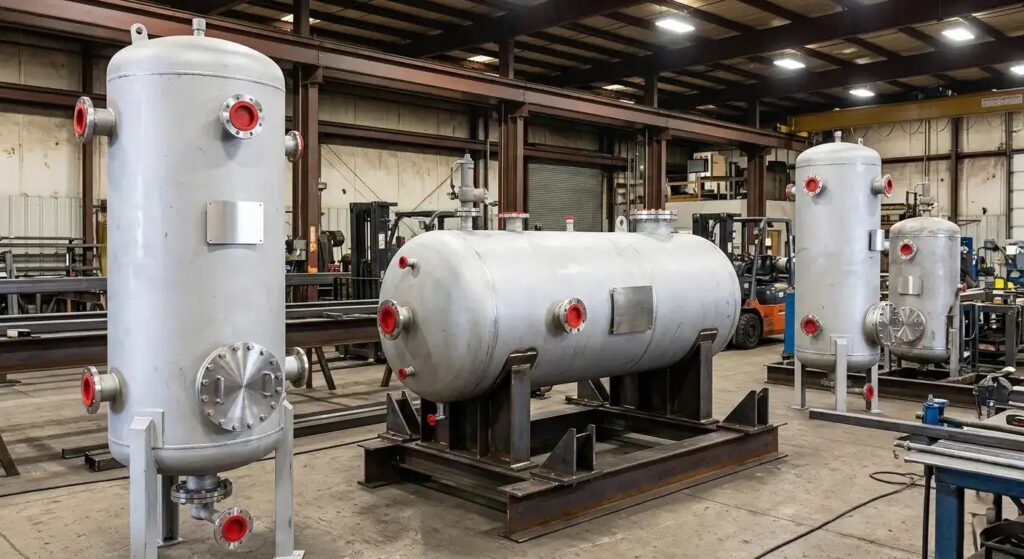
A receiver tank is a pressure vessel that stores a compressed gas or pressurized liquid between the point of generation and the point of use, buffering supply and demand so the upstream equipment runs at steady, efficient conditions rather than reacting to every downstream flow change. Compressed air, steam, refrigerant, and process liquids are the most common stored media, and each type of receiver has distinct sizing, material, and code requirements that are set during the design phase before fabrication begins.
Key Takeaways
- A compressed air receiver tank stores compressed air between the compressor and the distribution system, protecting the compressor from short cycling and providing reserve capacity for demand spikes.
- A steam receiver vessel holds steam at line pressure between the boiler and steam-driven process equipment, damping pressure fluctuations and separating condensate from the steam supply.
- A liquid receiver tank in a refrigeration or process system holds refrigerant or process liquid, ensuring continuous liquid supply to expansion devices and allowing the system to operate across varying load conditions.
- Receiver tank sizing is based on the compressor or generator output, the downstream demand rate, the acceptable pressure variation band, and the required hold time between start-stop cycles.
- Every receiver tank operating above 15 psig must carry the ASME U Stamp under Section VIII, Division 1, and be registered with the National Board of Boiler and Pressure Vessel Inspectors.
- Red River fabricates ASME-certified receiver tanks in carbon steel and stainless steel for compressed air, steam, refrigerant, and process fluid service from Gillette, Wyoming, since 2003.
What Is a Receiver Tank and What Does It Do?
A receiver tank decouples supply from demand in a pressurized system. Without a receiver, every change in downstream demand immediately affects upstream equipment. A compressor starts and stops every time a user opens a valve. A boiler modulates continuously trying to match an unsteady process load. A receiver absorbs those demand fluctuations, presenting a stable pressure and flow source to downstream equipment while the upstream generator runs at its most efficient operating point.
The Core Function Across All Receiver Types
The core function is the same regardless of the stored medium: the receiver accepts output from the upstream source when supply exceeds demand, stores it as pressure, and releases it when demand exceeds the upstream source’s instantaneous capacity. The stored energy in the vessel is what bridges the gap between the two rates. Red River’s pressure vessel fabrication covers all three primary receiver tank types across industrial and process applications.
Why Receivers Are Coded Pressure Vessels
Because a receiver tank stores pressurized fluid and sits permanently in a pressurized system, it is an ASME Section VIII pressure vessel when operating above 15 psig. The code governs the design calculation, materials, weld examination, hydrostatic testing at 1.3 times the maximum allowable working pressure (MAWP), and the documentation package required for National Board registration. Operating a non-coded receiver in a pressurized system above 15 psig violates code requirements and affects insurance coverage and jurisdictional registration.
What Are the Three Main Types of Receiver Tanks?
Receiver tanks are classified by the medium they store. Each type has a different internal design, material requirement, and sizing basis.
Compressed Air Receiver Tanks
A compressed air receiver tank sits between the air compressor and the compressed air distribution system. It serves three simultaneous functions. First, it buffers the compressor against short cycling by storing enough compressed air that the compressor can run through a full load-unload cycle rather than starting and stopping for each small demand event. Second, it provides peak demand capacity for momentary loads that exceed the compressor’s steady-state output. Third, it separates condensed moisture and oil aerosols from the compressed air stream before the air enters the distribution system.
Compressed air receivers are typically vertical vessels to maximize the drain path for condensate and are sized using a formula that accounts for the compressor’s free air delivery rate, the downstream demand rate, the acceptable system pressure band, and the required minimum run time. Standard shop air receivers range from 60 to 240 gallons. Industrial installations serving large compressors commonly use 500 to 2,000-gallon receivers, and high-demand facilities may install multiple large receivers in parallel.
Steam Receiver Vessels
A steam receiver vessel holds steam at line pressure between the boiler and steam distribution header. It performs two functions: it damps pressure fluctuations caused by variable demand from multiple steam users drawing from the same header, and it provides a separation zone where entrained condensate drops out of the steam before it reaches process equipment. Wet steam reaching a steam trap, turbine, or process heat exchanger reduces performance and can damage equipment by water hammer.
Steam receivers are typically horizontal to maximize the liquid surface area for condensate separation and are drained continuously or on a timed interval through a steam trap or manual drain valve. Materials are confirmed against the steam pressure, temperature, and water chemistry. For saturated steam service at moderate pressures, carbon steel is standard. For superheated or high-pressure steam, alloy materials may be required. Red River’s process tank scope covers steam receiver vessels across boilers and combined heat and power applications.
Liquid Receiver Tanks
A liquid receiver tank in a refrigeration system holds refrigerant liquid between the condenser and the expansion device. It ensures that only subcooled liquid enters the expansion valve, preventing flash vapor from degrading system performance. In process cooling applications, liquid receivers hold process coolant or refrigerant at a defined pressure, providing the system with a stable liquid supply across varying ambient temperatures and load conditions. Liquid receivers must be compatible with the specific refrigerant or process fluid, including its pressure-temperature relationship, its effect on elastomer seals, and any moisture or contamination sensitivity.
How Are Receiver Tanks Sized?
Receiver tank sizing is a function of the output rate of the upstream equipment, the demand rate of the downstream system, the acceptable pressure variation, and the required operating interval between equipment cycles.
Compressed Air Receiver Sizing Formula
The standard formula for compressed air receiver sizing is:
V = (T × Qd × Pa) / (P1 − P2)
Where V is the receiver volume in cubic feet, T is the required hold time in minutes, Qd is the demand flow rate in cubic feet per minute at atmospheric pressure, Pa is atmospheric pressure (14.7 psia), P1 is the upper pressure limit in psia, and P2 is the lower pressure limit in psia. A system with a 5-minute hold time requirement, 100 cfm demand, a 150 psig upper limit, and a 90 psig lower limit requires a receiver volume of approximately 10.6 cubic feet, or about 80 gallons. Red River’s fabrication capabilities include working through this sizing calculation with clients before the fabrication scope is defined.
Steam Receiver Sizing
Steam receivers are sized from the total connected steam load, the boiler’s output capacity, and the acceptable pressure variation the header can sustain before affecting the downstream process. A common starting point is two to five minutes of total connected load capacity at the design steam demand rate.
Liquid Receiver Sizing
Liquid receivers in refrigeration systems are sized to hold the total system refrigerant charge when the system is in a pumpdown condition for service, plus operating reserve for load variation. Sizing requires the refrigerant charge weight, the liquid density at condensing temperature, and the required operating reserve volume.
What ASME Requirements Apply to Receiver Tanks?
Every receiver tank operating above 15 psig must be fabricated to ASME BPVC Section VIII, Division 1. The code requirements apply regardless of tank size, operating medium, or installation location.
What Section VIII Governs
ASME Section VIII governs the pressure design calculation confirming the shell and head thickness for the design pressure and temperature, material selection from approved ASME material specifications with certified mill test reports (MTRs), weld joint classification and required examination, hydrostatic pressure testing at 1.3 times the MAWP witnessed by the Authorized Inspector, nozzle reinforcement calculations, and the ASME Form U-1 Manufacturer’s Data Report filed with the National Board.
Pressure Relief Device Requirements
Every receiver tank must have a pressure relief device sized to prevent the vessel pressure from exceeding 110 percent of the MAWP under any operating condition. The relief device must be set at or below the MAWP, be of sufficient capacity to pass the full output of the upstream equipment, and be connected directly to the vessel without intervening isolation valves.
Red River’s Certification Scope
Red River holds active ASME U Stamp and NBBI R Stamp certifications. Every coded receiver tank ships with the ASME Form U-1, certified MTRs, weld qualification records, NDE examination reports coordinated through qualified inspection personnel, and the hydrostatic test record. These documents form the traceability package the vessel carries across its full service life.
What Design Details Matter for Receiver Tanks?
Several mechanical design details determine whether a receiver tank performs reliably in service and is maintainable over its service life.
Inlet and Outlet Nozzle Placement
On a compressed air receiver, the inlet from the compressor typically enters at the top, and the outlet to the distribution system exits at the side or top, while the drain exits at the absolute bottom of the vessel to maximize condensate removal. On a steam receiver, the steam inlet and outlet are both at the top of the shell, and the condensate drain exits at the bottom. On a liquid receiver, the inlet from the condenser enters near the top and the liquid outlet exits at the bottom to ensure only subcooled liquid exits to the expansion device.
Pressure Gauges, Safety Valves, and Drain Access
Every receiver requires a pressure gauge mounted at or near the vessel, accessible without removing insulation or covers. The pressure relief valve must be accessible for testing and replacement. Drain connections must be sized to remove accumulated condensate completely and must be reachable for timed or manual drain operation. Red River’s modular skid packages and prefabrication scope confirm all accessory connections and service access before the skid assembly ships.
Receiver Tanks Fabricated for Your System From the Start
Receiver tanks are specified for a defined system and a defined duty. A tank sized to the wrong formula, rated to the wrong pressure, or fabricated from an incompatible material for the stored fluid fails its system. Getting the receiver right means confirming the sizing basis, material compatibility, nozzle schedule, and ASME code requirements during the design review, before any plate is cut. Red River has fabricated ASME-certified receiver tanks for compressed air, steam, refrigerant, and process fluid applications from Gillette, Wyoming, since 2003.
Discuss Your Receiver Tank Requirements With Red River
Red River fabricates ASME-certified receiver tanks in carbon steel and stainless steel for compressed air, steam, biogas, refrigerant, and industrial process applications. Red River holds active ASME U Stamp and NBBI R Stamp certifications and is an American Welding Society (AWS) member.
Ready to Define Your Receiver Tank Scope?
Request a quote or call 1-307-257-5332 to discuss your receiver tank type, sizing basis, operating pressure, and fabrication scope with Red River’s team. The sizing and code review starts before fabrication scope is defined.
Frequently Asked Questions
1. What Is a Receiver Tank?
A receiver tank is a pressure vessel that stores compressed gas or pressurized liquid between the point of generation and the point of use. It buffers supply and demand, allows upstream equipment to run at efficient steady-state conditions, and provides reserve capacity for demand spikes. Common types are compressed air receivers, steam receivers, and liquid refrigerant receivers.
2. How Is a Compressed Air Receiver Tank Sized?
Compressed air receiver sizing uses the formula V = (T × Qd × Pa) / (P1 − P2), where T is the required hold time, Qd is the downstream demand flow rate, Pa is atmospheric pressure, P1 is the upper system pressure limit, and P2 is the lower pressure limit. The result gives the required receiver volume in the same units as the input flow rate and time combination.
3. What Is the Difference Between a Compressed Air Receiver and a Steam Receiver?
A compressed air receiver stores compressed air and separates condensed moisture between the compressor and distribution system. A steam receiver stores steam between the boiler and the steam distribution header, damps pressure fluctuations, and separates condensate from the steam supply before it reaches process equipment. Both are ASME-coded pressure vessels when operating above 15 psig, but they differ in orientation, drain design, material, and internal configuration.
4. Does a Receiver Tank Need to Be ASME-Coded?
Yes, when operating above 15 psig. Any receiver tank above that pressure must be fabricated to ASME BPVC Section VIII, Division 1, by a U Stamp-certified fabricator and registered with the National Board of Boiler and Pressure Vessel Inspectors. Operating a non-coded receiver above 15 psig violates code requirements and affects insurance coverage and jurisdictional registration.
5. What Size Receiver Tank Is Typical for Industrial Compressed Air Systems?
Industrial compressed air systems serving large compressors commonly use 500 to 2,000-gallon receivers. High-demand facilities may install multiple large receivers in parallel. The correct size for any specific system comes from the sizing formula applied to the actual compressor output, downstream demand rate, acceptable pressure band, and required minimum compressor run time.
6. Can Red River Fabricate Receiver Tanks as Part of a Modular Package?
Yes. Red River fabricates receiver tanks as standalone ASME pressure vessels and as part of modular skid packages that integrate the vessel with compressors, dryers, filtration equipment, pressure gauges, relief valves, and drain connections into a single pre-tested assembly. Modular delivery reduces field installation scope and allows factory acceptance testing of the complete package before it ships.
Related Blog Post
Can Condensate Storage Improve Reliability?
Where Do Condensate Tanks Fit in a Steam System?
Which Nozzles Simplify Maintenance on Pressure Vessels?
How to Vent Condensate Tanks in Steam Systems
How Do Baffle Layouts Affect Stratification in TES Tanks?
About Author



