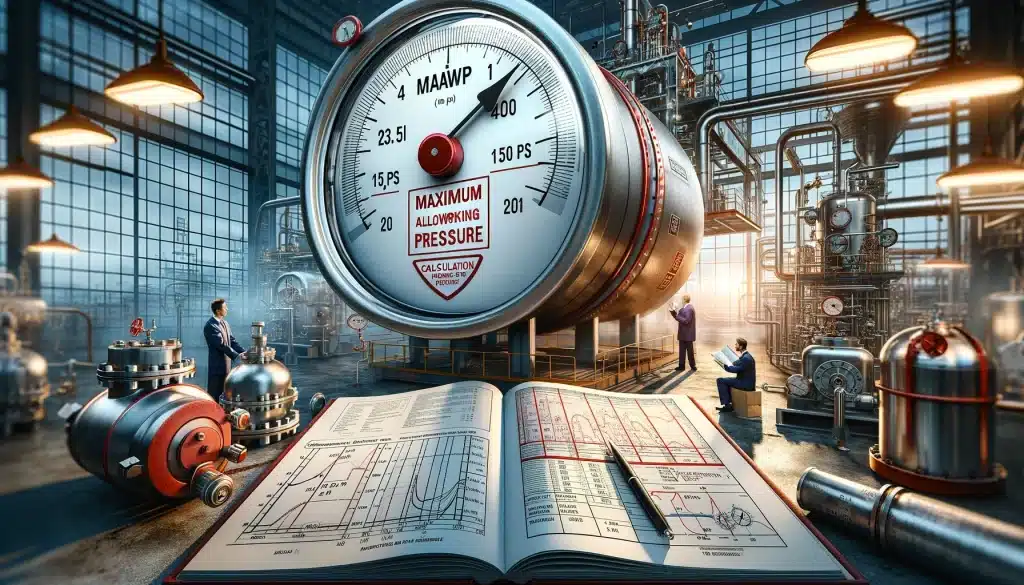
MAWP is the highest pressure a vessel can safely withstand under specified conditions. It’s determined by factors like material strength, vessel thickness, shape, and temperature. This guide explains how MAWP is calculated using ASME standards, how it’s influenced by temperature and design, and its role across industries like chemical processing and pharmaceuticals. With Red River’s engineering, MAWP isn’t just a number, it’s a benchmark for safety, compliance, and durability. Learn how design, testing, and emergency protocols ensure performance under pressure.
Introduction to Maximum Allowable Working Pressure of a Vessel
A pressure vessel is a container designed to hold gases or liquids at pressures different from the surrounding atmosphere. Maximum Allowable Working Pressure (MAWP) is the highest pressure a vessel can safely operate under specific conditions. At Red River, we craft vessels that exceed safety standards, combining reliability with long-term durability.
Exploring Maximum Allowable Working Pressure (MAWP) of a Vessel
What is MAWP?
MAWP represents the optimal pressure at which a pressure vessel can safely operate. Thus, it serves as a critical benchmark in vessel design, ensuring both protection and efficiency.
The Science Behind Maximum Allowable Working Pressure of a Vessel
MAWP is based on sound engineering principles, considering factors such as material strength and environmental conditions. As a result, these elements help define the safe operational limits of the vessel.
How MAWP is Determined
Determining MAWP involves rigorous testing, material selection, and precise engineering see how that plays out in Red River’s design and engineering phase of pressure vessel manufacturing. Tests factor in the vessel’s materials, design, and intended use, enabling engineers to establish accurate pressure thresholds.
Maximum Allowable Working Pressure of a Vessel: Pressure Vessel Design and MAWP
Key Design Factors Affecting MAWP
Several design factors such as size, shape, and construction methods significantly influence the vessel’s MAWP. Consequently, this requires specific engineering to align the vessel’s structure with its operational needs. For example, larger vessels may require additional reinforcements, while smaller ones might need precise material selection to handle higher pressures.
Material Considerations for Pressure Vessels
Selecting materials is essential, as metals and alloys have varying tolerances for pressure and temperature. Therefore, careful material selection ensures the vessel meets safety and efficiency standards. Moreover, this choice directly influences the vessel’s performance under operational conditions.
The Role of Thickness and Shape in Maximum Allowable Working Pressure of a Vessel
Thickness and shape directly impact a vessel’s ability to withstand internal pressures. Thus, they are vital considerations when determining MAWP. For instance, thicker materials typically provide greater pressure resistance, while the shape can distribute stresses more evenly.
Maximum Allowable Working Pressure of a Vessel: Regulations and Standards for Pressure Vessels
ASME Standards and MAWP
ASME requirements provide critical guidance for MAWP, ensuring vessels meet safety and performance standards. Consequently, adhering to these standards promotes reliability and minimizes risks associated with pressure vessel operations.
International Pressure Vessel Codes
Beyond ASME standards, other global codes guide vessel design. In Europe, EN 13445 focuses on unfired pressure vessels, offering slightly different testing requirements from ASME Section VIII. In Australia, AS 1210 addresses high-temperature and high-pressure operations. Understanding these regional differences ensures compliance, especially for companies operating across multiple jurisdictions.
Maximum Allowable Working Pressure of a Vessel: Compliance and Safety in Design
Compliance with standards is essential to ensure maximum protection in pressure vessel layouts. Moreover, compliance fosters trust and operational reliability, ensuring businesses meet both regulatory and operational expectations.
Calculating the Maximum Operating Pressure
Basic Calculation Methods
The fundamental MAWP calculation follows the ASME Boiler and Pressure Vessel Code formula:
MAWP = (S × t × E) / (R + 0.6 × t)
Where:
- S = Maximum allowable stress value (psi)
- t = Minimum thickness of shell (inches)
- E = Joint efficiency factor
- R = Inside radius of vessel (inches)
For cylindrical vessels, additional factors include corrosion allowance and temperature derating factors.
Advanced Computational Techniques
Finite Element Analysis (FEA) software provides more precise MAWP calculations by:
- Analyzing stress distribution patterns
- Accounting for complex geometries and load combinations
- Incorporating temperature gradient effects
- Validating theoretical calculations with real-world conditions
Case Studies: MAWP Calculation Examples
Example 1: Carbon Steel Storage Tank
- Material: SA-516 Grade 70 (S = 20,000 psi at 100°F)
- Thickness: 0.5 inches
- Radius: 48 inches
- Joint Efficiency: 1.0 (seamless)
- Calculated MAWP: 206 psi
Safety Measures and MAWP
Our approach goes beyond standard safety. We incorporate robust emergency protocols and regular inspections to maintain vessel integrity. Learn more about Red River’s comprehensive pressure vessel inspections, which include advanced non-destructive testing and IoT-based monitoring.
Emergency Protocols for Pressure Exceedance
Immediate Response Steps:
- Pressure Detection: Monitor systems trigger alarms at 90% of MAWP
- Automatic Shutdown: Emergency systems activate at 95% of MAWP
- Personnel Evacuation: Clear 500-foot radius around vessel
- Pressure Relief: Primary and secondary relief valves engage
- System Isolation: Close all inlet valves and isolate vessel
- Emergency Venting: Manual venting procedures if automatic systems fail
- Incident Documentation: Record pressure readings, timeline, and response actions
Post-Incident Procedures:
- Complete vessel inspection before restart
- Pressure test at 1.5 times MAWP
- Review and update safety protocols
Regular Maintenance and Inspection
Routine maintenance and inspections are critical for ensuring long-term vessel integrity and safety.
Maximum Allowable Working Pressure of a Vessel: Emergency Protocols for Pressure Exceedance
Preparedness for pressure exceedance is vital for mitigating potential risks and ensuring operational continuity.
Maximum Allowable Working Pressure of a Vessel: The Impact of Temperature on MAWP
Temperature Effects on Material Strength
Temperature fluctuations affect material strength in pressure vessels. Elevated heat can reduce tensile strength, while extreme cold can make materials brittle.
| Material | Strength at 100°F | Strength at 500°F | % Strength Loss |
| Carbon Steel SA-516 | 20,000 psi | 17,500 psi | -12.5% |
| Stainless Steel 316 | 21,000 psi | 18,900 psi | -10% |
Adjusting MAWP for Temperature Variations
By applying temperature derating factors, engineers ensure vessels remain safe across expected operating conditions.
Case Studies: Temperature-Induced Pressure Changes
Real-world scenarios demonstrate how temperature fluctuations affect vessel performance, underscoring the importance of incorporating temperature considerations into MAWP calculations.
Maximum Allowable Working Pressure of a Vessel: Pressure Vessels in the Chemical Industry
Applications in Petroleum Refining
Pressure vessels play an essential role in petroleum refining, in which they’re used for distillation, cracking, and other excessive-pressure tactics.
Maximum Allowable Working Pressure of a Vessel: Role in Pharmaceutical Manufacturing
In pharmaceutical production, pressure vessels ensure the integrity and purity of merchandise, adhering to stringent industry requirements.
Maximum Allowable Working Pressure of a Vessel: Innovations and Future Trends in Pressure Vessel Design
Emerging Materials and Technologies
Advancements in substances and technology promise more efficient, more secure, and longer-lasting pressure vessels.
Sustainable and Eco-Friendly Practices
The trend toward sustainability is riding the adoption of eco-friendly substances and practices in pressure vessel production.
Maximum Allowable Working Pressure of a Vessel: Predictions for Future Pressure Vessel Standards
Future requirements are anticipated to evolve, incorporating new technologies and environmental issues.
Maximum Allowable Working Pressure of a Vessel: Choosing the Right Pressure Vessel for Your Needs
Predictions for Future Pressure Vessel Standards
Selecting the right pressure vessel includes considering elements like cloth, design, ability, and compliance with standards.
Custom Solutions by Red River
Red River gives custom pressure vessel answers, tailored to satisfy unique enterprise wishes and necessities.
Maximum Allowable Working Pressure of a Vessel: Consultation and Support Services
Our professional crew gives comprehensive consultation and guidance, making sure you select the excellent pressure vessel for your software.
Need a reliable partner?
Red River specializes in the design and manufacturing of pressure vessels. We also fabricate related items such as prefabricated spools and skid packages.
Reach out to us today and experience the Red River difference. Where American-made products and American Values come together, we care more.
Frequently Asked Questions
What are the most common materials used in pressure vessel construction and why?
Pressure vessels are typically constructed using carbon steel for its strength-to-cost ratio (MAWP 150–600 psi), stainless steel for corrosive environments (MAWP 1,000+ psi), and unfamiliar alloys for extreme pressures (>2,000 psi) or high temperatures (>1,000°F).
How do environmental factors influence the design and operation of pressure vessels?
Environmental factors including temperature, humidity, and exposure to corrosive factors extensively impact the layout and operation of pressure vessels. Designers ought to consider those factors to ensure the vessel’s cloth and shape can resist such situations without compromising protection. For instance, vessels used in marine environments require substances and coatings proof against saltwater corrosion. Similarly, vessels running in cold climates want substances that may endure low temperatures without turning into brittle.
Can pressure vessels be customized for specific industrial applications?
Absolutely. Pressure vessels can be substantially custom-designed to meet particular commercial wishes. This customization can encompass size, form, cloth, internal lining, and the inclusion of various components like valves, gauges, and controls. For example, within the pharmaceutical industry, vessels would possibly require special linings to save contamination, while in the oil and fuel enterprise, vessels might need to be designed to deal with high pressures and corrosive materials.
What are the key safety features incorporated in modern pressure vessel designs?
Modern pressure vessels incorporate multiple safety features including:
- Primary Relief Valves: Set at 100% of MAWP
- Secondary Relief Systems: Backup protection at 105% of MAWP
- Rupture Disks: Fail-safe devices at 110% of MAWP
- Emergency Shut-off Systems: Automatic isolation valves
- Pressure Monitoring: Digital systems with 0.1% accuracy
- Temperature Compensation: Automatic MAWP adjustment for temperature changes
- Redundant Safety Systems: Multiple independent protection layers
How does the prefabrication of pressure vessels contribute to overall project efficiency?
Prefabrication of pressure vessels in a controlled environment ends in more advantageous performance in several ways. It allows for more accurate construction with fewer errors, reduces the time and cost related to on-website online meetings, and minimizes the effect of outside factors like climate. Prefabrication also enables higher exceptional management and trying out before the vessel is mounted, ensuring higher standards of safety and overall performance.
Key Takeaways
- MAWP defines safety limits: It’s the maximum pressure a vessel can safely handle under specified conditions.
- Design drives MAWP: Factors like thickness, material, shape, and joint efficiency all influence the final pressure rating.
- ASME codes are essential: Compliance with ASME and international standards ensures legal and operational reliability.
- Temperature impacts performance: Material strength decreases with high temperatures, requiring derating for safety.
- Engineering + testing = precision: MAWP calculations use formulas and advanced simulations (like FEA) for accuracy.
- Safety is layered: Relief valves, shutdown systems, and routine inspections protect against overpressure incidents.
- Customization matters: Vessels must be tailored to industry needs whether for pharmaceuticals, oil & gas, or refining.
- Red River delivers: From design to fabrication, Red River builds pressure vessels that exceed safety expectations.
Related Blog Post
Pressure Vessel Design & Engineering: Concept to Launch
What is Pressure Vessel Design and Engineering: Code-Ready Guide
What are the Key Factors in Pressure Vessel Engineering
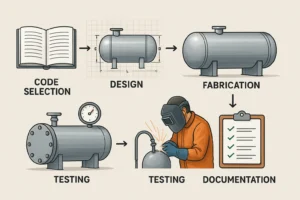
How Do You Design a Pressure Vessel: A Step-By-Step Guide
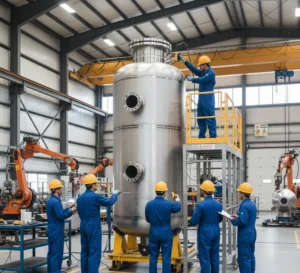
What is Pressure Vessel Fabrication and Manufacturing
No related articles found.
About Author