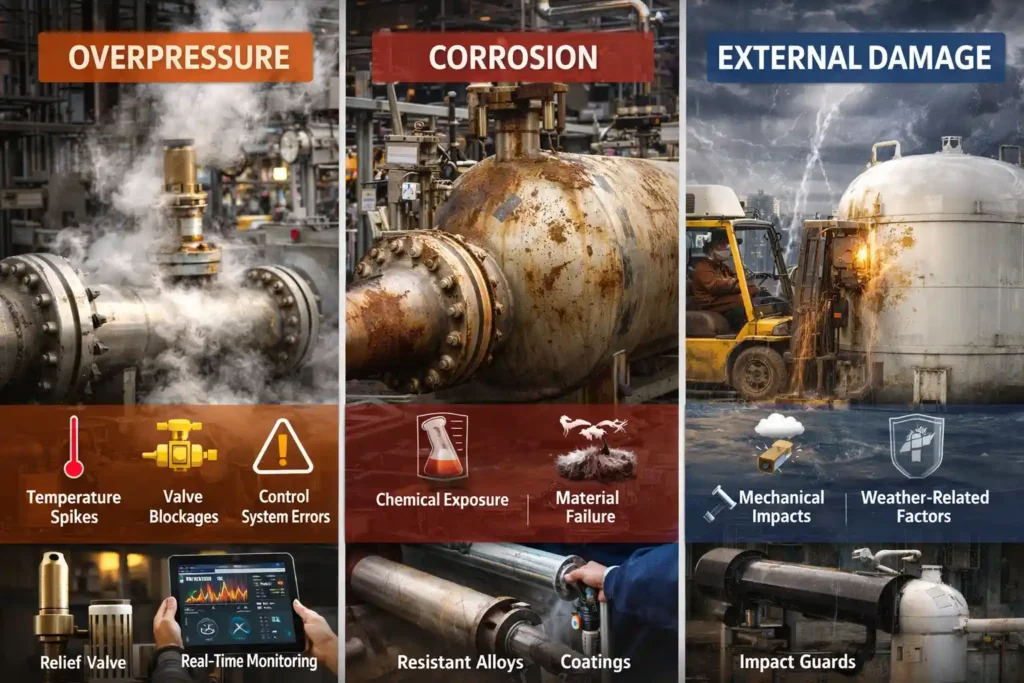
Pressure vessels pose three major hazards: overpressure, corrosion, and external damage. Overpressure often results from temperature spikes, valve blockages, or control system errors and can be prevented with properly rated relief valves, real-time monitoring, and scheduled pressure testing. Corrosion and material failure stem from chemical exposure or poor material choices, best mitigated through resistant alloys, coatings, and ultrasonic inspections. External threats like impacts and environmental stress require physical guards, weatherproofing, and structural anchoring. To stay compliant and safe, follow ASME standards, inspect regularly, train operators rigorously, and adapt protocols based on real-world incidents.
Introduction to Three Major Hazards of Pressure Vessels
At Red River, we apprehend that cognizance is the first step closer to ensuring safety. Pressure vessels are indispensable to numerous industries, however, they come with inherent dangers. For a foundational overview of how these vessels work and why their safety is mission-critical, see our guide on Understanding Pressure Vessels. It’s crucial to apprehend these risks to mitigate potential dangers efficiently. Our dedication to your safety starts with educating you about the top 3 fundamental risks associated with pressure vessels. By identifying these hazards, you can take proactive measures to protect your assets, your team, and your business.
Overview of Pressure Vessel Operations at Red River
At Red River, we take delight in our specialized knowledge in pressure vessel manufacturing. Our group is devoted to delivering exquisite pressure vessels that meet and exceed enterprise standards. Learn more about our precision-focused approach in Pressure Vessel Fabrication at Red River LLC. With years of experience and a commitment to innovation, we’ve developed manufacturing strategies designed to cater particularly to the specific necessities of pressure vessel manufacturing.
The Role of Safety Regulations in Pressure Vessel Management
Safety guidelines are the spine of responsible pressure vessel management. At Red River, we understand the significance of compliance with national and international standards. We not only meet but frequently exceed ASME standards for pressure vessels to ensure the highest level of protection and quality in our products.
Hazard 1: Overpressure and Its Consequences
What Causes Overpressure in Pressure Vessels
Overpressure occurs when internal pressure exceeds the vessel’s designed limit. Common causes include:
- Blocked outlet valves (e.g., due to scaling or mechanical failure)
- Rapid temperature increases from steam buildup or exothermic reactions
- Faulty pressure relief valves that fail to activate in time
- Control system errors, such as sensor misreadings
Explore Understanding the Maximum Allowable Working Pressure of a Vessel to learn how design limits are established.
Real-Life Incidents of Overpressure Mishaps
Real-life incidents serve as effective reminders of the results of overpressure. We’ll delve into instances where overpressure caused accidents, emphasizing the need for vigilance and proactive measures. For further insights, see Common Causes of Pressure Vessel Explosions.
Preventative Measures for Overpressure
Preventing overpressure is crucial to safety. Effective strategies include routine testing of pressure relief valves, proper control system calibration, and regular maintenance. For a detailed breakdown, visit Pressure Vessel Inspection Requirements.
Hazard 2: Corrosion and Material Failure
Corrosion in Pressure Vessels: How It Starts & How to Stop It
Corrosion weakens pressure vessel walls, increasing the risk of leaks or rupture. Key contributors include:
- Electrochemical reactions (e.g., contact with acidic liquids or gases)
- Poor material compatibility (e.g., carbon steel in saltwater environments)
- Microbial corrosion in humid or stagnant conditions
For more on corrosion prevention, see Is Antifreeze Corrosive? Understanding Ethylene Glycol.
Case Studies: The Impact of Corrosion
Real-international case studies will illustrate the devastating effects of corrosion on pressure vessel integrity, underlining the importance of corrosion prevention and mitigation.
Strategies for Corrosion Prevention and Maintenance
Effective strategies include material selection, protective coatings, and regular maintenance schedules. Learn more in Material Selection Guide: Right Materials for Industrial Use.
Hazard 3: External Damage and Environmental Factors
Top External Damage Risks to Pressure Vessels (and How to Prevent Them)
Pressure vessels face integrity risks from external factors such as:
- Mechanical impacts (e.g., forklift collisions, dropped tools)
- Seismic movement or structural vibration
- Weather exposure (e.g., hail, freezing, intense sun)
- Improper insulation or anchoring
Preventative steps include installing impact guards in high-traffic zones, conducting vibration analysis annually, and using weatherproof coatings for outdoor installations. See Essential Safety Devices in Air Receivers for additional protective measures.
The Effects of Environmental Conditions
Environmental factors like temperature, humidity, and publicity to corrosive factors can affect pressure vessels’ overall performance. We’ll delve into these consequences and their implications.
Mitigating External and Environmental Risks
This segment will offer insights into a way to correctly mitigate outside and environmental risks, safeguarding your pressure vessels towards capability harm.
Comprehensive Safety Protocols for Three Major Hazards of Pressure Vessels
Red River’s End-to-End Safety Protocols for Pressure Vessels
We don’t just meet safety benchmarks we engineer our entire process around them. Here’s how we mitigate the three core hazards (overpressure, corrosion, external damage):
Design & Compliance Phase
- All vessels built to ASME Section VIII Div 1 or 2
- Material selection based on chemical compatibility and temperature rating
- Built-in allowances for corrosion rate over time
Fabrication & Quality Control
- X-ray weld inspection and hydrotesting on every vessel
- Pressure relief valve testing using calibrated gauges
- Anti-corrosion coatings applied post-fabrication
Operational Safeguards
- Routine inspection intervals logged and tracked via digital system
- Operator training tied to job roles (certified under OSHA 1910 standards)
- Emergency response drills conducted every quarter
Learn more about our Comprehensive Guide to Pressure Vessel Inspection.
Key Safety Checks and Balances
Learn approximately the important safety exams and balances that can be indispensable to our pressure vessel production process.
Emergency Response Planning
In unforeseen circumstances, having a nicely described emergency reaction plan could make all the difference. We’ll explain how we prepare for emergencies to shield your pressure vessels and employees.
Regular Inspection and Maintenance: A Key to Safety
The Importance of Routine Inspections
We’ll stress the importance of regular inspections in identifying potential troubles and making sure the continuing secure operation of your pressure vessels.
7 Advanced Pressure Vessel Inspection Techniques for Hidden Defects
Staying ahead of potential hazards requires more than basic visual checks. At Red River, we employ advanced inspection methods that detect flaws before they escalate:
- Ultrasonic Testing (UT) – Measures wall thickness and detects internal cracks
- Radiographic Testing (RT) – Uses X-rays to find weld defects and hidden corrosion
- Magnetic Particle Testing (MT) – Identifies surface and subsurface cracks in ferromagnetic materials
- Dye Penetrant Testing (PT) – Highlights surface-breaking flaws on non-porous materials
- Eddy Current Testing (ET) – Ideal for detecting cracks in tubing and heat exchanger components
- Acoustic Emission Monitoring – Real-time stress and crack detection during pressurization
- Thermographic Imaging – Detects temperature anomalies linked to internal damage
Maintenance Schedules and Best Practices
Discover how our maintenance schedules and nice practices are tailored to maintain your pressure vessels in the choicest situation, minimizing dangers and making sure of sturdiness.
Training and Awareness: Empowering Employees
Training Programs at Red River
Our training packages are designed to equip your group with the information and capabilities needed to deal with pressure vessels adequately. We provide many schooling modules tailor-made to different roles and responsibilities, making sure that everyone is nicely organized to mitigate risks.
Fostering a Culture of Safety Awareness
Safety isn’t just a checkbox it’s a mindset. We’ll proportion how Red River nurtures a culture where protection is ingrained in every motion and selection. When protection turns into 2nd nature, accidents end up the exception.
Case Studies: The Impact of Training on Safety
Real-world examples show off the profound impact of our training programs on protection consequences. This case research highlights how nicely educated personnel can prevent injuries and ensure the secure operation of pressure vessels.
Three Major Hazards of Pressure Vessels: Legal Compliance and Industry Standards
Navigating Pressure Vessel Regulations
We’ll demystify the complicated global pressure vessel regulations, making sure that you have a clean know-how of the felony framework that governs their operation. Compliance isn’t an alternative; it’s a necessity.
Adhering to National and International Standards
Discover how Red River goes above and beyond to meet or exceed national and global standards. Your safety is our precedence, and we spare no attempt to make sure that our products follow the very best industry benchmarks.
Red River Commitment to Compliance
We’ll emphasize our dedication to compliance and the way it extends to each thing of our pressure vessel manufacturing technique. At Red River, compliance isn’t only a checkbox; it is a cost we live via.
Innovations in Pressure Vessel Technology
Emerging Trends in Pressure Vessel Design
Stay ahead of the curve with the aid of exploring the contemporary trends in pressure vessel layout. We’ll share insights into how innovation is reshaping the industry, making vessels safer and more efficient.
The Role of Technology in Enhancing Safety
Technology is a recreation-changer when it comes to protection. Learn how Red River leverages technological advancements to proactively address safety worries and reduce risks.
Red River Investment in Innovation
Our dedication to innovation is unwavering. We’ll highlight our investments in research and improvement to make sure that our pressure vessels include ultra-modern safety technology, providing you with peace of mind.
Client Case Studies: Success Stories in Pressure Vessel Safety
How Red River Improved Client Safety
Discover how partnering with Red River has drastically superior the protection of our customers’ pressure vessel operations.
Lessons Learned from Real-World Applications
Real-global packages offer invaluable instructions. We’ll mirror on demanding situations, solutions, and the insights gained from our studies.
Testimonials from Satisfied Clients
Our consumer’s delight is a testimony to our determination to protect. Read firsthand the debts of their studies with Red River LLC and the way we have exceeded their expectations.
Partner with Red River for Pressure Vessel Safety
Protect your team, assets, and operations by choosing a partner who prioritizes safety, compliance, and innovation. At Red River, we specialize in designing and manufacturing pressure vessels that meet and exceed ASME standards while mitigating overpressure, corrosion, and external hazards.
Reach out today to explore how our precision engineering, advanced inspection techniques, and comprehensive training programs can safeguard your operations and give you peace of mind.
Frequently Asked Questions
1. What are the three major hazards related to pressure vessels?
The 3 predominant hazards associated with pressure vessels are overpressure, corrosion, and fabric failure, and outside damage and environmental elements. Overpressure can arise because of different factors and information on its causes is important for prevention. Corrosion and fabric failure pose dangers to the vessel’s integrity and require proactive measures. External harm and environmental elements, consisting of physical influences and publicity to harsh situations, can also jeopardize safety.
2. How Do You Prevent Overpressure in Pressure Vessels?
To prevent overpressure:
- Install and test pressure relief valves rated to 110–125% of max operating pressure
- Use automated monitoring systems to track pressure/temperature in real-time
- Train operators to identify signs of buildup or valve blockage
- Conduct hydrostatic pressure tests every 12 months per ASME standards
3. What role does compliance with regulations play in pressure vessel safety?
Compliance with countrywide and worldwide rules is vital to ensure the secure operation of pressure vessels. Regulations provide guidelines for design, fabrication, inspection, and preservation, supporting to mitigate risks and ensuring adherence to industry standards.
4. What are the emerging trends in pressure vessel technology for enhancing safety?
Emerging tendencies in the pressure vessel era consist of using superior materials, digital tracking, predictive renovation, and progressed corrosion-resistant coatings. These improvements contribute to enhancing vessel safety and toughness.
5. How does Red River prioritize safety in pressure vessel manufacturing?
Red River prioritizes safety via a protection tradition, rigorous first-class manipulation, and ongoing schooling programs. Our dedication to compliance with industry standards and non-stop development ensures that protection stays at the forefront of our operations.
Key Takeaways
- Overpressure is the most dangerous and preventable risk to install relief valves and automate monitoring to stay within safe limits.
- Corrosion silently weakens vessels over time, chooses compatible materials and inspect walls annually with ultrasonic testing.
- External and environmental factors are often overlooked to protect vessels from mechanical impact and climate exposure using guards and coatings.
- Compliance with ASME and OSHA standards is not optional to embed regulation checks into both design and maintenance cycles.
- Training and proactive inspections save lives and costs, invest in role-specific safety programs and run quarterly emergency drills.
Related Blog Post
Can Condensate Storage Improve Reliability?
Where Do Condensate Tanks Fit in a Steam System?
Which Nozzles Simplify Maintenance on Pressure Vessels?
How to Vent Condensate Tanks in Steam Systems
How Do Baffle Layouts Affect Stratification in TES Tanks?
- How to Conduct a Pressure Vessel Inspection in Water Treatment Facilities
- Safety Guidelines for Operating Water Pressure Vessels
- Standard Pressure Vessel Inspection Procedures in U.S. Plants
- Non-Destructive Testing (NDT) Methods for Pressure Vessel Safety
- OSHA pressure vessel: Safety Requirements for compliance
- Comprehensive Guide to Controlling Pressure Hazards
About Author