Understanding the different types of stresses in pressure vessels is crucial for ensuring safe, reliable, and efficient operation. These stresses influence design decisions, material selection, and fabrication methods. RedRiver LLC applies advanced analysis and engineering expertise to manage these stresses and deliver vessels that meet stringent safety standards.
Exploring What Are the Types of Stresses in Pressure Vessels
What are the types of stresses in pressure vessels is a fundamental question in engineering design, as these stresses directly determine a vessel’s strength, stability, and longevity. Pressure vessels are designed to hold fluids or gases at high pressures, making them susceptible to complex stress patterns. If these stresses are not properly analyzed and managed, they can lead to deformation, cracking, or catastrophic failure.
To prevent this, engineers perform pressure vessel stress analysis and calculations during the design phase. This process ensures that materials, shapes, and welds can safely withstand operating conditions. By understanding and balancing stress distribution, RedRiver LLC designs and fabricates pressure vessels that perform reliably under even the most demanding environments.
The Core Stresses Explained in Pressure Vessel Stress Analysis
Each stress type interacts differently with the vessel’s structure. Identifying and managing these is key to successful pressure vessel stress analysis and calculations.
Hoop Stress
Hoop stress acts circumferentially around the vessel’s body, caused by the internal pressure pushing outward on the walls. It is one of the most significant stresses because it tries to expand the vessel, testing the tensile strength of the material.
During pressure vessel engineering, hoop stress is often the primary focus since it directly influences wall thickness and material selection. High-quality materials like stainless steel or carbon steel are often used to resist hoop stress while maintaining cost efficiency
Longitudinal Stress
Longitudinal stress runs parallel to the axis of the vessel and is generated by the internal pressure acting on the vessel’s end caps. While it is typically lower than hoop stress, longitudinal stress affects the vessel’s overall shape and stability.
Understanding this stress type is critical when engineers determine how to perform stress analysis on a pressure vessel, especially for tall or cylindrical designs. Reinforcing rings or thicker heads can be used to counteract these forces.
Radial Stress
Radial stress occurs through the wall thickness of the vessel, starting at maximum intensity on the inner surface and decreasing toward the outer wall. It helps maintain the vessel’s equilibrium under pressure.
Although radial stress is usually smaller than hoop or longitudinal stress, it must be included in all pressure vessel stress calculations to ensure accuracy. Overlooking this stress can lead to localized weaknesses.
Thermal Stress
Thermal stress arises from temperature fluctuations during heating or cooling cycles. When one section of the vessel expands faster than another, differential expansion creates internal tension.
In pressure vessel engineering, managing thermal stress involves selecting materials with appropriate thermal conductivity and using expansion joints when necessary. It also affects decisions about welding in pressure vessel engineering, as improper welding can amplify thermal strain.
Residual Stress
Residual stress is locked into the vessel after manufacturing processes such as rolling, forming, or welding. It is invisible but can significantly influence performance under pressure.
Post-weld heat treatment and stress-relief processes are used to reduce residual stress. At RedRiver LLC, these steps are integral to every fabrication project, ensuring vessels maintain structural integrity throughout their service life.
The Role of Welding in Pressure Vessel Engineering
Welding is a crucial factor in how stresses develop and are managed within pressure vessels. Poorly executed welds can create weak points that concentrate stress, leading to premature failure.
What Is Welding in Pressure Vessel Engineering
Welding in pressure vessel fabrication refers to the process of joining components like shells, heads, and nozzles to create a leak-proof and pressure-resistant structure. Proper welding ensures that the vessel can handle both internal and external stresses effectively.
How Is Welding Used in Pressure Vessel Fabrication
Welding is used to join parts with precision and uniformity to distribute stress evenly. Skilled welders follow ASME codes and use inspection techniques such as radiographic or ultrasonic testing to verify weld quality.
What Are the Common Welding Methods for Pressure Vessels
The common welding methods for pressure vessels include:
- Gas Tungsten Arc Welding (GTAW/TIG): Delivers clean, precise welds, ideal for stainless steel fabrication.
- Submerged Arc Welding (SAW): Produces deep, consistent welds in thicker components.
- Gas Metal Arc Welding (GMAW/MIG): Efficient for large-scale production with excellent penetration.
- Shielded Metal Arc Welding (SMAW): Flexible for maintenance and repair work.
RedRiver LLC uses these methods strategically, depending on material type and vessel configuration, ensuring that welding supports stress distribution identified in pressure vessel stress analysis and calculations.
Material Selection and Its Impact on Stress
Material choice directly affects what are the types of stresses in pressure vessels and how they behave. The right material must balance strength, ductility, corrosion resistance, and weldability, while ensuring ASME code compliance for vessels is maintained throughout the design and fabrication process. Selecting materials that meet these standards helps engineers achieve reliable performance under pressure and reinforces ASME code compliance for vessels in every critical application.
Common materials include:
- Carbon Steel: Economical and strong, suitable for moderate pressure and temperature.
- Stainless Steel: Excellent corrosion resistance for food, pharmaceutical, and chemical industries.
- Nickel Alloys: Withstand extreme heat and corrosive environments.
- Duplex Stainless Steels: Offer superior strength and resistance to cracking.
- Titanium: Lightweight and ideal for highly corrosive or demanding applications.
By integrating material science into pressure vessel stress analysis, RedRiver LLC ensures each vessel performs according to its intended pressure and environmental conditions.
Managing and Reducing Stress During Fabrication
Even with precise design and material selection, stress control continues during fabrication. Techniques such as heat treatment, controlled welding sequences, and post-weld inspections are used to minimize stress buildup.
Proper design alignment, balanced weld placement, and stress-relieving processes reduce internal tension and ensure consistent performance. These steps reflect RedRiver LLC’s dedication to safety, precision, and quality in every project.
What Are the Types of Stresses in Pressure Vessels: Conclusion
In summary, understanding what are the types of stresses in pressure vessels provides a foundation for safe and efficient vessel design. Each stress hoop, longitudinal, radial, thermal, and residual plays a distinct role in determining strength and durability.
Through accurate pressure vessel stress analysis, advanced material selection, and expert welding, RedRiver LLC ensures every vessel meets stringent safety and performance requirements. Their engineering-driven approach transforms complex designs into reliable, real-world solutions.
Partner with RedRiver LLC
When you need precision-engineered, code-compliant pressure vessels, RedRiver LLC is your trusted partner. Their expertise in pressure vessel stress analysis, welding techniques, and fabrication ensures quality and safety from concept to completion.
Visit RedRiver LLC to explore their services and discover how their engineering excellence can strengthen your next project.
Frequently Asked Questions
1. What are the types of stresses in pressure vessels?
The main stresses include hoop, longitudinal, radial, thermal, and residual stresses, all of which affect the vessel’s strength and durability.
2. What is pressure vessel stress analysis?
It is the engineering process of determining how internal and external pressures influence a vessel’s structure and materials.
3. How do you perform stress analysis on a pressure vessel?
Engineers apply analytical formulas, simulation tools, and physical testing to calculate stresses and verify safety.
4. What is welding in pressure vessel engineering?
Welding joins vessel components to create a sealed, pressure-resistant structure capable of withstanding stress.
5. How is welding used in pressure vessel fabrication?
It connects the shell, heads, and nozzles, ensuring uniform stress distribution and structural integrity.
6. What are the common welding methods for pressure vessels?
Common methods include TIG, MIG, SAW, and SMAW, each chosen based on material and vessel type.
7. Why is stress analysis important for pressure vessels?
It ensures that the vessel can withstand operational loads safely without deformation or failure.
Key Takeaways
- Understanding what are the types of stresses in pressure vessels is key to safe and efficient design.
- Hoop, longitudinal, radial, thermal, and residual stresses each influence vessel performance.
- Welding plays a major role in stress distribution and must be precisely controlled.
- Material selection affects stress resistance, corrosion protection, and overall reliability.
- RedRiver LLC combines stress analysis, fabrication expertise, and advanced welding to deliver durable, code-compliant vessels.
Related Blog Post
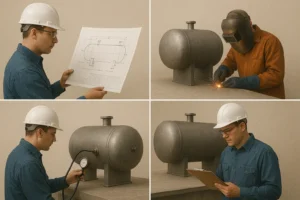
Pressure Vessel Design & Engineering: Concept to Launch
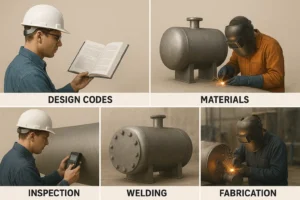
What is Pressure Vessel Design and Engineering: Code-Ready Guide
What are the Key Factors in Pressure Vessel Engineering
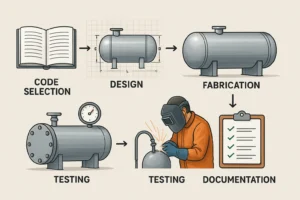
How Do You Design a Pressure Vessel: A Step-By-Step Guide
What is Pressure Vessel Fabrication and Manufacturing
About Author