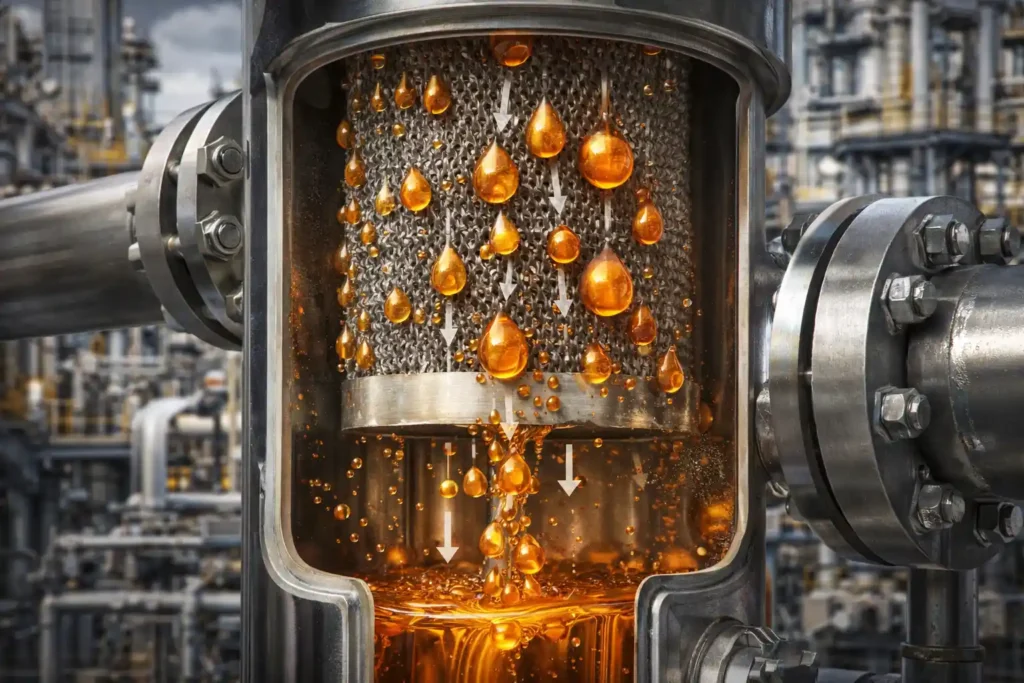
A coalescing filter removes liquid droplets, aerosols, and solid contaminants from gas streams by merging small particles into larger droplets through a porous filter medium. In pressure vessel applications, coalescing filtration protects compressors, valves, meters, and instrumentation from contamination that causes wear, corrosion, and premature failure. Red River LLC fabricates ASME-coded coalescing filter vessels for upstream oil and gas, petrochemical, and compressed gas systems.
How Coalescing Filtration Works
Coalescing filtration removes contaminants through three mechanisms. Direct interception captures droplets that contact filter fibers as the gas stream flows through the medium. Inertial impaction causes larger droplets to deviate from the gas flow path and collide with fibers due to their mass. Diffusion captures submicron particles through random Brownian motion.
Once captured, small droplets coalesce on the filter fiber surface, merging into larger droplets. These droplets drain by gravity to the filter sump, where they are discharged through an automatic drain. The cleaned gas exits through the filter outlet at design pressure minus the pressure drop across the element.
Types of Coalescing Filters in Pressure Vessel Applications
Three main coalescing filter types are used in industrial pressure vessel systems:
- Gas/liquid coalescers remove liquid droplets and aerosols from gas streams. Standard applications include natural gas pipeline systems, instrument air, and compressor discharge. Filter grades range from 1-micron to 0.01-micron removal ratings.
- Liquid/liquid coalescers separate immiscible liquids such as water from hydrocarbon streams. Used in crude oil dehydration, fuel conditioning, and produced water treatment applications.
- High-efficiency cartridge coalescers achieve removal efficiencies above 99.97% for submicron aerosols. Required for turbine fuel gas conditioning, instrument air, and analytical sample systems.
Selecting the correct coalescing filter type requires matching the filter grade to the contaminant particle size distribution, operating pressure, gas velocity, and required outlet cleanliness. See our comparison of coalescing and desiccant filtration for a side-by-side breakdown of each approach.
Coalescing Filter Applications in Oil and Gas Production
Upstream oil and gas operations install coalescing filter vessels at multiple points in the production process to protect critical equipment:
- Compressor inlet protection: Gas/liquid coalescers upstream of reciprocating and centrifugal compressors remove liquid carryover that causes valve damage and cylinder wear.
- Gas dehydration units: Coalescers upstream of TEG contactors remove hydrocarbon liquids that degrade glycol performance and cause foaming.
- Fuel gas conditioning: High-efficiency coalescers protect gas turbine fuel systems from liquid slugs and compressor oil aerosols.
- Amine treating units: Inlet coalescers protect amine absorbers from hydrocarbon contamination that causes foaming and reduced treating efficiency.
Operating pressures in upstream gas applications typically range from 100 psi to 1,500 psi. Filter housing design pressure must accommodate maximum system pressure plus surge allowance. Managing pressure drop across coalescing filter elements is critical for maintaining system efficiency and scheduling element replacement intervals.
ASME Code Requirements for Coalescing Filter Vessels
Coalescing filter housings that operate above 15 psi internal pressure are classified as pressure vessels under ASME Section VIII, Division 1. ASME-compliant filter vessels require minimum wall thickness calculations per UG-27, nozzle reinforcement per UG-37, full material certification with mill test reports, and hydrostatic pressure testing at 1.3 times design pressure prior to shipment.
Red River LLC holds ASME Section VIII certification and builds coalescing filter vessels with National Board registration and ASME U-stamp. Our vessels are fabricated from carbon steel, stainless steel, or duplex stainless steel based on process fluid compatibility and corrosion requirements.
Frequently Asked Questions About Coalescing Filtration
What is a coalescing filter pressure vessel?
A coalescing filter pressure vessel is an ASME-rated containment shell that houses one or more coalescing filter elements for removing liquid droplets and solid contaminants from pressurized gas streams. The vessel operates at system pressure while the internal filter element separates contaminants from the process gas before it passes downstream.
What is a coalescer and how does it work?
A coalescer is a filtration device that removes liquid aerosols and fine droplets from gas streams by causing small particles to merge into larger droplets on a porous filter medium. The enlarged droplets drain by gravity while clean gas passes through the filter outlet. Coalescers are used in natural gas processing, compressed air systems, and oil and gas production to protect downstream equipment.
What coalescing filter efficiency should I specify?
Standard coalescers remove 98% of droplets larger than 0.3 microns. High-efficiency grades achieve 99.97% removal of submicron aerosols. Specification depends on downstream equipment sensitivity, required gas cleanliness, and acceptable carry-over limits. Gas turbine fuel systems and analytical instrumentation typically require high-efficiency grades.
How often should coalescing filter elements be replaced?
Coalescing filter element replacement intervals are determined by differential pressure across the element, not calendar time. Most manufacturers recommend element replacement when differential pressure reaches 10 to 15 psid above the initial clean element pressure drop, or annually, whichever comes first. High-liquid-loading applications may require more frequent replacement.
Does Red River build ASME coalescing filter vessels?
Yes. Red River LLC fabricates ASME Section VIII coalescing filter vessels for oil and gas, petrochemical, and industrial gas applications. We provide full documentation including ASME data reports, National Board registration, material certifications, and hydrostatic test records. Contact our team to request a quote for your coalescing filter vessel requirements.
Related Blog Post
Can Condensate Storage Improve Reliability?
Where Do Condensate Tanks Fit in a Steam System?
Which Nozzles Simplify Maintenance on Pressure Vessels?
How to Vent Condensate Tanks in Steam Systems
How Do Baffle Layouts Affect Stratification in TES Tanks?
No related articles found.
About Author