

Pressure vessel analysis helps determine how internal and external forces affect vessel materials, shapes, and welds. This blog explains how stress analysis is performed, the different stress types, and the role of welding in pressure vessel fabrication. With decades of experience, RedRiver LLC applies advanced engineering and precision techniques to guarantee vessel integrity and compliance with global standards.
Exploring What Is Pressure Vessel Stress Analysis in Engineering
What is pressure vessel stress analysis refers to the process of evaluating the stresses and deformations that occur in a vessel under internal or external pressure. This analysis is vital for predicting how the vessel will perform under load and for preventing failure, cracking, or rupture. During pressure vessel stress analysis and calculations, engineers assess multiple factors such as pressure, temperature, and material strength to ensure that the design meets safety standards. The results determine whether the vessel’s wall thickness, shape, and welds can withstand its intended working conditions.
For RedRiver LLC, this process is the foundation of every fabrication project. It ensures not only compliance with the ASME Boiler and Pressure Vessel Code (BPVC) but also long-term reliability for industrial operations.
How Do You Perform Stress Analysis on a Pressure Vessel
The question of how do you perform stress analysis on a pressure vessel is central to engineering design. Stress analysis involves applying mathematical models and computer simulations to determine how materials respond under pressure.
The main steps include:
- Defining the load conditions: Engineers identify internal pressure, external loads, and temperature variations that the vessel will face.
- Calculating stress distribution: Using classical formulas and computational models, they analyze the effects of hoop, longitudinal, and radial stresses.
- Verifying against standards: The calculated stress levels are compared with allowable limits set by international safety codes.
- Validating through simulation: Finite Element Analysis (FEA) software allows visualization of stress concentrations and deformation zones.
By combining traditional engineering principles with modern simulation tools, RedRiver LLC ensures that every design meets the highest safety, efficiency, and pressure vessel welding quality control benchmarks.
What Are the Types of Stresses in Pressure Vessels
Understanding what are the types of stresses in pressure vessels is crucial for accurate design and fabrication. Each stress type influences how a vessel behaves under pressure.
The key stresses include:
- Hoop Stress: Acts circumferentially along the vessel wall, caused by internal pressure attempting to expand the vessel.
- Longitudinal Stress: Runs along the length of the vessel and is caused by pressure acting on the end caps.
- Radial Stress: Occurs through the wall thickness and decreases from the inside to the outside surface.
- Thermal Stress: Generated by temperature fluctuations during operation.
- Residual Stress: Remains after welding or forming and may require heat treatment to relieve.
A comprehensive understanding of these stresses enables engineers to prevent weak points and ensure durability. RedRiver LLC evaluates each type carefully during pressure vessel stress analysis and calculations, ensuring optimal material performance and structural integrity.
Welding in Pressure Vessel Engineering
Welding plays a pivotal role in pressure vessel stress analysis and calculations because weld seams are often the most critical areas for potential failure.
What Is Welding in Pressure Vessel Engineering
Welding in pressure vessel engineering involves joining metal components together to create a seamless, high-strength structure capable of withstanding high pressure. The welding process must ensure that no weak points or leaks occur under operational stress.
How Is Welding Used in Pressure Vessel Fabrication
Welding in pressure vessel fabrication depends on the vessel design and material selection. Welding connects cylindrical shells, heads, and nozzles while maintaining uniform strength and resistance to deformation. Proper technique ensures that stress is evenly distributed throughout the vessel.
What Are the Common Welding Methods for Pressure Vessels
Engineers employ several welding methods to maintain safety and performance, ensuring industrial pressure vessel reliability throughout their service life. The most common welding methods for pressure vessels include techniques such as arc welding, TIG welding, and submerged arc welding, each selected based on material type and operating conditions. Proper application of these methods is critical for sustaining industrial pressure vessel reliability, preventing leaks, cracks, or failures under high pressure and temperature conditions.
- Gas Tungsten Arc Welding (GTAW or TIG): Produces precise, clean welds ideal for stainless steel and thinner materials.
- Submerged Arc Welding (SAW): Provides deep weld penetration for thick materials.
- Shielded Metal Arc Welding (SMAW): Flexible for field and repair work.
- Gas Metal Arc Welding (GMAW or MIG): Suited for high-efficiency, large-scale production.
RedRiver LLC employs certified welders and advanced automation systems to guarantee weld consistency, pressure vessel welding quality control, and strength, ensuring that each vessel meets ASME and customer requirements.
The Importance of Pressure Vessel Stress Analysis and Calculations
The value of pressure vessel stress analysis and calculations lies in their ability to ensure that every vessel performs safely under expected loads. Stress analysis provides insights into:
- Whether a design is structurally sound under operational pressure.
- The vessel’s resistance to fatigue, creep, and thermal cycles.
- The effects of welding, material selection, and fabrication techniques on long-term integrity.
Without proper stress analysis, a vessel could fail prematurely, leading to safety hazards and financial losses. RedRiver LLC integrates stress analysis at every stage, from concept design to final inspection, to minimize risks and maximize performance.
Material Selection and Design Integrity
Material selection plays a major role in how pressure vessel analysis results translate into real-world performance. Different materials respond differently to internal pressure, temperature, and corrosion.
Common materials include:
- Carbon Steel: Strong and economical for general applications.
- Stainless Steel: Resistant to corrosion and ideal for food, pharmaceutical, and chemical industries.
- Nickel Alloys: Handle extreme temperatures and corrosive environments.
- Duplex Steels: Combine strength and resistance to cracking.
- Titanium: Lightweight and resistant to chemical attack.
By matching materials to application requirements, RedRiver LLC ensures vessels remain reliable throughout their operational life, even in harsh industrial settings.
Thermal and Fatigue Considerations
During pressure vessel stress analysis and calculations, engineers must consider the long-term effects of temperature changes and cyclic loading. Continuous expansion and contraction can cause fatigue failure if not addressed in the design phase.
RedRiver LLC uses advanced modeling to predict how materials behave under thermal fluctuations, ensuring vessels maintain dimensional stability and strength. Stress-relieving treatments and post-weld heat treatments are applied when needed to reduce residual stresses.
What Is Pressure Vessel Stress Analysis: Conclusion
In summary, what is pressure vessel stress analysis can be defined as the engineering process of evaluating internal and external forces to ensure a vessel’s safety, durability, and efficiency. It combines physics, mathematics, and material science to produce vessels that perform reliably under pressure.
Through advanced simulation, certified welding, and precision fabrication, RedRiver LLC ensures every vessel meets stringent safety and pressure vessel welding quality control standards. Their expertise in pressure vessel stress analysis and calculations sets them apart as a trusted leader in pressure vessel design and manufacturing.
Work with RedRiver LLC
When you need expertly designed, fabricated, and tested pressure vessels, turn to RedRiver LLC. The company’s engineering-driven approach ensures every project meets exact specifications and global compliance standards.
Visit RedRiver LLC to explore how their advanced analysis, precision welding, and manufacturing expertise can deliver superior performance for your next project.
Frequently Asked Questions
1. How do you perform stress analysis on a pressure vessel?
Engineers use analytical equations, finite element analysis, and simulation software to calculate stress distribution and identify weak points.
2. What are the types of stresses in pressure vessels?
The main stresses include hoop, longitudinal, radial, thermal, and residual stresses, each impacting the vessel’s structure differently.
3. What is welding in pressure vessel engineering?
It refers to the process of joining vessel components to create a leak-proof and high-strength structure capable of withstanding high pressure.
4. How is welding used in pressure vessel fabrication?
Welding connects vessel parts such as shells, heads, and nozzles, ensuring uniform stress distribution and pressure containment.
5. What are the common welding methods for pressure vessels?
Techniques include TIG, MIG, SAW, and SMAW, selected based on material type and vessel thickness.
6. Why is stress analysis important in fabrication?
It ensures the vessel’s design can withstand operational pressures, temperature variations, and external loads safely.
Key Takeaways
- What is pressure vessel stress analysis focuses on evaluating structural integrity under pressure.
- Stress analysis ensures compliance with safety codes and prevents structural failure.
- Welding quality directly impacts vessel strength and performance.
- Material selection plays a critical role in managing stress and fatigue.
- RedRiver LLC leads the industry with advanced design, welding expertise, and precision fabrication.
Related Blog Post
Pressure Vessel Design & Engineering: Concept to Launch
What is Pressure Vessel Design and Engineering: Code-Ready Guide
What are the Key Factors in Pressure Vessel Engineering
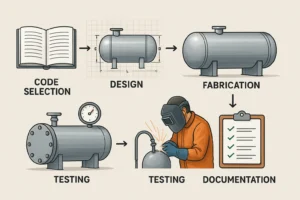
How Do You Design a Pressure Vessel: A Step-By-Step Guide
What is Pressure Vessel Fabrication and Manufacturing
About Author



