
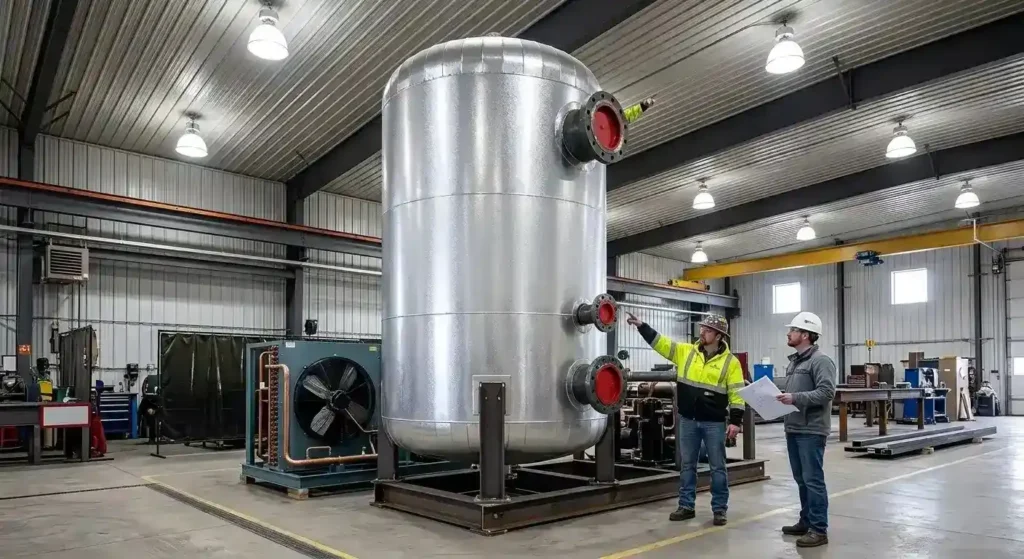
Use a hydronic tank whenever a water-based heating or cooling loop needs more volume, hydraulic separation, load shifting, or fluid conditioning than the bare piping can provide. The decision comes down to four triggers: short cycling calls for a buffer tank, variable flow calls for hydraulic separation, peak demand cost calls for thermal storage, and air or dirt in the loop calls for a separator.
Key Takeaways
- Use a buffer tank when the loop volume is too low for the heat source, causing short cycling and wasted energy with every start-stop cycle.
- Using a thermal storage tank when generating heating or cooling off-peak and deploying it during high-cost peak demand windows makes economic sense.
- Use an expansion tank to control pressure in a closed loop and a separator to clear the air and debris that disrupt flow and foul equipment.
- The trigger is the system condition, not the building type. The same facility may need several tank types operating together.
- A hydronic tank operating above 15 psig is a coded pressure vessel built to ASME Section VIII and sized for the specific loop’s pressure and temperature requirements.
When Do You Need a Hydronic Tank?
A hydronic tank is needed when the loop cannot accomplish something the system requires on its own: hold enough volume to run the heat source efficiently, store energy for later use, absorb thermal expansion safely, or keep the fluid free of air and debris.
Reading the System Symptoms
The practical way to identify the need is to read the system behavior. A chiller or boiler that starts and stops constantly points to a volume problem. A utility bill dominated by peak demand charges points to a storage opportunity. Pressure that climbs as the loop heats points to an expansion need. Noisy pumps and uneven heating point to air and dirt. Each signal maps to a specific tank type, and more than one often applies to the same system.
When Do You Need a Buffer Tank?
A buffer tank is needed when the loop holds too little water for the heat source to run in stable cycles. This is the most common reason to add a hydronic tank, and it appears most often on chilled water systems and low-mass heating loops.
Short Cycling and Low System Volume
When a chiller or boiler is oversized for the connected loop volume, it satisfies the load almost instantly, shuts off, and restarts moments later. Short cycling wastes energy and accelerates wear on compressors and burners. Adding water volume through a buffer tank gives the source what it needs to run complete cycles, sized from the source’s minimum run time and the smallest anticipated load. See Red River’s thermal energy storage and process tanks pages for related vessel types used in closed-loop applications.
Variable Flow and Hydraulic Decoupling
Systems with variable-speed pumps can reduce flow below what the heat source requires to operate safely. A buffer tank adds volume that holds steady and hydraulically separates the source from the distribution side, so the building side can vary its flow while the chiller or boiler sees stable conditions. ASHRAE publishes guidance on sizing buffer tanks and hydraulic separation components for hydronic systems.
When Should You Use a Thermal Storage Tank?
Use a thermal storage tank when heating or cooling can be generated at one time and used at another, typically to avoid expensive peak demand rate charges. A storage vessel charged overnight on off-peak utility rates can carry a facility’s full load through the costly peak window the following day.
The Economics of Peak Demand Shifting
Facilities on demand-based utility tariffs pay heavily for their highest peak consumption interval. Shifting that load to off-peak hours with a storage vessel flattens the demand curve and produces measurable utility savings. The case for storage strengthens as peak rate exposure grows.
Internal Design and Thermal Stratification
A thermal storage vessel depends on internal diffuser and baffle design to maintain separation between the hot and cold fluid layers. A tank that allows those layers to mix loses usable stored capacity. Diffuser sizing and nozzle placement are confirmed during the engineering review before fabrication begins. See Red River’s pressure vessel fabrication scope for how vessel internals are specified.
When Is an Expansion Tank or Separator Required?
An expansion tank and a separator are needed when the loop requires pressure control and fluid conditioning rather than volume or storage. These needs appear in nearly every closed hydronic system.
Expansion Tank: Managing Thermal Volume Change
An expansion tank is required whenever water in a sealed loop heats and expands, because that additional volume has no safe path without one. The tank absorbs the volume change and holds pressure within a safe band as temperatures cycle. Without it, pressure climbs toward unsafe limits as the loop heats.
Separator: Clearing Air and Debris
A separator is needed when entrained air and suspended debris disrupt flow. Trapped air causes noise, cavitation, and dead spots where flow stalls. A separator slows fluid velocity enough for air to rise out and particles to settle, protecting downstream equipment. On larger systems this function is often combined with buffering in a single vessel. See Red River’s capabilities for standalone separator and combined buffer-separator configurations.
What Happens If You Skip the Hydronic Tank?
Skipping a tank the system requires does not eliminate the cost. It defers it and compounds it. A loop without adequate volume short-cycles the heat source, shortening equipment life and raising energy costs. A facility without storage pays full peak demand rates. A loop without pressure control swings as water heats and cools. A loop without a separator slowly fouls pumps and heat exchangers. These problems appear months later as higher bills and premature failures that cost more to correct than the tank would have cost at design.
What This Means When Specifying a Hydronic Tank
Knowing when to use hydronic tanks comes down to reading the system conditions: short cycling calls for a buffer tank, peak demand cost calls for thermal storage, pressure swings call for an expansion tank, and air or dirt call for a separator. The right decision is made during design, confirmed against the actual load profile, and built into the fabrication scope before the vessel is ordered.
Discuss Your Hydronic Tank Requirements With Red River
Red River has fabricated ASME-certified hydronic, buffer, and thermal storage tanks for power generation, industrial process, biogas, and commercial applications from Gillette, Wyoming, since 2003. Red River holds active ASME U Stamp and NBBI R Stamp certifications and is an American Welding Society (AWS) member. Request a quote or call us to discuss which tank type your system needs and confirm sizing and fabrication scope.
Frequently Asked Questions
1. When Should I Add a Buffer Tank to a Chilled Water System?
Add a buffer tank when the chiller short cycles because the loop holds too little water. This is common on low-mass systems and oversized chillers. The tank adds the volume the chiller needs to run complete cycles, sized from its minimum run time and the smallest expected load.
2. When Is a Thermal Storage Tank Worth the Investment?
Storage is worth it when a facility faces high peak demand charges and can shift load to off-peak hours. Charging the tank overnight and drawing from it during the peak window flattens the demand curve and lowers utility cost. The larger the peak rate exposure, the stronger the case.
3. Do I Need Both a Buffer Tank and an Expansion Tank?
Often yes. The buffer tank adds volume to prevent short cycling. The expansion tank controls pressure as water heats and expands. Many closed-loop systems include both, along with a separator for air and dirt conditioning.
4. When Does a Hydronic Tank Need to Be ASME-Coded?
A hydronic tank operating above 15 psig is built to ASME Section VIII as a coded pressure vessel. Most pressurized closed-loop systems exceed that threshold. The design specification confirms the operating pressures that place the tank under the code.
5. Can Red River Help Determine Which Hydronic Tank Is Needed?
Yes. Red River reviews the system’s load profile, flow conditions, and operating parameters to confirm which tank type and size fit, then fabricates the vessel to ASME code. Sizing and connection details are confirmed during the engineering review before fabrication begins.
Related Blog Post
Which Materials Suit Make-Up Water Service?
How Big Should Make-Up Water Tanks Be?
Make-Up Water Tanks: Design, Sizing, and Fabrication
When to Spec Equalization Tanks for Industrial Systems
How Do Equalization Tanks Balance Flow?
No subpillar set for this blog post.
About Author



