
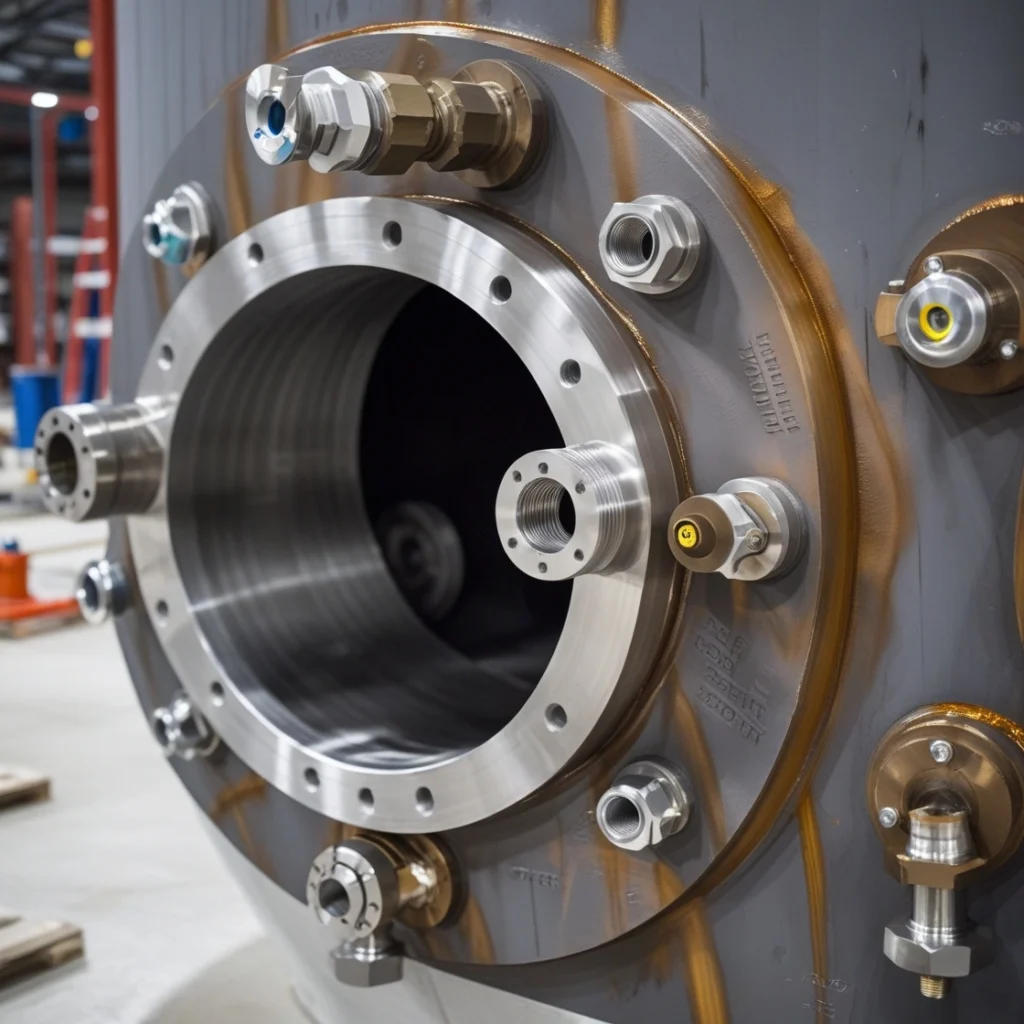
Receiver tanks typically use NPT threaded connections for smaller ports and flanged or welded connections for larger or higher-pressure applications. The correct connection depends on operating pressure, pipe size, fluid service, and ASME code requirements to ensure safe, reliable performance.
Key Takeaways
- Standard receiver tanks use NPT (National Pipe Taper) threaded connections for ports up to two inches, including air inlet, outlet, drain, pressure gauge, and safety relief valve.
- Larger connections and high-pressure applications use flanged fittings conforming to ASME B16.5 or B16.47 standards, which allow bolted face-to-face joints that are easier to service than threaded alternatives.
- Every ASME-coded receiver tank must include a properly sized safety relief valve connection rated at or below the vessel’s MAWP.
- Connection placement on the vessel shell follows ASME Section VIII Division 1 ASME pressure vessel nozzle reinforcement requirements. Adding connections after fabrication requires engineering review and re-inspection.
- Specify all required connections before fabrication begins. Retrofitting nozzles to a coded pressure vessel requires NBBI R Stamp work to keep the vessel’s registration intact.
What Are the Standard Connection Types on Industrial Receiver Tanks?
A receiver tank in a compressed air system typically carries five to eight receiver tank connections depending on system complexity.
NPT Threaded Connections
NPT fittings compressed air engineers specify in North America use a taper that creates a mechanical seal as the fitting is threaded in, effective at pressures up to 300 psig in sizes up to two inches when properly installed with thread sealant. Most receiver tanks under 200 gallons use NPT connections for all ports: air inlet, outlet, drain, pressure gauge, and safety relief valve. For ports that require frequent service, a flanged or union connection is more practical because repeated NPT assembly and disassembly degrades the seal.
Flanged Connections
Flanged connections are specified for larger pipe sizes above two inches, higher pressure ratings, and applications where the connection will be broken regularly. ASME B16.5 covers flanges from half an inch through 24 inches at pressure classes from 150 to 2500. For modular skid packages in oil and gas or power generation service, flanged connections are standard because they handle higher pressures and are easier to service in confined installations.
Socket Weld and Butt Weld Connections
Socket weld fittings suit small-bore high-pressure piping up to two inches. Butt weld connections are used on larger bore piping where pipe ends are beveled and welded face to face. Both require welding qualifications under ASME Section IX and are specified where threaded connections are not suitable: service above 300 psig, elevated temperatures, or vibration-prone applications.
What Connections Are Required on Every ASME Receiver Tank?
ASME Section VIII Division 1 mandates specific connections on every coded pressure vessel above 15 psig. Their sizing and rating must be documented in the ASME Form U-1.
Safety Relief Valve Connection
Every receiver tank must have at least one safety relief valve. The connection must be sized to pass the full relieving capacity without system pressure exceeding 110 percent of the MAWP. The valve must be set at or below the MAWP and must be ASME-certified.
Pressure Gauge and Drain Connections
A quarter-inch or half-inch NPT gauge port is required on every receiver. A drain valve connection at the vessel’s lowest point is also required, typically three-quarter-inch or one-inch NPT with a manual ball valve, often supplemented by an automatic timed drain.
Air Inlet and Outlet Connections
Inlet and outlet connections are sized to match the distribution system. For most industrial receivers, these are one inch to two inches NPT or flanged depending on system flow rate.
What Are the ASME Nozzle Reinforcement Requirements?
When a connection penetrates a pressure vessel shell, it removes material and creates a stress concentration. Every ASME pressure vessel nozzle must be reinforced under Section VIII Division 1 through a pad, heavier nozzle wall, or excess shell material. The calculation must be documented before the vessel passes inspection.
Adding connections after fabrication is not simply cutting a hole and welding in a fitting. It requires a new reinforcement calculation, a qualified weld procedure, inspection by an Authorized Inspector, and documentation filed with the National Board under the NBBI R Stamp process. Red River holds active ASME U Stamp and NBBI R Stamp certifications. See Red River’s pressure vessel fabrication and capabilities for how nozzle scope is managed across new construction and post-fabrication modifications.
What Should You Specify Before Fabrication Begins?
The most cost-effective time to define receiver tank connections is before fabrication. Every port added at the design stage costs a fraction of what it costs to retrofit after the vessel is stamped.
Prepare a complete connection schedule listing every port by size, type, rating, and location. Confirm every fitting is rated at or above the vessel’s MAWP. A 150-class flange is rated to approximately 285 psig; if MAWP exceeds that, a 300-class or higher flange is required. Confirm drain connections are at the lowest installed point, gauge ports are accessible, and the relief valve connection has clear discharge space. If future instrumentation taps or bypass connections may be needed, specify capped nozzle provisions now. Red River’s prefabrication services include complete connection schedule review as part of every skid package scope.
What This Means When Specifying Receiver Tank Connections
Which connections fit receiver tanks comes down to pressure, pipe size, and service conditions, and all of them must be defined before fabrication begins. A vessel that arrives missing a required port or with connections in the wrong location creates field rework that costs far more than getting the specification right upfront.
Discuss Your Receiver Tank Connections With Red River
Red River fabricates ASME-certified receiver tanks with complete connection schedules reviewed before the first weld, from Gillette, Wyoming, since 2003. Red River holds active ASME U Stamp and NBBI R Stamp certifications and is an American Welding Society (AWS) member. Request a quote or call 1-307-257-5332 to discuss your receiver tank connection requirements, ASME certification scope, and fabrication schedule.
Frequently Asked Questions
1. Which Connections Fit Receiver Tanks for Compressed Air Systems?
Standard compressed air receiver tanks use NPT threaded connections for ports up to two inches, including the air inlet, outlet, drain, pressure gauge, and relief valve. Larger flow connections and high-pressure applications use ASME B16.5 flanged fittings. The correct fitting type depends on the connection size, system pressure, and whether the port will be broken regularly for maintenance.
2. Can I Add Connections to a Receiver Tank After It Has Been Fabricated?
Yes, but it requires formal engineering review, a qualified weld procedure under ASME Section IX, a reinforcement calculation, and inspection by an Authorized Inspector. The modification must be filed with the National Board under the NBBI R Stamp process. Retrofitting is significantly more expensive than specifying all required connections before fabrication.
3. What Size Connection Is Required for the Safety Relief Valve?
The relief valve connection must be sized to pass the full relieving capacity without pressure exceeding 110 percent of the MAWP. For most industrial receiver tanks, relief valve connections range from three-quarters of an inch to two inches NPT. The valve must be ASME-certified and set at or below the vessel’s MAWP.
4. Do Receiver Tank Connections Need to Be the Same Material as the Vessel Shell?
Not necessarily, but materials must be compatible with the service fluid, rated for the operating pressure and temperature, and meet ASME Section VIII Division 1 requirements. Carbon steel NPT fittings are standard for most compressed air applications. Stainless steel or alloy fittings are specified for corrosive service such as biogas or chemical process applications.
5. What Is the Difference Between NPT and BSPT Fittings?
NPT and BSPT are both tapered thread standards that seal on the thread engagement, but they are not interchangeable. Thread angle, pitch, and taper rate differ between the two. Attempting to mate NPT and BSPT fittings produces a leak path. North American industrial receiver tanks use NPT. Confirm the thread standard when sourcing fittings for imported vessels or international project specifications.
Related Blog Post
Can Condensate Storage Improve Reliability?
Where Do Condensate Tanks Fit in a Steam System?
Which Nozzles Simplify Maintenance on Pressure Vessels?
How to Vent Condensate Tanks in Steam Systems
How Do Baffle Layouts Affect Stratification in TES Tanks?
About Author



