
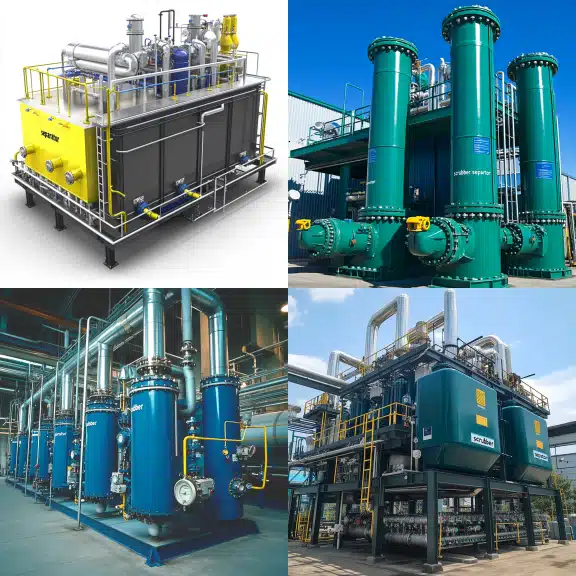
Understanding the difference between a scrubber and a separator is essential for industrial efficiency and compliance. Scrubbers remove pollutants from gas streams, while separators divide different phases such as gas, liquid, or solids. Proper selection, maintenance, and operation ensure optimal system performance and adherence to pressure vessel safety standards and compliance. Red River provides expertise in designing reliable filtration and separation solutions to maximize equipment efficiency.
Understanding the Difference Between a Scrubber and a Separator for Industrial Systems
In business and environmental engineering, the terms “scrubber” and “separator” often appear interchangeable. However, they serve distinct purposes in managing gases and liquids. This article explains the differences among scrubbers and separators, their functionalities, and their roles in various industries.
What is a Scrubber?
A scrubber actively removes pollutants from exhaust gases before their release into the environment. These devices operate by passing the gas through a liquid (or occasionally a dry sorbent) that captures and neutralizes pollutants such as sulfur dioxide (SO2), nitrogen oxides (NOx), particulate matter, and volatile organic compounds (VOCs).
Types of Scrubbers:
- Wet Scrubbers: These devices use liquids, typically water or chemical solutions, to absorb and neutralize pollutants through chemical reactions. Wet scrubbers efficiently eliminate soluble gases and particulates based on industrial emission requirements. Learn more about the role of scrubbers in industrial air pollution control.
- Dry Scrubbers: These operate by using dry sorbents like lime, limestone, or sodium bicarbonate to chemically react with pollutants in the gas stream. Afterward, particulate control devices remove the solid waste. For detailed operations, see how scrubber vessels work.
What is a Separator?
A separator is a tool used to break up one substance from another in a mixture. Separators are normally hired in numerous industries to segregate liquids from gases, solids from drinks, or extraordinary beverages from every different primarily based mostly on their bodily houses such as density, viscosity, and particle size.
Types of Separators:
- Gas-Liquid Separator: Used to split gases from liquids, including natural gas processing plants or refineries where natural gas is separated from liquid hydrocarbons. Check out oil and gas separators for examples in action.
- Liquid-Liquid Separator: Used to separate two immiscible liquids, such as oil-water separators in wastewater treatment plants or petroleum facilities. More insights are available in oil separation technology.
- Solid-Liquid Separator: Designed to remove solid particles from liquid streams, including municipal water treatment facilities or industrial processes where solids must be extracted from effluents. Learn the basic principles of separator work.
Key Differences Between Scrubbers and Separators:
Functionality:
- Scrubbers: Used in industries to control air pollutants by reducing emissions of harmful gases and particulates. See scrubbers in CO2 emission reduction.
- Separators: Employed across oil and gas, chemical processing, wastewater treatment, and food processing to separate different components. For improved operations, review separator efficiency for better operations.
Applications:
- Scrubbers: Used in industries to govern air pollutants with the aid of decreasing emissions of dangerous gases and particulates.
- Separators: Employed in a full-size range of industries which include oil and fuel, chemical processing, wastewater remedy, and meals processing to separate numerous additives of combos.
Types:
Scrubbers have kinds together with moist and dry scrubbers, every proper for extraordinary emission manipulate desires.
Separators have types like gasoline-liquid, liquid-liquid, and stable-liquid separators, every designed for specific separation requirements.
Examples of Scrubbers and Separators in Action:
- Scrubbers: A coal-fired electricity plant uses a wet scrubber to put off sulfur dioxide from flue gases in advance before releasing them into the atmosphere, thereby lowering acid rain formation.
- Separators: An offshore oil platform employs a fuel-liquid separator to split herbal gas from crude oil and water recovered from underwater wells, ensuring inexperienced processing and transportation.
Advantages and Considerations:
Scrubbers offer powerful pollutant manipulation and compliance with environmental regulations but may additionally moreover require huge safety and operational fees.
Separators facilitate inexperienced processing and aid recuperation but should be designed and operated effectively to obtain preferred separation performance.
Difference Between a Scrubber and a Separator for Industrial Efficiency
Understanding the difference between a scrubber and a separator ensures proper equipment selection, improved operational efficiency, and compliance with pressure vessel safety standards. Regular pressure vessel inspection and maintenance and adherence to the ASME code enhance equipment reliability. Partnering with Red River guarantees expertly designed solutions that maximize system performance and minimize operational risks.
Partner with Red River for Expert Filtration and Separation Solutions
Ensure your industrial systems run efficiently, safely, and in compliance with industry standards. Red River specializes in designing and manufacturing pressure vessels, prefabricated spools, and skid packages tailored to your operational needs.
Contact us today to optimize your equipment performance and experience the Red River difference where American Made meets American Values.
Frequently Asked Questions
1. Can a scrubber also function as a separator?
Some wet scrubbers can act as gas-liquid separators by removing liquid droplets along with pollutants, providing dual functionality.
2. What are the environmental benefits of using scrubbers and separators?
Scrubbers reduce harmful gas emissions, while separators enable efficient resource recovery and minimize industrial waste.
3. How do separators improve industrial operations?
By separating distinct phases, separators help recover valuable resources, enhance product quality, and maintain regulatory compliance.
4. Which industries commonly use scrubbers and separators?
Scrubbers are widely used in power generation, chemical processing, and manufacturing. Separators are used in oil and gas, wastewater treatment, food processing, and pharmaceuticals.
5. What factors should be considered when choosing a scrubber or separator?
Consider pollutant or phase type, characteristics of the gas or liquid stream, regulatory requirements, operational performance, and lifecycle costs.
6. How do scrubbers and separators comply with safety regulations?
Compliance is achieved through proper pressure vessel inspection and maintenance, following the ASME code for pressure vessel safety, and adhering to pressure vessel safety standards and compliance.
7. How often should scrubbers and separators be inspected?
Inspection frequency depends on operational conditions and system use, but regular monitoring ensures optimal performance and reduces equipment failure.
Key Takeaways
- Scrubbers remove pollutants from gas streams; separators divide different phases based on physical properties.
- Proper selection and maintenance are crucial for efficiency and equipment longevity.
- Compliance with pressure vessel safety standards and ASME code ensures safe operation.
- Regular inspections prevent downtime and operational hazards.
- Partnering with Red River provides reliable solutions for industrial filtration and separation.
Related Blog Post
Which Materials Suit Make-Up Water Service?
How Big Should Make-Up Water Tanks Be?
Make-Up Water Tanks: Design, Sizing, and Fabrication
When to Spec Equalization Tanks for Industrial Systems
How Do Equalization Tanks Balance Flow?
No related articles found.
About Author



