

You start with accurate process conditions, choose a sound code path, select materials and corrosion strategy, size shells and heads, reinforce openings, and prove integrity with qualified welding, targeted NDE, and controlled testing. Keep a clean documentation trail and coordinate early with piping and QA. If you need a single accountable partner for analysis, drawings, fabrication, and the MDR, consider Red River LLC.
How do you design a pressure vessel from requirements to nameplate?
How do you design a pressure vessel in a way that is safe, efficient, and audit-ready? You follow a lifecycle workflow that converts real process data into a compliant pressure boundary with traceable calculations, practical details, and inspection plans that actually find what matters. Below is a clear path you can apply on your next project.
Lock down the problem definition
How do you design a pressure vessel without precise inputs? You don’t. Gather and freeze design pressure and temperature, operating ranges, credible transients (startup, shutdown, CIP, quench), corrosion allowance, fluid properties, cleanliness constraints, and any client specifications. Framing What is pressure vessel design and engineering for your stakeholders at this stage prevents scope drift and rework.
Choose the governing code and acceptance route
Select the applicable code and decide where design-by-rules is sufficient and where design-by-analysis is warranted. Build a compliance matrix that ties each clause to calculations, drawings, weld maps, MDMT and impact testing, PWHT rules, and NDE acceptance criteria. This is the backbone of Pressure Vessel Design and Engineering.
Select materials with a corrosion and temperature strategy
Evaluate carbon steels, low-alloys, stainless/duplex, and nickel alloys against the medium, temperature, and fabrication realities. Confirm MDMT and toughness at low temperature and check creep/relaxation at elevated temperature. Decide whether overlays, cladding, or linings are smarter than full-alloy construction. This is where the key factors in pressure vessel engineering, materials, toughness, corrosion, begin to drive cost and life.
Translate loads into geometry and thickness
Convert loads into shell and head thickness with the chosen code rules by performing a thorough pressure vessel load analysis. Consider internal and external pressure, vacuum, deadweight, test loads, lifting/transport, and support reactions. Pick head type (hemispherical, 2:1 ellipsoidal, torispherical) with an eye on stress, forming, and cost. For complex intersections, supplement formulas with local Finite element analysis (FEA) and keep stress categories and limits transparent.
Engineer nozzles, flanges, and tightness
Calculate nozzle reinforcement including shell contribution and pad effects; check cumulative interactions of closely spaced openings. Select flange class and gasket type for seating stress and relaxation over the full temperature band. Define bolt load targets and documented torque sequences. Tightness is designed, not wished into existence.
Manage thermal gradients, MDMT, and fatigue
Treat temperature as a load case. Model ramp rates and cleaning cycles; specify mixing/baffles or insulation details to limit gradients. Validate MDMT and impact testing for materials or local thickness; specify PWHT where it reduces residual stress and improves ductility. For cyclic duty, apply permitted fatigue methods and smooth stress raisers at nozzles, pads, and attachments.
Qualify welding and plan inspection that finds what matters
Write WPSs tied to P-Numbers and F-Numbers; prove them with PQRs; ensure welder qualifications match essential variables. Set preheat/interpass controls for hardenable alloys. Target NDE: UT or RT for volumetric, MT or PT for surface, PMI for alloy verification, then map indications to weld maps and heat numbers. This is Pressure Vessel Design process and Engineering in action.
Control dimensions and prove integrity through testing
Specify rolling/out-of-round tolerances, head fit, nozzle projection, and minimum remaining thickness after forming. Define hydrostatic test pressure, temperature, venting, and safety zones; reserve pneumatic tests for exceptional cases with strict controls. Capture calibrated gauges, charts, and certificates in the turnover package.
Design supports that quietly do their job
Size skirts for overturning and check the skirt-to-shell transition; define anchor bolts and base ring details. For horizontals, place saddles to limit bending and verify local shell compression; add wear pads or thicker courses if needed. Provide lift lugs and transport saddles with clear boundaries.
Coordinate with piping early and often
Request nozzle loads early from piping stress, integrate them into local checks, and collaborate on routing or flexibility (springs, loops) where loads exceed sensible reinforcement. Early alignment eliminates late redesigns and field fixes.
Keep the digital thread intact to the MDR
Maintain a single source of truth: datasheets, calcs, CAD, weld maps, MTRs, NDE reports, heat-treat charts, test records, nameplate data, and the MDR. This “one-file reality” answers What is pressure vessel design and engineering better than any slide deck.
Design for sustainability and total cost
Optimize head selection, nozzle count, and insulation for weight and energy. Choose consumables and plates with favorable embodied carbon where practical. Plan coatings, CP, or selective upgrades that extend service life at low capex. These are What are the key factors in pressure vessel engineering when budgets get tight.
Why Red River LLC for getting it right the first time
How do you design a pressure vessel while juggling deadlines, audits, and fabrication realities? Red River LLC integrates analysis, shop-ready drawings, qualified welding, targeted NDE, controlled testing, and a complete MDR under one accountable team. That reduces handoffs, clarifies ownership, and accelerates approvals.
How do you design a pressure vessel? Final thoughts
How do you design a pressure vessel that performs on day one and keeps performing? You lock down credible inputs, apply the right code path, pick materials matched to service, convert loads into buildable details, coordinate with piping, qualify welding, focus NDE, and prove integrity with disciplined testing and documentation. Keep the digital thread clean, and you convert design intent into dependable operation.
Talk to a vessel expert
Need a plan you can defend? Share your datasheet and constraints with Red River LLC to receive a practical path from concept to nameplate, complete with schedule, risks, and deliverables you can track.
Frequently Asked Questions
1. What is pressure vessel design and engineering?
It’s the lifecycle discipline that turns process requirements into a safe, code-compliant vessel with traceable calculations, shop-ready drawings, qualified welding, targeted NDE, controlled testing, and a complete MDR.
2. What are the key factors in pressure vessel engineering?
Credible inputs, correct code selection, realistic load combinations, validated materials, MDMT and impact testing checks, qualified welding/PWHT, focused NDE, dimensional control, and rigorous documentation. These factors keep designs safe and auditable.
3. How do you design a pressure vessel with high nozzle loads?
Pull piping stress data early. Reconcile loads with reinforcement and local checks; adjust pad geometry, shell thickness, routing, or flexibility devices so code limits and operability can coexist.
4. How do you design a pressure vessel to resist fatigue?
Identify cyclic drivers (pressure swings, thermal ramps, vibration); use permitted fatigue assessments; smooth transitions and blend weld toes; and target inspection at the calculated hotspots to manage life.
5. Where does PWHT fit into the plan?
Specify PWHT when required by code or beneficial for residual stress relief and toughness. Define soak temperature/time and controlled heat-up/cool-down with calibrated records—then include them in the MDR.
Key Takeaways
- Follow a lifecycle workflow that ties inputs, code rules, materials, geometry, welding/NDE, supports, and testing into one traceable plan.
- Early alignment on nozzle loads, thermal behavior, MDMT, and external pressure prevents rework and field surprises.
- A clean digital thread and targeted inspection convert design intent into reliable operation and easier audits.
- Red River LLC provides integrated execution, analysis, drawings, fabrication quality, NDE, testing, and MDR, so your vessel is ready for service with confidence.
Related Blog Post
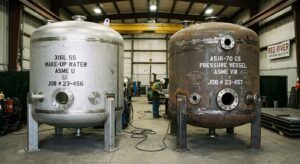
Which Materials Suit Make-Up Water Service?
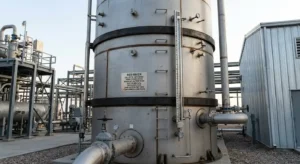
How Big Should Make-Up Water Tanks Be?
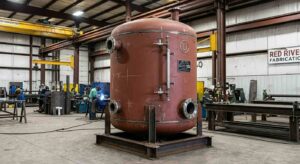
Make-Up Water Tanks: Design, Sizing, and Fabrication
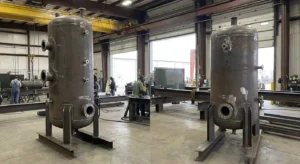
When to Spec Equalization Tanks for Industrial Systems
How Do Equalization Tanks Balance Flow?
About Author



