
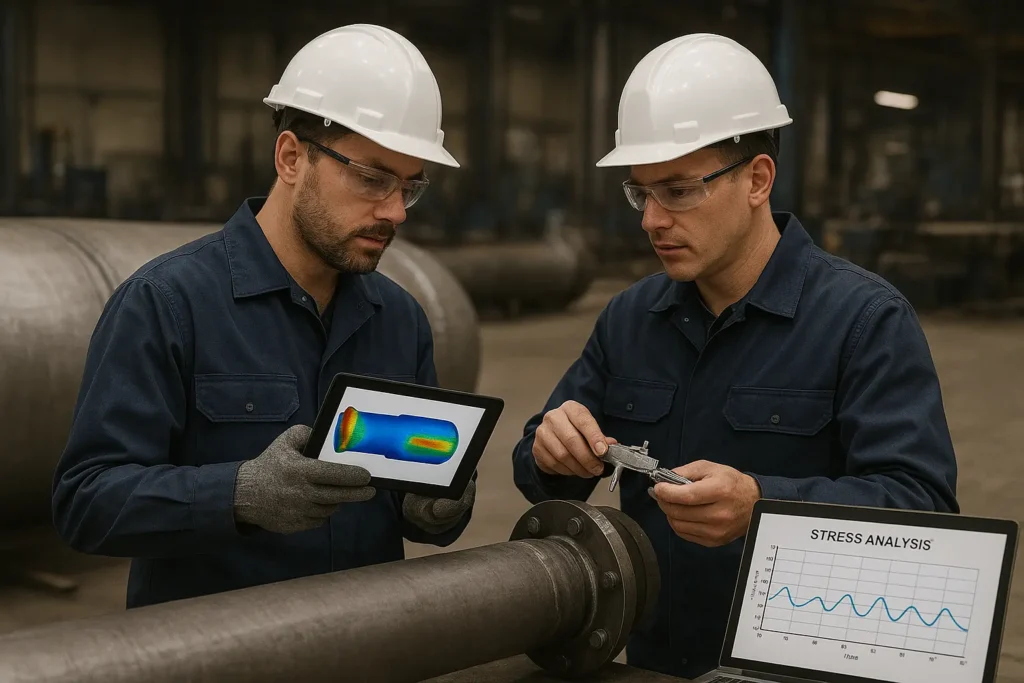
Pressure vessel stress analysis is crucial for safe and efficient vessel design, as it evaluates stresses and strains under internal and external pressures to prevent failure. This process includes detailed calculations, consideration of welding effects, and adherence to industry standards. RedRiver LLC applies these principles to ensure quality and reliability in every stage of fabrication and manufacturing.
Understanding Pressure Vessel Stress Analysis and Calculations
Pressure vessel stress analysis and calculations are vital steps in the design and fabrication process that determine how a vessel will respond under pressure, temperature, and loading conditions. Pressure vessels are used to contain gases or liquids at pressures different from the surrounding environment, which makes them subject to complex stresses that can lead to catastrophic failure if not managed correctly.
By performing stress analysis, engineers can predict the vessel’s behavior, prevent overloading, and ensure that its design complies with safety standards like the ASME Boiler and Pressure Vessel Code (BPVC). These analyses form the foundation for safe, efficient, and cost-effective pressure vessel fabrication and manufacturing.
What Is Pressure Vessel Stress Analysis
To understand what is pressure vessel stress analysis, it’s important to view it as both a theoretical and practical process. Pressure vessel stress analysis and calculations identify and quantify the mechanical stresses acting on the vessel’s components cylindrical shells, heads, nozzles, and welds under various pressure and temperature conditions. Accurate pressure vessel stress analysis and calculations are essential for ensuring safety, compliance with codes, and reliable operation throughout the vessel’s service life.
This process ensures that:
- The material selected can handle both internal and external forces.
- The vessel’s geometry distributes stress evenly.
- Fatigue and creep over time are minimized.
- Welded joints and seams remain structurally sound.
RedRiver LLC applies advanced computational techniques and simulation software to evaluate stress patterns and validate every vessel’s performance before it enters service.
How Do You Perform Stress Analysis on a Pressure Vessel
Engineers use different methods to perform pressure vessel stress analysis and calculations depending on the vessel’s shape, material, and operational conditions. The process involves:
The process involves:
- Identifying Load Conditions: Determining all possible loads acting on the vessel, including internal pressure, external loads, thermal stress, and mechanical weight (explore load types).
- Establishing Boundary Conditions: Defining how the vessel interacts with its environment, such as support points or connection interfaces.
- Applying Analytical or Numerical Methods: Using classical equations, finite element analysis (FEA), or computer-aided simulations to calculate stresses.
- Evaluating Results Against Design Standards: Comparing computed stresses with allowable limits established by ASME or other codes (ASME-certified vessels).
In practical terms, RedRiver LLC combines both manual calculations and digital modeling tools to ensure accuracy and compliance throughout design and fabrication.
What Are the Types of Stresses in Pressure Vessels
One of the key aspects of Pressure Vessel Stress Analysis and Calculations is understanding the different types of stresses that occur during operation. Accurate Pressure Vessel Stress Analysis and Calculations ensures that these stresses are identified, quantified, and properly addressed. By performing detailed Pressure Vessel Stress Analysis and Calculations, engineers can account for the dynamic interactions between stresses during the design phase. Ultimately, reliable Pressure Vessel Stress Analysis and Calculations is essential for safe, code-compliant vessel operation.
Common stress types include:
- Hoop Stress: Circumferential stress around the vessel’s body due to internal pressure (learn more about hoop stress).
- Longitudinal Stress: Axial stress along the vessel’s length, influenced by internal pressure and end caps.
- Radial Stress: Acts through the wall thickness, decreasing from inner to outer surfaces.
- Thermal Stress: Caused by temperature gradients during heating or cooling cycles (thermal considerations).
- Residual Stress: Remaining stress after welding or forming, often requiring stress relief (post-weld treatments).
Understanding these stresses is a critical part of Pressure Vessel Stress Analysis and Calculations. Through detailed Pressure Vessel Stress Analysis and Calculations, engineers can predict failure points and adjust design parameters effectively. Accurate Pressure Vessel Stress Analysis and Calculations also guides the selection of materials to ensure long-term safety. Ultimately, performing thorough Pressure Vessel Stress Analysis and Calculations ensures the vessel operates reliably under all conditions.
The Role of Welding in Pressure Vessel Engineering
Welding plays a pivotal role in pressure vessel stress analysis and calculations because weld seams often become critical stress concentration areas.
What Is Welding in Pressure Vessel Engineering
In the context of pressure vessel fabrication and manufacturing, welding is the process of joining metal components to form a sealed, leak-proof structure. The welding quality directly influences the vessel’s ability to withstand internal pressures without deformation or rupture.
How Is Welding Used in Pressure Vessel Fabrication
Welding is essential for assembling shells, heads, and nozzles while preserving structural strength and uniformity. Proper welding practices ensure that stresses are evenly distributed across joints, minimizing weak points that could lead to failure under pressure. Techniques such as TIG (GTAW) and SAW are widely used due to their precision, control, and reliability. TIG (GTAW) offers high accuracy for critical areas and thin materials, producing clean, defect-free welds, while SAW is effective for high-deposition applications on thicker sections. Together, these methods help maintain the integrity of pressure vessels, ensure safety, and extend service life by providing consistent, high-quality welds that withstand operational demands.
What Are the Common Welding Methods for Pressure Vessels
The main welding methods used in pressure vessel fabrication and manufacturing include:
- Gas Tungsten Arc Welding (GTAW or TIG): Ideal for stainless steel and thin materials (TIG welding explained).
Submerged Arc Welding (SAW): Produces deep, consistent welds in thicker components. - Shielded Metal Arc Welding (SMAW): Commonly used for maintenance and field welding due to flexibility.
- Gas Metal Arc Welding (GMAW or MIG): Efficient for large-scale production requiring high deposition rates.
Each welding process contributes differently to stress distribution and integrity. RedRiver LLC’s certified welders ensure that welds meet or exceed ASME standards, providing structural resilience and lasting reliability.
Material Selection and Its Impact on Stress Analysis
Material selection is a critical component of Pressure Vessel Stress Analysis and Calculations. The vessel’s material determines how it will respond to pressure, temperature, and chemical exposure, directly influencing stress distribution and potential failure points. Accurate Pressure Vessel Stress Analysis and Calculations consider material properties such as yield strength, toughness, and corrosion resistance to ensure long-term reliability. Engineers rely on Pressure Vessel Stress Analysis and Calculations to optimize wall thickness, nozzle placement, and reinforcement to withstand operational stresses. Performing thorough Pressure Vessel Stress Analysis and Calculations also helps comply with industry codes and standards. Ultimately, effective Pressure Vessel Stress Analysis and Calculations guarantees a safe, durable, and code-compliant pressure vessel.
Common materials include:
- Carbon Steel: Offers strength and affordability for moderate pressure applications.
- Stainless Steel: Corrosion-resistant (stainless steel fabrication).
- Nickel Alloys: Withstand extreme temperatures and corrosive environments.
- Duplex Stainless Steels: Combine high strength with excellent resistance to cracking.
- Titanium: Lightweight, corrosion-resistant, and ideal for specialized applications.
When evaluating what is pressure vessel fabrication and manufacturing, it’s clear that materials must be chosen based on both mechanical and environmental factors. The engineering team at RedRiver LLC performs detailed material analysis to ensure that the vessel maintains structural integrity throughout its lifecycle.
Analytical and Computational Techniques in Stress Calculations
Performing pressure vessel stress analysis and calculations requires a combination of analytical equations and computational models.
Traditional thin- and thick-wall cylinder formulas estimate stresses, but complex geometries or loads require Finite Element Analysis (FEA) for precise stress simulation. FEA allows engineers to model intricate shapes, material behaviors, and boundary conditions, ensuring accurate predictions, improved safety, and optimized designs beyond the limits of conventional analytical methods in pressure vessel and structural engineering.
FEA lets engineers visualize stress concentrations, deformation zones, and potential failure points. It enables precise optimization of wall thickness, reinforcement placement, and weld configurations, enhancing structural performance. By simulating real-world conditions, FEA ensures safety, reliability, and efficiency, allowing designs to be validated and improved before fabrication, reducing risk and costly modifications.
By integrating analytical and computational approaches, RedRiver LLC ensures that each vessel is optimized for strength, efficiency, and cost-effectiveness.
Thermal and Fatigue Considerations in Pressure Vessel Design
Thermal variations and cyclic loading are key considerations in Pressure Vessel Stress Analysis and Calculations. During operation, temperature changes cause expansion and contraction, leading to fatigue over time, which must be addressed through detailed Pressure Vessel Stress Analysis and Calculations. Engineers use Pressure Vessel Stress Analysis and Calculations to evaluate how these thermal effects interact with pressure-induced stresses. Accurate Pressure Vessel Stress Analysis and Calculations ensures that fatigue-prone areas are reinforced and material selection is appropriate. Ultimately, comprehensive Pressure Vessel Stress Analysis and Calculations guarantees that the vessel can withstand operational conditions safely throughout its service life.
In pressure vessel stress analysis and calculations, engineers evaluate:
- Thermal Expansion: Prevents cracking or deformation (thermal considerations).
- Fatigue Life: To estimate how many load cycles a vessel can endure before failure.
- Creep Resistance: For vessels operating under high temperatures for prolonged periods.
Proper design, material selection, welding, and stress-relief treatments mitigate risks and extend vessel lifespan.
Inspection, Testing, and Verification
After design and fabrication, each vessel undergoes inspection to verify the results of Pressure Vessel Stress Analysis and Calculations. These inspections include hydrostatic testing, non-destructive examination (NDE), and dimensional verification to confirm compliance with specifications. RedRiver LLC follows a comprehensive inspection protocol that combines visual assessment, ultrasonic testing, and radiography to ensure every vessel meets global safety and performance standards. Accurate Pressure Vessel Stress Analysis and Calculations guide the inspection plan, while detailed Pressure Vessel Stress Analysis and Calculations reports provide documentation for compliance. Thorough Pressure Vessel Stress Analysis and Calculations also helps identify areas requiring reinforcement, making final verification more reliable. Ultimately, proper Pressure Vessel Stress Analysis and Calculations ensures safe and durable operation.
Pressure Vessel Stress Analysis and Calculations
In conclusion, pressure vessel stress analysis and calculations form the foundation of safe and effective vessel design. They ensure that materials, welds, and structures can withstand demanding operational conditions without failure.
Through advanced engineering, precise welding, and thorough inspection, RedRiver LLC delivers vessels that meet the highest standards of safety, reliability, and performance in modern pressure vessel fabrication and manufacturing.
Partner with RedRiver LLC
For engineering excellence, RedRiver LLC provides expertise in stress analysis, design, and fabrication. Their focus on safety, innovation, and quality ensures every vessel exceeds expectations.
Request a quote or contact RedRiver LLC to learn more about their approach to pressure vessel fabrication.
Frequently Asked Questions
1. What is pressure vessel stress analysis?
It is the process of determining stresses acting on a vessel under internal and external pressure to ensure safety and performance.
2. How do you perform stress analysis on a pressure vessel?
Engineers use analytical formulas, computer simulations, and finite element analysis (FEA) to predict stress distribution and identify weak points.
3. What are the types of stresses in pressure vessels?
The main types include hoop, longitudinal, radial, thermal, and residual stresses all crucial to evaluating vessel strength.
4. What is welding in pressure vessel engineering?
Welding in pressure vessel engineering is the process of joining components to create a leak-proof and structurally sound assembly.
5. How is welding used in pressure vessel fabrication?
Welding connects the vessel’s shell, heads, and nozzles while maintaining strength and pressure resistance.
6. What are the common welding methods for pressure vessels?
Common welding methods TIG, MIG, submerged arc, and shielded metal arc are selected based on material type and thickness, ensuring precise, strong, and reliable joints for various applications.
7. Why is material selection important in stress analysis?
Selecting the appropriate material ensures resistance to pressure, temperature, and corrosion, enhancing safety, reliability, and performance while extending the lifespan of components under demanding operational conditions.
8. How do standards like ASME affect stress analysis?
ASME standards establish design limits, testing procedures, and safety factors, ensuring pressure vessels comply with global quality, reliability, and safety requirements throughout their operational life.
Key Takeaways
- Pressure vessel stress analysis and calculations are essential for predicting and managing mechanical stresses under pressure.
- Understanding stress types hoop, longitudinal, radial, and thermal is key to safe design.
- Welding quality significantly impacts vessel strength and performance.
- Proper material selection ensures durability, safety, and cost efficiency.
- RedRiver LLC combines advanced analysis, precision fabrication, and expert welding for industry-leading results.
Related Blog Post
Which Materials Suit Make-Up Water Service?
How Big Should Make-Up Water Tanks Be?
Make-Up Water Tanks: Design, Sizing, and Fabrication
When to Spec Equalization Tanks for Industrial Systems
How Do Equalization Tanks Balance Flow?
About Author



