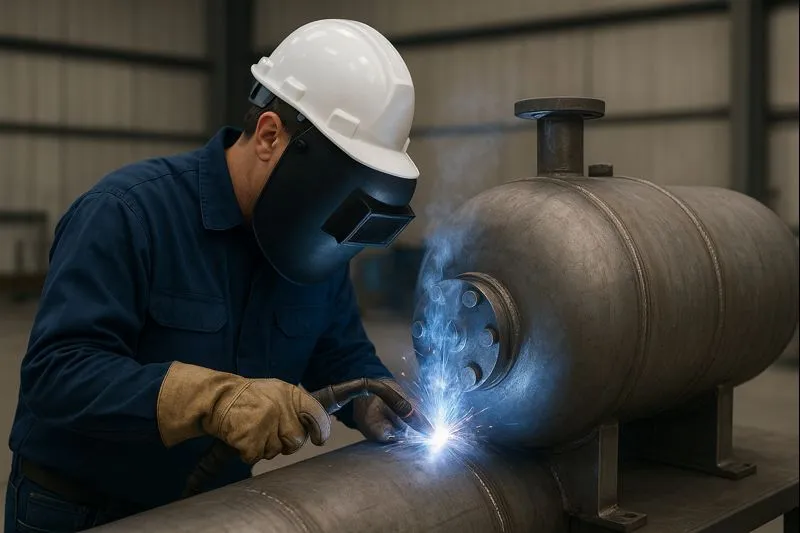
Welding is a crucial aspect of pressure vessel engineering, directly impacting safety, stress distribution, and long-term performance. This guide covers welding techniques, compliance requirements, and best practices, highlighting how skilled execution ensures durable, code-compliant vessels.
Understanding Welding in Pressure Vessel Engineering
Welding in pressure vessel engineering forms the backbone of vessel construction because every component, from shells to heads to nozzles, must be fused into a single, pressure-resistant structure. When done correctly, welds become as strong as or even stronger than the base material itself, allowing the vessel to withstand extreme pressures, fluctuating temperatures, and demanding operating environments. Engineers must understand what is welding in pressure vessel engineering because welding does far more than join metal; it determines stress paths, integrity, leak resistance, and overall safety. The fabricated weld zones carry their own behaviors and mechanical properties, influencing compliance with pressure vessel safety standards.
RedRiver LLC approaches every weld with precise engineering and deep respect for codes such as the ASME Boiler and Pressure Vessel Code. Every seam, bead, and inspection step ties directly back to performance expectations and operational safety.
The Role of Welding in Pressure Vessel Engineering
Welding in pressure vessel engineering supports the creation of vessels that must perform in high-pressure environments and maintain structural integrity for years. The first paragraph must incorporate the keyword, so here it is: Welding in pressure vessel engineering requires careful planning, execution, and verification to ensure that each welded joint can handle internal and external loads without failure.
This branch of engineering focuses on factors such as material compatibility, welding sequence, heat input, post-weld treatments, weld geometry, joint design, and stress relief. Because pressure vessels must contain gases and liquids under intense pressure, any defect even a microscopic discontinuity can compromise the entire system.
Welding associates also plan around stress concentrations created by nozzles, seams, transitions, and thickness changes. The decisions made during the welding process determine the long-term performance of the vessel, especially in terms of fatigue resistance, corrosion tolerance, and durability.
How Welding Integrates Into Pressure Vessel Fabrication
Understanding how is welding used in pressure vessel fabrication helps illustrate its importance. In pressure vessel fabrication, welding brings together multiple components such as:
Fabrication teams must ensure smooth transitions between welded surfaces and base materials to maintain even stress distribution. If a weld introduces distortion, residual stress, or a mismatch in material strength, the vessel may respond unpredictably under pressure.
RedRiver LLC incorporates both engineering analysis and advanced welding procedures to ensure consistent quality. Their process includes preparing joint edges, selecting the correct filler materials, applying proper preheating, and using the right welding sequence to minimize distortion.
What Makes Welding in Pressure Vessel Engineering Complex
Several factors make welding in pressure vessel engineering uniquely challenging: The high-pressure conditions demand joints that are not only strong but also defect-free, as even minor flaws can lead to catastrophic failure. Material selection is critical, since different metals respond differently to heat, affecting weld integrity. Controlling distortion during welding is another key concern, as uneven heating can compromise the vessel’s shape and safety. Additionally, strict compliance with codes like ASME Section VIII ensures both performance and regulatory approval. Skilled welders, precise procedures, and rigorous inspection techniques, including non-destructive testing, are essential. Welding in pressure vessel engineering combines science, precision, and safety in a high-stakes environment.
- Metals expand and contract under heat, creating the risk of distortion.
- Pressure vessel materials often include high-alloy steels, stainless steels, and specialty metals that require unique welding parameters.
- Welds must maintain uniform thickness and penetration to avoid weak points.
- Vessel geometry requires welders to work in tight or curved spaces while maintaining bead consistency.
- Residual stresses created during welding must be relieved or controlled.
- Weld quality must meet strict non-destructive examination standards.
Engineering teams plan weld procedures carefully to ensure compliance with pressure vessel safety standards.
The Common Welding Methods for Pressure Vessels
What are the common welding methods for pressure vessels depends on material type, thickness, and design. Some of the most commonly applied methods include:
- Gas Tungsten Arc Welding (GTAW or TIG): Provides exceptional precision and control, producing clean, high-quality welds. It is ideal for thinner materials and alloys such as stainless steel and nickel alloys.
- Shielded Metal Arc Welding (SMAW or Stick Welding): Versatile and widely used, especially for repairs or field work. Works well with thicker materials and is effective for structural welds.
- Gas Metal Arc Welding (GMAW or MIG Welding): Known for efficiency and speed, making it a strong choice for repetitive welds in pressure vessel fabrication.
- Submerged Arc Welding (SAW):Suited for thick sections that require deep penetration, such as long seams on vessel shells.
Each method has unique advantages and applies to different aspects of fabrication. RedRiver LLC uses multiple techniques based on the engineering requirements, ensuring quality welds that support long-term reliability.
Welding Materials and Their Impact on Vessel Strength
ChatGPT said:
Choosing welding materials is equally important as choosing the base metal. Weld filler materials must be compatible with the vessel metal to ensure proper bonding and mechanical strength. In welding in pressure vessel engineering, thermal expansion, heat input, and cooling rates must be carefully managed to prevent cracks and distortions. Preheating and post-weld heat treatment are often required to relieve residual stresses. Welding in pressure vessel engineering also demands strict adherence to codes and standards, ensuring safety under high pressure. Skilled operators, precise procedures, and thorough inspections, including radiographic or ultrasonic testing, are essential to maintain integrity. Welding in pressure vessel engineering is a precise, high-stakes process.
Common filler metals include:
- Carbon steel wire or rods
- Stainless steel fillers
- Nickel-based alloys
- Duplex stainless filler metals
- Low-hydrogen electrodes
The filler material determines corrosion resistance, heat resistance, and crack resistance at the weld joint. RedRiver LLC evaluates chemical composition, mechanical properties, and post-weld conditions before selecting any welding consumable.
The Importance of Welding Sequence and Heat Control
Heat control plays a vital role in welding in pressure vessel engineering. Without proper management, excessive heat can compromise material properties. To manage heat effectively, engineers employ strategies such as preheating, controlling interpass temperatures, and applying post-weld heat treatment. In welding in pressure vessel engineering, these measures prevent cracking, reduce residual stress, and ensure proper metallurgical bonding. Careful selection of welding parameters, including current, voltage, and travel speed, is also critical. Welding in pressure vessel engineering demands strict compliance with codes and standards, alongside skilled operators and rigorous inspections. Overall, welding in pressure vessel engineering requires precision, expertise, and meticulous heat management to ensure safety and durability.
- Preheating the metal before welding
- Controlling the heat input by adjusting amperage
- Using multiple passes for thick sections
- Allowing controlled cooling between passes
- Applying post-weld heat treatments
These controls prevent cracking, reduce residual stress, and ensure the weld metal bonds properly with the base material. Managing heat also improves the vessel’s resistance to fatigue and pressure-induced stress cycles. In welding in pressure vessel engineering, careful control of parameters like current, voltage, and travel speed is essential. Preheating, interpass temperature monitoring, and post-weld heat treatment help maintain structural integrity. Welding in pressure vessel engineering requires adherence to stringent codes and standards to guarantee safety under extreme pressures. Skilled operators, precise procedures, and thorough inspections, including non-destructive testing, are critical. Welding in pressure vessel engineering combines technical expertise, material science, and rigorous quality control.
Pressure Vessel Safety Standards and Compliance in Welding
No discussion about welding in pressure vessel engineering is complete without understanding pressure vessel safety standards and compliance. Welding procedures must meet stringent codes, such as ASME Section VIII, to ensure the vessel can safely handle high pressures and temperatures. In welding in pressure vessel engineering, documentation of procedures, welder qualifications, and inspection records is critical for regulatory approval. Proper testing, including radiographic, ultrasonic, and hydrostatic methods, verifies weld integrity. Welding in pressure vessel engineering also involves careful material selection, heat control, and stress management to prevent failure. Ultimately, welding in pressure vessel engineering combines technical expertise, adherence to standards, and rigorous quality assurance for safe operation.
What Are the Safety Standards for Pressure Vessels
These standards ensure vessels are designed, built, and inspected to minimize the risk of failure. Welded pressure vessels must undergo visual inspection and non-destructive testing such as radiography, ultrasonic testing, and dye penetrant inspection to detect flaws. In welding in pressure vessel engineering, adherence to these standards guarantees structural integrity and operational safety under high pressure. Welding in pressure vessel engineering also requires careful control of heat input, selection of compatible materials, and skilled execution to prevent cracks and distortion. Documentation of procedures, welder qualifications, and inspection results is mandatory. Overall, welding in pressure vessel engineering combines precise technique, strict compliance, and rigorous testing to ensure reliable, safe vessels.
- Radiography
- Ultrasonic testing
- Magnetic particle testing
- Dye penetrant testing
These inspections verify that every weld meets structural and safety requirements.
What Is ASME Code for Pressure Vessel Safety
The ASME Boiler and Pressure Vessel Code outlines:
- Material requirements
- Welding processes
- Examination standards
- Stress limits
- Design documentation requirements
ASME codes are globally accepted and shape most pressure vessel fabrication practices. RedRiver LLC welders follow ASME-approved procedures and hold relevant certifications. In welding in pressure vessel engineering, compliance with these codes ensures the vessel can withstand high pressures and operational stresses safely. Welding in pressure vessel engineering also requires precise control of heat input, proper selection of compatible materials, and skilled execution to prevent defects such as cracks or distortion. Thorough inspections, including radiographic and ultrasonic testing, verify weld quality. Welding in pressure vessel engineering demands strict adherence to standards, meticulous documentation, and expert workmanship. Ultimately, welding in pressure vessel engineering integrates safety, precision, and regulatory compliance for reliable vessel performance.
How Do Pressure Vessels Comply With Safety Regulations
Compliance involves:
- Using qualified welders
- Following approved welding procedures
- Conducting full inspections
- Performing hydrostatic testing
- Documenting all welding parameters
Welding Defects and Their Prevention
Fabricators must avoid weld defects because they can compromise vessel performance. Common welding issues include:
- Porosity
- Cracks
- Lack of fusion
- Undercutting
- Distortion
- Incomplete penetration
RedRiver LLC uses careful preparation, certified welders, advanced welding equipment, and thorough inspection processes to eliminate defects and ensure long-lasting weld quality.
Welding in Pressure Vessel Engineering
Welding in pressure vessel engineering is an essential discipline that blends technical skill, material understanding, and precise execution. Welds determine the vessel’s strength, performance, and ability to withstand stress, making welding a central part of fabrication and compliance.
From selecting weld methods to understanding safety standards, RedRiver LLCintegrates engineering expertise with craftsmanship to deliver welded pressure vessels that exceed expectations. Their commitment to code compliance, rigorous testing, and quality control ensures every vessel is built to perform safely and reliably.
Work With RedRiver LLC
When you need expertly welded pressure vessels engineered with precision and integrity, RedRiver LLC is your trusted fabrication partner. Their team delivers craftsmanship backed by strict compliance, comprehensive engineering, and advanced welding techniques.
Explore how RedRiver LLC can support your project today.
Frequently Asked Questions
1. What is welding in pressure vessel engineering?
It is the specialized process of joining components of a pressure vessel to create a strong, leak-proof and code-compliant structure.
2. How is welding used in pressure vessel fabrication?
It joins shells, heads, nozzles, and supports while maintaining strength, durability, and pressure resistance.
3. What are the common welding methods for pressure vessels?
Common methods include TIG, MIG, SMAW, and SAW, selected based on material type and vessel design.
4. What are the safety standards for pressure vessels?
Standards define design, fabrication, welding, and inspection rules to ensure safe operation under pressure.
5. What is ASME code for pressure vessel safety?
The ASME BPVC outlines the complete framework for material selection, welding procedures, inspections, and testing.
6. How do pressure vessels comply with safety regulations?
Compliance requires certified welders, approved procedures, non-destructive testing, and full documentation.
7. Why is welding so important in pressure vessel performance?
Welds are structural points that hold the vessel together, influence stress distribution, and prevent leaks.
8. How does RedRiver LLC ensure welding quality?
Through certified welders, engineered welding plans, advanced testing methods, and strict quality control.
Key Takeaways
- Welding in pressure vessel engineering directly determines vessel safety and performance.
- Proper welding supports structural integrity, reduces stress concentrations, and prevents failure.
- ASME standards guide welding procedures, material choices, and inspection requirements.
- RedRiver LLC combines expert craftsmanship and engineering precision in every weld.
- High-quality welding ensures long-term pressure vessel reliability and compliance.
Related Blog Post
Which Materials Suit Make-Up Water Service?
How Big Should Make-Up Water Tanks Be?
Make-Up Water Tanks: Design, Sizing, and Fabrication
When to Spec Equalization Tanks for Industrial Systems
How Do Equalization Tanks Balance Flow?
About Author